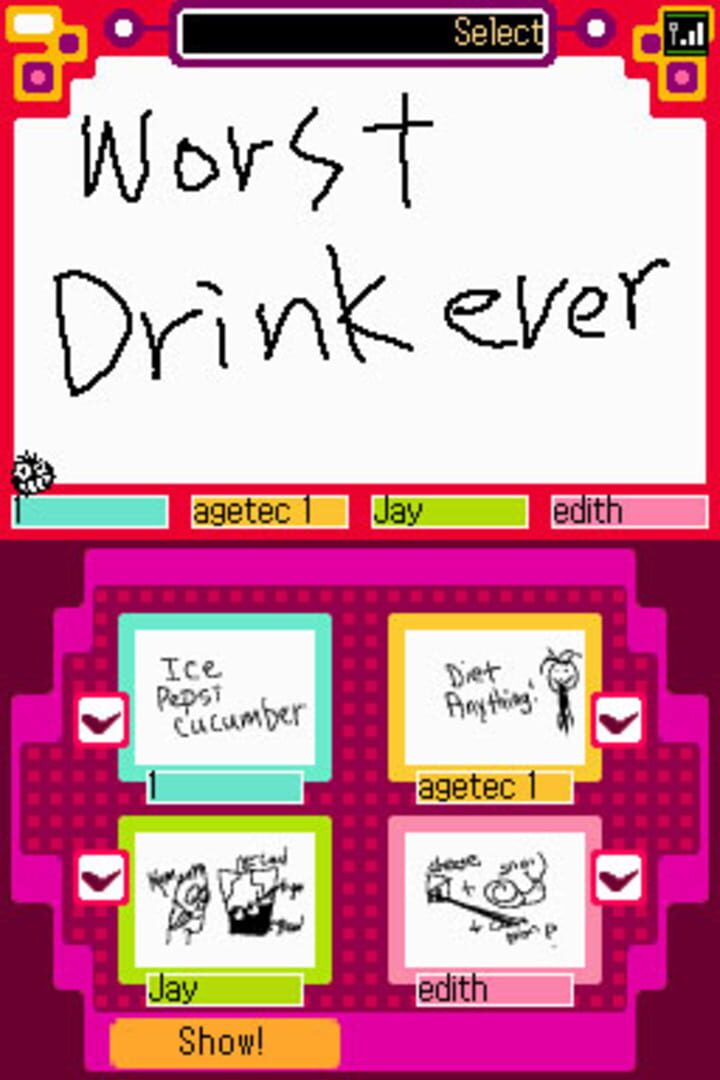
A multiplayer game in which a host player asks a question, requiring others to write or draw their answers on the DS touchscreen.
Screenshots
Featured in
A multiplayer game in which a host player asks a question, requiring others to write or draw their answers on the DS touchscreen.
Rhythm Heaven puts the music in your hands and some rhythm in your life. Let the music move you as you tap and slide your stylus on the touch screen to the beat of more than 50 musical rhythm games. The controls are as natural as tapping your finger to music.
Worms World Party is an artillery game, which is a type of Turn-based strategy game. Like its predecessors, Worms World Party involves controlling a team of worms and using a collection of weaponry to eliminate the opposing team(s). The worms can walk and jump around and use tools such as the ninja rope and parachute to move to otherwise unreachable locations. The worms have an arsenal of dozens of weapons, ranging from longbows to bazookas and from fireballs to Holy Hand Grenades.
Shooter / Platform / Strategy / Action / Comedy
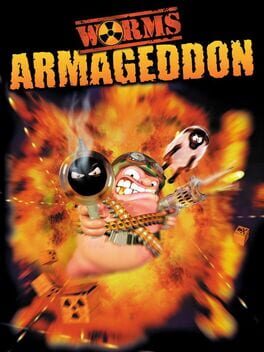
Those intrepid invertebrates return with a vengeance in the much-loved Worms Armageddon. It’s a whole new can of worms! It’s hilarious fun that you can enjoy on your own or with all your friends. Worms Armageddon was originally developed as an expansion pack to Worms 2 and initially titled Wormageddon before it was released as a standalone game. Worms Armageddon was acclaimed by critics, who praised the refined gameplay and stylized graphics, and it has been featured in a number of "greatest games of all time" lists. Worms Armageddon is still updated periodically as of 2020, and was released on the Steam platform in 2013.
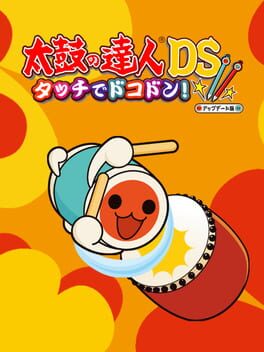
Taiko no Tatsujin DS: Touch de Dokodon is a rhythm game for Nintendo DS by Namco Bandai where you play a Taiko drum to the beat of several songs. There are optional button controls, but the main mode of control is to take two styli and tap on the touch screen, which shows the image of large Taiko drum. The two main gamemodes are Free Play and Daily Dojo. Free Play is exactly as one would expect, and Daily Dojo is a once-a-day challenge on a random song you've unlocked. There are four difficulties: Flower, Bamboo, Tree, and Demon. Demon difficulty, also known as Oni Mode, is initially hidden and must be unlocked. In addition to the actual gameplay, you can also dress up your Taiko character in silly outfits. This does not affect actual gameplay and is only a visual change. There is also a multiplayer mode available. It can be played in single-cart mode, but if an opponent has a copy of the game the outfit they have dressed their Taiko in will appear on whatever character corresponds to which player they are. The game comes with two "Bachi Pens", which are Taiko no Tatsujin-themed styli for use with the game, and is rated A on the CERO rating system (the Japanese equivalent of an E for Everyone on the ESRB rating system).
A rhythm-action game like no other from the same team that created WarioWare. Rhythm Tengoku contains 48 minigames that put your rhythm to the test in a variety of crazy scenarios. Rhythm Tengoku was developed by Nintendo R&D1 and released exclusively in Japan for the GBA in 2006 and in arcades with Sega's help in 2007. Being developed by the same studio responsible for the WarioWare games, Rhythm Tengoku mixes the mini-game based gameplay with rhythm game elements, featuring unusually high-quality music for a GBA game. The game started development in 2004. A 2002 prototype for a GBA drum sequencer was incorporated into Rhythm Tengoku as well: the player can freely drum within the Sound Test or take on 19 drum lessons. (Source) The game contains eight stages with five rhythm games and one remix of the previous five each, adding up to 48 different mini-games total. Each game can be completed without hitting every note perfectly, although doing so will unlock various rhythm-related bonus games and modes, such as a drum set where you have to mimic what the drummer does. Much like the Wario Ware series of games, Rhythm Tengoku is all about following your senses and trying to be aware of various cues in the visuals and audio. This emphasis on sense instead of language makes it quite easy for anyone to pick up and play, even though the game is entirely in Japanese (and consequently only available in the Asian region or through an import website). For example, one of the game's levels has you rapping with a computer-controlled character. He'll speak a colour-coded Japanese phrase, and the player must press 'A' in different rhythms. Although the game explains what rhythms to do for which phrase, non-Japanese speaking players can watch hand movements on-screen to figure it out without the need for language. Occasionally, challenges will crop up, asking you to complete a level without any mistakes. Doing so earns you a certificate for that level, and a pink heart with a 'P' on it appears in that level's description.
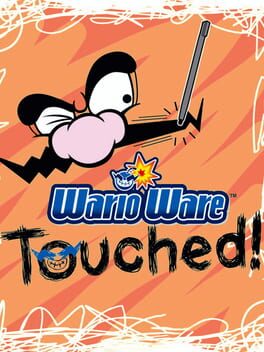
Wario makes his debut on the Nintendo DS with hundreds of all-new minigames. Now you must complete your goals by using the touch screen and a stylus. Tap, scratch, and rub your stylus on the touch screen to play minigames that have you do everything from milking a cow and drawing a mustache to hurling stars at evil ninjas. You can even play some minigames by blowing into the DS's built-in microphone. The more minigames you clear, the more characters and items you unlock. The 3DS version was exclusively available for a few months in 2016 to My Nintendo members.
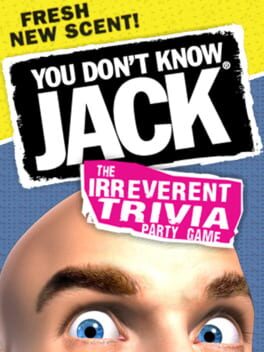
Strategy / Quiz/Trivia / Comedy / Party
You Don't Know Jack is where high culture and pop culture collide! Loaded with outrageous questions, wall-to-wall music and sound effects, blistering humor, and Cookie Masterson, your semi-lovable master of ceremonies, You Don't Know Jack is trivia-licious!
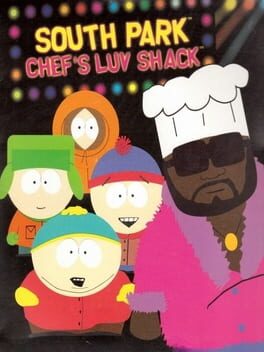
Puzzle / Quiz/Trivia / Comedy / Party
South Park: Chef's Luv Shack is a 2D game-show style video game based on the television show South Park. It gained its popularity by having mini games and the ability to play against friends in a challenge for the most points. It also involves trivia questions about South Park and other topics. The game intermittently switches between questions and minigames, with a minigame proceeding every three questions. Players score points by answering questions first (correctly) and based on minigame ranking. Players lose points for questions answered incorrectly. The game is exclusively multiplayer, as when played by one player, there is no AI, so that player always wins, even with a negative score