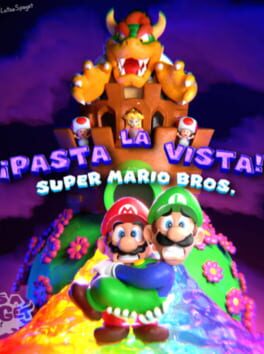
Pasta La Vista Super Mario Bros. is a romhack of Super Mario World that reimagines the original Super Mario Bros. with enhanced graphics.
Screenshots
Featured in
Pasta La Vista Super Mario Bros. is a romhack of Super Mario World that reimagines the original Super Mario Bros. with enhanced graphics.
Platform / Adventure / Action / Fantasy
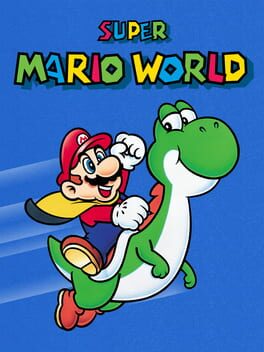
A 2D platformer and first entry on the SNES in the Super Mario franchise, Super Mario World follows Mario as he attempts to defeat Bowser's underlings and rescue Princess Peach from his clutches. The game features a save system, a less linear world map, an expanded movement arsenal and numerous new items for Mario, alongside new approaches to level design and art direction.
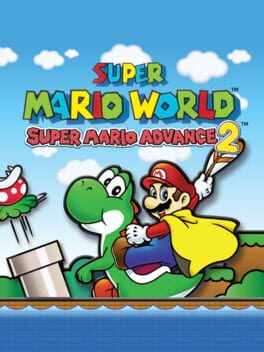
Super Mario Advance 2: Super Mario World is a remake of Super Mario World for the Game Boy Advance starring Mario's dinosaur friend Yoshi for the first time. Super Mario Advance is a four-part series for the GBA with Super Mario games of the NES and SNES era. The remakes came with adjusted graphics, sound and additional content. Each game of the series includes additionally the arcade-classic "Mario Bros" which can be played in multiplayer via link cable.
Platform / Adventure / Action / Kids
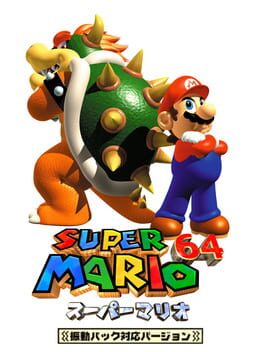
This version of Super Mario 64, originally released only in Japan, is an enhancement over the International release of the game, as it retains all of the glitch fixes as well as graphical and sound changes. The main differences of this version are the Rumble Pak support, some small glitch fixes, the most notorious being the removal of the backwards long jump, a very important technique for the speedrunning scene, and a new title screen easter egg. This version would later be released on the iQue Player in China (without Rumble support), on the Japanese Wii and Wii U Virtual Console. It was finally localized and released internationally as part of Super Mario 3D All-Stars (under the name of "Super Mario 64"), with small visual enhancements.

Super Mario Bros.: The Lost Levels is a direct sequel to Super Mario Bros. Not to be confused with the western Super Mario Bros. 2, this sequel to Super Mario Bros. is very much an expansion to the original, with many reused graphics and concepts, though new ones are also present. The game was initially released for the Japan-only Family Computer Disk System.
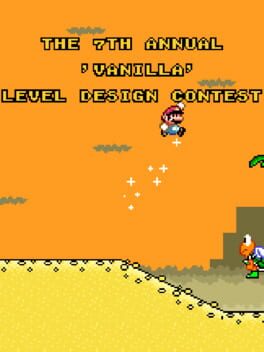
For the past seven years, SMW Central has held a vanilla level design contest every spring. “Vanilla level design” refers to using only Lunar Magic to create your level - that is, no custom blocks, no custom sprites, and no custom code of any sort. They eventually began allowing people to use custom music, but this is not factored into their score. Once they finished designing their level, they would submit an IPS file, it would get judged + ranked, and that would be the end of it. This year, however, S.N.N. decided to assign resources (secondary exits, Map16 slots, etc) to users with the intention of putting all of their levels into a ROM and essentially creating a full hack out of it. The hack features 82 submitted entries and 4 switch palaces, which makes a grand total of 86 levels for you to beat. All of the levels are open from the start - you can play them in any order you’d like. To help you keep track of your progress, the game autosaves on the world map and beating a level will give you an “M” in the top right corner of the overworld. As a disclaimer, the levels are organized on the overworld by theme, and not by ranking. This means that the quality of the levels might fluctuate dramatically from one to the next (e.g. having a 70th place entry directly before a 12th place entry). The bottom 8 and top 8 each have their own world, however, so it’s easy to distinguish them from the rest.
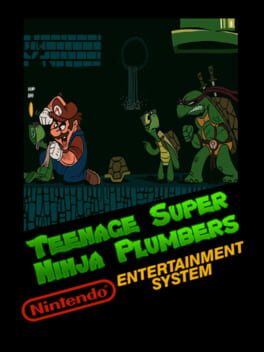
The sewers of The Mushroom Kingdom have been infested by teenage mutant ninja turtles, It’s up to Mario and Luigi to save the day by becoming Teenage Super Ninja Plumbers!