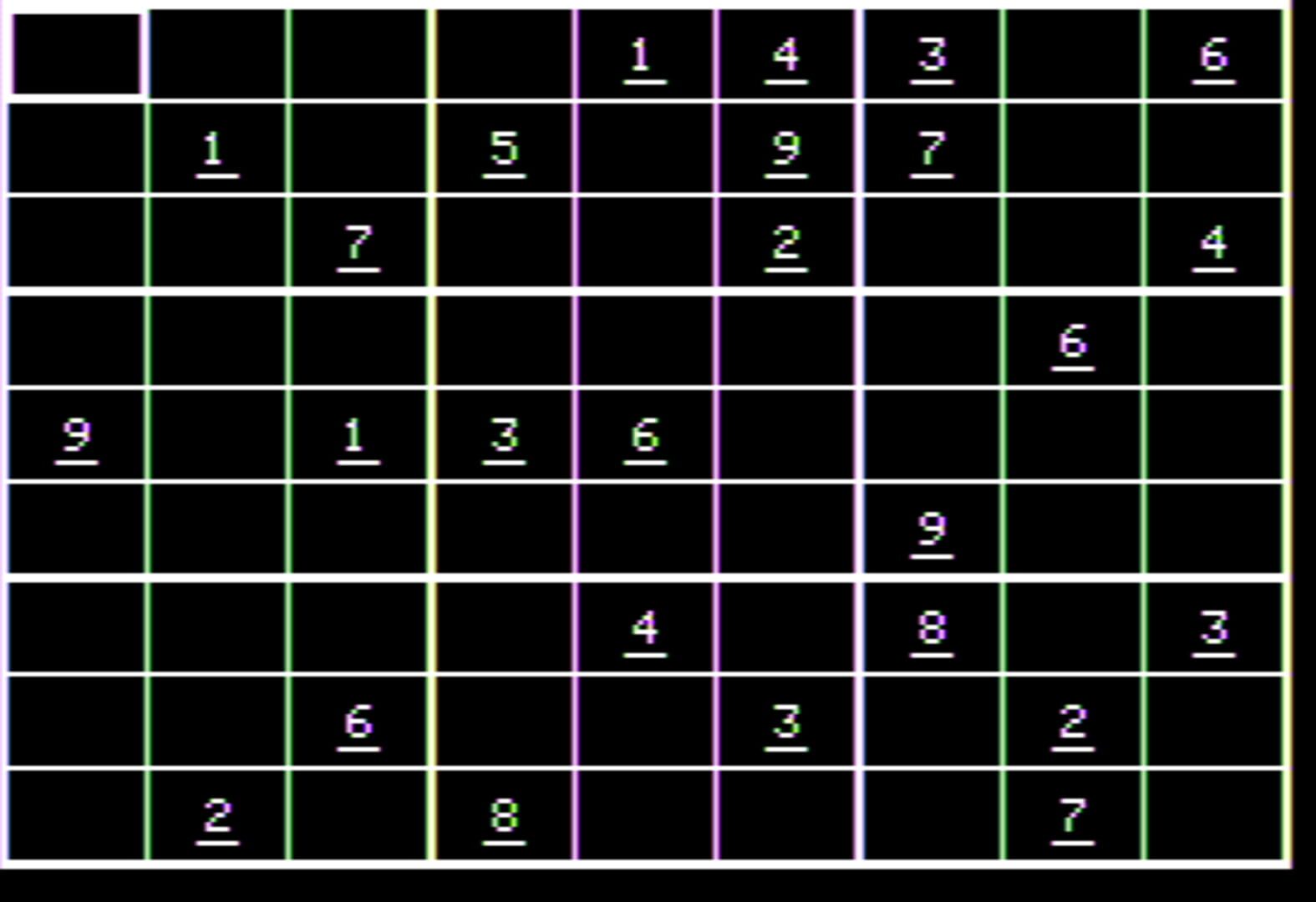

Apple II Sudoku is a sudoku interpretation for Apple II systems. Follows typical sudoku rules. There is a 3 x 3 square consisting of smaller 3 x 3 squares. The players must put the numbers 1 - 9 into each small square, so that each number is used only once per square, as well as used only once in a vertical and horizontal line. Controlled via the keyboard, there are three levels of difficulty. Players have the option to allow incorrect or invalid values to be flagged.

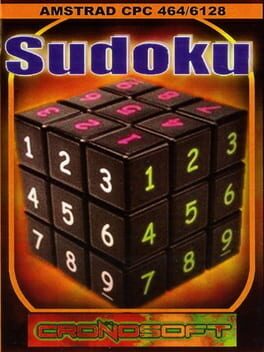
Sudoku is, obviously, a Sudoku game for CPC and Speccy. Players can select the grid size of 4x4, 6x6, 8x8, 9x9, 10x10 and 12x12, although 9x9 is default. Players then choose the difficulty. The object is to fill in each empty spot with a number of 1 to 9. On the 10x10 and 12x12 grids, the letters A and A to C are also used. Each horizontal row, vertical column and sub-grid can contain a number only once.

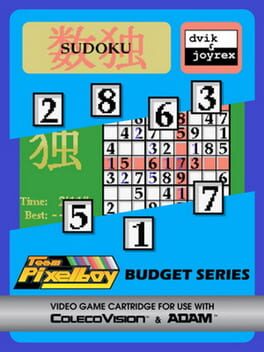
To solve a Sudoku puzzle, place a number into each cell so that each row, each column, and each small 3x3 box within the larger puzzle will contain every number from 1 to 9. In other words, no number may appear more than once in every row, column, or 3x3 box. The game is initialized with predefined numbers and the objective is to complete the puzzle with the missing numbers that will lead to the correct solution. The game features three levels of difficulty: Novice, Adept, and Master.

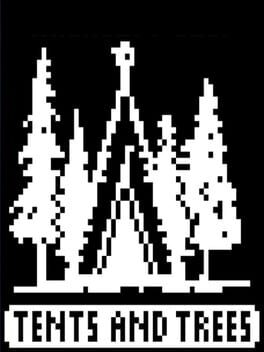
A deceptively simple puzzle game written for the Fairchild Channel F. The aim of the game is to place a tent adjacent to each tree in such a way that the correct number are in each row and column, as shown by the numbers alongside. When you have the correct number in a particular row or column, the number will turn green. Tents cannot be placed if there is no tree to the left, right, above or below.

Sudoku 23 is a version of Sudoku that is playable on the NES.

Sudoku: NESWorld Edition is a homebrew sudoku game for the NES.