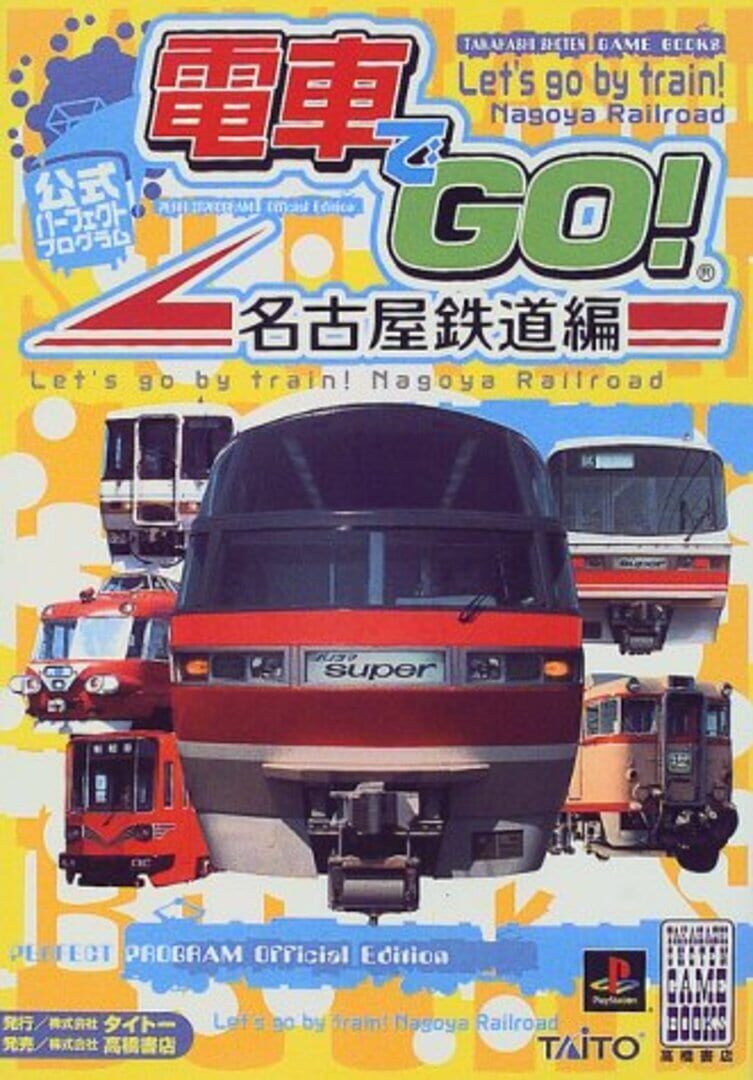
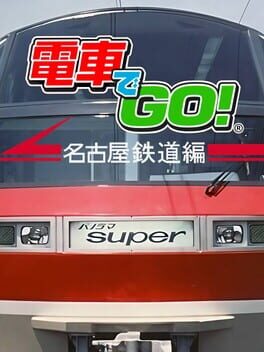

A release not seen in arcades, this Densha de Go! entry focuses on Meitetsu's railroad lines in Nagoya, including the series' only monorail. You play as a train engineer which serve the Meitetsu Nagoya line in Japan. There are many kinds of trains that you can drive, from express trains to monorails. Some trains are locked until you finish a mission, for example you can only drive monorails until you've finished the commuter and express train missions. All of the game parts, except the menu and station names, are in Japanese. In addition or the Meitetsu Nagoya Line, coverage includes Meitetsu Inuyama Line, Meitetsu Minomachi Line and Meitetsu Monkey Park Monorail Line. This was the first version to feature a monorail, and also featured a Meitetsu hybrid light rail route which ran both on regular train lines and as a sort of urban tram on special lanes in city streets. Part of the gameplay of this required the user to stop for regular traffic signals and avoid car traffic. This was the Densha de Go player's first opportunity to drive a vehicle much lighter (and thus shorter stopping distance) than standard trains. In this version, the driver must sound the horn before beginning to accelerate out of a station. This is unique to this title. The gameplay, physics, and strictness of this version were all somewhat relaxed compared to previous versions. The game was published by Taito for the Sony PlayStation in Japan on January 27, 2000. It was later ported to the PC by Unbalance on December 1, 2000. The PS1 version later received a re-release as part of D3Publisher's Simple 1500 series of budget games, as Simple 1500 Series Vol. 102: The Densha Untenshi - Densha de Go! Nagoya Tetsudou-hen, on August 29, 2002.
Densha de GO! is a 1997 train simulator arcade game developed and published by Taito in Japan. Players are tasked with driving a train, adhering to the schedule and obeying signals and speed restrictions. It features real-world train lines from Japan, including the Yamanote Line and Keihin-Tohoku Line. The game was ported to the PC, Sega Saturn, and PlayStation. The concept for Densha de Go! was inspired by designer Akira Saito's personal fascination with Japanese train lines and railroads. He wanted to create a game that allowed players to familiarize themselves with driving a train. The controls were his primary focus as he wanted them to be accurate and responsive, and to mimic the controls of a real train—his father worked for the Kyoto City Transportation Bureau Facilities Division, which made this easier to accomplish. Saito included real-world railroads and trains to appeal towards other railroad enthusiasts, thinking that it could also attract more "ordinary" players for its realistic, familiar theme. As arcades at the time were dominated primarily by racing and fighting games, he believed its unique concept could make it stand out. Densha de Go! is among Taito's most successful games, preceded only by Space Invaders. The PlayStation version sold over one million copies. The game was well-received by critics for its controls, attention to detail, and unique concept. Some felt that its home releases lacked enough content and had poor visuals. It was followed by a long series of sequels, spin-offs, and reimaginings, beginning with Densha de Go! 2 in 1999.

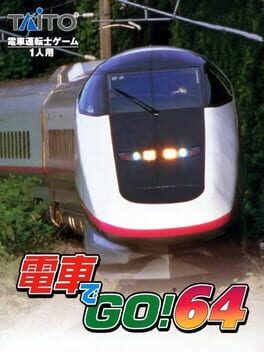
The Nintendo 64 version of Densha de GO! 2 Kousoku-hen was released as Densha de GO! 64. It added both a new Beginner mode and Voice Recognition Unit compatibility.

Simulator / Strategy / Tactical / Drama / Non-fiction
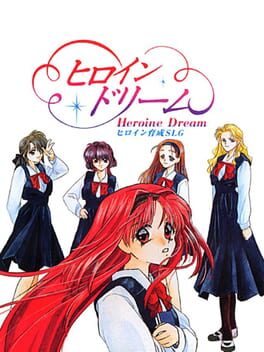
Heroine Dream is an idol simulation game in which the player takes a role of a producer whose goal is to help Shizuka Maiki enter the scene in style. But that doesn't happen over night, in fact, it requires many weeks of training. The heroine herself has many attributes that lack in quality and as her producer, you will have to balance her training (ballet, dancing, swimming etc.), but at the same time keep an eye on her stress level. The game features voice-acting, but without the ability to see subtitles, only the answers you can select during conversations with other characters. Depending on what kind of a star producer you turn out to be, the game may reach one of several different endings.

Simulator / Sport / Non-fiction
A Japan-exclusive port of Pro Evolution Soccer 2014. This version centers on career progression with the Japan national team, offering modes that guide players through international competition and national representation.

Simulator / Arcade / Non-fiction
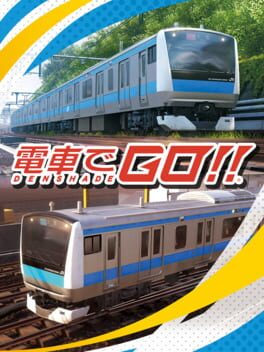
Densha de Go!! (loosely translated to "Go by Train!!") is an electric train simulation game developed by Taito and released by Square Enix for arcades (using PC-based Taito Type X4 hardware) in Japan on November 7, 2017. The first mainline arcade release of the Densha de Go! series in 14 years (after Densha de Go! Ryojou-hen), Densha de Go!! features a deluxe multi-monitor cockpit housing (with four screens, three large ones to form a panoramic view and one touchscreen to display ) resembling E231-500 series trains, and modern high-definition graphics built on Unreal Engine 4. While the game only included parts of the Yamanote Line and the Chuo-Sobu Line from the start, it received additional routes (with new vehicles) in regular bi-yearly updates (including parts of the Osaka Loop Line, the Hanshin Main Line, the Chuo West Line, and the Meitetsu Nagoya Main Line, as well as an extension of the Yamanote Line). In 2019, the game received an alternate "compact" cabinet resembling those used in the original arcade game. It also received two bonus "Fukkoku-ban" game modes, providing a faithful recreation of two of the original arcade games: one for Densha de Go! (on June 26, 2019) and one for Densha de Go! 2: Kousoku-hen 3000-bandai (on September 25, 2019). The game also received a child-friendly spin-off known as Densha de Go!! Kids, which uses a more simplistic cabinet. It later received a revamped console version for the PlayStation 4 and Nintendo Switch in 2020-2021 as Densha de Go!! Hashirou Yamanote-sen. This version is notable for having the full Yamanote Line, as well as routes parallel with it. On March 10th, 2021, the Keihein Tohoku Line was added.

Simulator / Sport / Non-fiction
J.League GG Pro Striker '94 is a football game released in 1994 for the Sega Game Gear. It was developed by SIMS and published by Sega. The game was part of the Pro Striker series.

Jet de GO! Pocket is the third installment of Taito's flight simulation series for Sony consoles and the first one to be released on PSP. The first title in the series, Jet de GO!, was released on PlayStation in 2000 and its sequel, simply titled "Jet de GO! 2", was released on PlayStation 2 in 2002. Just like its predecessors, the game allows the player to take the captain's chair in the cockpit of a commercial airliner making flights to and from major Japanese cities such as Tokyo, Osaka and Sapporo. The game features a variety of airplanes such as the Boeing B747, B777 and B767, different weather and daytime conditions and flight plans. The player can choose between three game modes: Flight, Trial and Replay. Since the game is endorsed by Japan Airlines, a real world airline, it is not actually possible to "crash" an airplane. Collisions with the ground are shown in a simplified fashion where the plane simply stops once it touches down, resulting in a "Game Over" screen. Although the game was only released in Japan, it features partially English menus.

Simulator / Arcade / Non-fiction / Kids
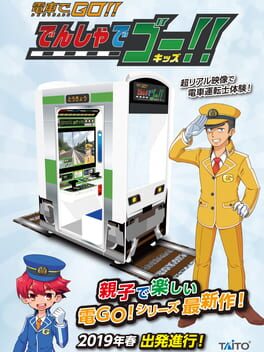
Densha de Go!! Kids (loosely translated to "Go by Train!! Kids") is an electric train simulation game developed by Taito and released by Square Enix for arcades (using PC-based Taito Type X4 hardware) in Japan on March 1, 2019. A spin-off of the 2017 game Densha de Go!!, Kids featured a simplistic single-screen arcade cabinet with a more child-friendly user interface and unique game rules (such as cleaning cartoon-ish obstacles from the window).