Arcade / Family Computer / Wii
Developed by Capcom.
Shooter / Arcade / Action / Science fiction
On a planet 6000 light-years from earth, there were creatures called Exes, which resemble large insects, that were used for industrial purposes. However, these creatures one day took to revolting against their creators. Two battle machines have been sent to fight against the Exes, known as Colonel and Sargent. The Exes are nearing completion of their secret weapon, Exed Exes, and they must be defeated before this is allowed to happen! Exed Exes is a basic vertical scrolling shooter; the game scrolls forward, and the player can maneuver their ship around the screen to shoot enemies and avoid attack. POW icons sometimes appear that can power up the ship or turn enemies into fruit that are worth extra points. The game can be played either solo or two-player cooperatively.

Shooter / Arcade / Action / Science fiction
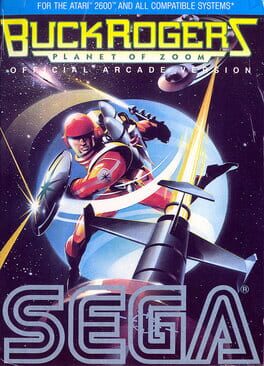
Sega released the arcade video game Buck Rogers: Planet of Zoom in 1982. It was a forward-scrolling rail shooter where the user controls a spaceship in a behind-the-back third-person perspective that must destroy enemy ships and avoid obstacles; the game was notable for its fast pseudo-3D scaling and detailed sprites. The game would later go on to influence the 1985 Sega hit Space Harrier, which in turn influenced the 1993 Nintendo hit Star Fox. Buck is never seen in the game, except assumedly in the illustration on the side of the arcade cabinet, and its only real connections to Buck Rogers are the use of the name and the outer space setting. Home versions were released for the Atari 2600, Atari 5200, Atari XE, ColecoVision, Coleco Adam, Intellivision, MSX and Sega SG-1000 video game systems, and the Commodore VIC-20, Commodore 64, Texas Instruments TI-99/4A, Apple II and ZX Spectrum computers. A version for IBM PC using CGA graphics was also available.

Shooter / Arcade / Action / Science fiction
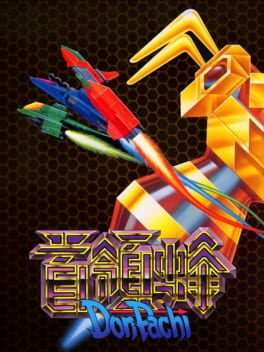
DonPachi is a 1995 vertical manic shoot-'em-up originally in arcades and was the first game from the developer Cave. Settings are mainly woodland and enemies are military vehicles and robots, culminating in the final boss, a huge robotic bee. One of three weapon configurations is chosen at start and then leveled up through dropped power-ups. DonPachi was ported to the Sega Saturn and Sony Playstation in 1996.

Shooter / Arcade / Action / Science fiction
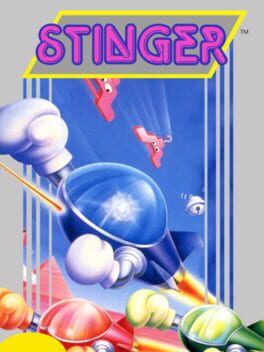
Stinger is a shoot-em-up developed by Konami. It is the North American version of the sequel to Twinbee.

Shooter / Arcade / Action / Science fiction
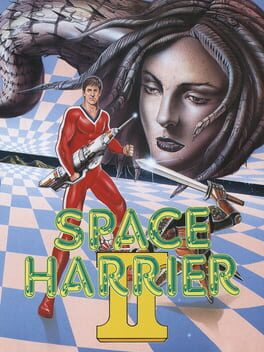
A call for help comes from deep in the universe. Fantasyland has been taken over by destructive forces. Quick on the scene is Space Harrier equipped with his laser, who must attempt to outwit and outmanoeuvre the hoards and prevent Fantasyland from being blown into oblivion!

Shooter / Arcade / Action / Science fiction
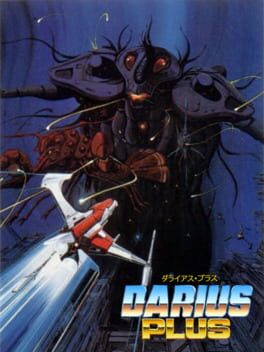
NOTE: "Darius Plus" is the TurboGrafx-16 PC-Engine port of the original Darius produced by Bits Laboratory and NEC Avenue. This is a different port than the title "Darius+", which was published by The Edge and developed by Softek for the Amiga, Atart ST, and ZX Spectrum. Amidst the clutter of arcade shooters in the late 1980s, companies needed to make their games stand out in some way. Simply flying a ship into outer space simply wasn't going to cut it anymore. Taito had an idea. Yes, there was still a spaceship. And yeah, that "outer space" part was still there too. But instead of the usual aliens, you fought fish. Yes, fish. Not even regular, aquatic fish, but robotic fish with lasers equipped to their fins, giant metal teeth and missiles firing from their gills. And not just fish either. There are squid, snails, and other undersea variations out for your blood as well. The requisite plot is about the people of the planet Darius, who are being terrorized by said intergalatic fish. Only the heroic pilots Proco Jr and Tiat Young can save the day. The constant star of the Darius series is the Silver Hawk. Much like Gradius, it has a primary, forward firing weapon, along with bombs that can be used to attack vertically, and the usual shield. The arcade game Darius games also used a unique system that attached three monitors together to create one massive horizontal playing field (also used in Taito's Ninja Warriors.) Naturally, this couldn't quite be replicated on the console system, so that nifty little gimmick is lost, but emulators can still replicate the dimensions of the screen, even if you end up looking at a tiny picture. Looking to further set itself apart from the crowd, every Darius game has multiple levels, with several branching paths throughout the game. It adds tremendously to the replay value, especially since there are usual multiple endings, depending on which final zone you end up at. Darius is a two-dimensional horizontally scrolling shoot 'em up set in a fictional future. Uniquely among shoot 'em ups, the game's screen was three times wider than conventional size, and the arcade cabinet used an arrangement of three screens to accommodate it. The player controls an ornate fighter spacecraft, named the Silver Hawk, and must navigate through scrolling terrain while battling a variety of fighter craft, ground vehicles, turrets, and other obstacles throughout the game's stages (referred to as zones in the game). The ship's arsenal consists of forward-firing missiles, aerial bombs and a protective force field, all of which can be upgraded by power-ups (in the form of large, colored orbs) that are dropped by specially-colored enemies throughout the game's zones. When the player reaches the end of a zone, a boss appears, which must be defeated to proceed. Once the boss of a zone is destroyed, the player is given a choice of which zone to play next via a branching path. While there are 28 zones in total, only seven can be played in a single run. When various ports of it were made for different consoles, Taito (and others) were forced to shrink the playfield to fit on one screen. The PC Engine saw three releases: - Darius Alpha (1990): A very rare beta release. This is one of the rarest Hu-Cards ever published. You could only get a copy of this hardcore shoot-em-up by buying Darius Plus and Super Darius and then mailing coupons to the publisher. 800 copies were made available, and names were drawn from those who mailed their info in. Some copies of the game were also given away as prizes by PC Engine Gekken and Marakatsu magazines. - Darius Plus (1990): The full game itself, again a PC Engine HuCard. The bosses that were removed in Alpha do not return here. Both Alpha and Plus were actually written for the PC Engine SuperGrafx and playing them on that console results in slightly improved graphics (less flicker and slowdown). - Super Darius (1990): A conversion of Darius for the PC Engine's Super CD-ROM, very close to the original arcade version other than being single-screen. Features new bosses, as well as a "boss rush" mode.

Shooter / Arcade / Action / Science fiction
DoDonPachi SaiDaiOuJou is a vertical scrolling shoot 'em up arcade game released by Cave in 2012. It's the sixth chapter in CAVE's DonPachi series. A Japanese region-free release was released on May 30, 2013.

Shooter / Arcade / Action / Science fiction
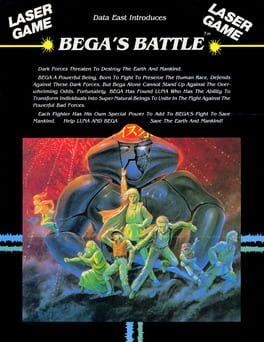
Data East used footage from the film Harmagedon to create a laserdisc video game titled Bega's Battle. It was released in June 1983. In the game, the player to take on the role of the robot Bega (Vega) whose goal was to stop the invasion forces of the alien Varga (Genma), while also rescuing his three friends who had been kidnapped by them. Even among laserdisc games Bega's Battle has become somewhat rare because many of the machines were converted into Cobra Command machines as part of a discount deal offered by Data East in exchange for the internals of the Bega's Battle arcade cabinet. Similar to Astron Belt, the game used the footage mainly for backgrounds, while the actual gameplay was a shooting game with sprites laid over the video. Bega's Battle also used brief full-motion video cut scenes to develop a story between the game's shooting stages. Years later, this would become the standard approach to video game storytelling. Bega's Battle also featured a branching storyline. The Twin Galaxies world record for Bega's Battle was set by Steve Harris (later the founder of Electronic Gaming Monthly) on July 18, 1983.

Shooter / Puzzle / Indie / Action / Science fiction
In this vertical scrolling spaceship shooter, you control a ship that can change its polarity at will. As blue/white, the ship can easily destroy red/black enemies, and vice versa. Bullets of your polarity can be collected to fuel your energy gauge, but those opposite will kill you. Destroying an enemy ship causes them to fire revenge bullets which can be absorbed and fired back by the player. Different difficulties exist to change exactly how you interact with polarized points, or how they appear. It is the spiritual successor to Radiant Silvergun, featuring similar level and boss design, as well as it's buddhism inspired themes and aesthetics. Both are directed by Hiroshi Iuchi, who also composed Ikaruga's soundtrack.