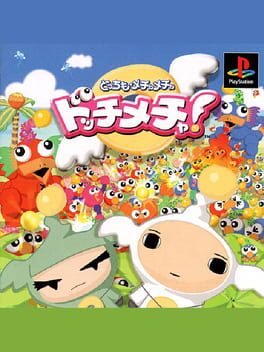
"GORYUZIN ELECTRO" is a board game acknowledged for its quality by the Good Toy Committee in Japan in 1997. Based on the legend of the dragon, you have to compete connecting special frames and see to what extend can you proceed into your opponent's territory. No matter how many times you play, it is a fun game for everyone. The gameplay is difficult to explain, the goal of the game is to use all of the player pieces or use the ones that the player needs to reach to other part of the board, (for example the player starts in the bottom of the screen and have to reach the top) the harder part is to that before the opponent do it, both players compete to use their pieces to create obstacles that avoid the opponent to reach the other side, using the opening (that is too the closing piece) to close the line and get a point (or more depending of the pieces used). The game got a challenging gameplay but the difficulty level is really hard.

Strategy game in which the player take the role of a little alien that have to pass some missions to reach his objectives.

Strategy / Card & Board Game / Party
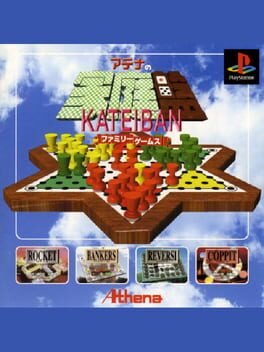
Variety game collection was recorded board game of nostalgia. I record five sugoroku like to play using the board that mimics of Othello-like "Reversi", the luster of diamond "King Diamond", hat up game "Kopit", "rocket", the Game of Life-style of "Bankers". Can be simultaneously play up to four people maximum. Let Moriagaro in the good old game a long time ago!

Sport / Strategy / Card & Board Game / Comedy / Non-fiction
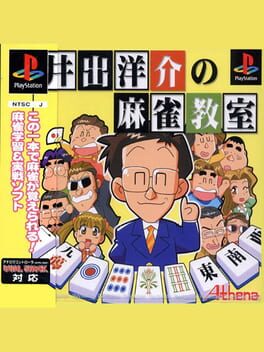
Ide Yōsuke no Mahjong Kyōshitsu is a Mahjong learning and practice game featuring Mahjong professional Ide Yōsuke. The game has a number of lessons shown with a manga style drawn Ide Yōsuke explaining the rules of the Chinese classic board game of Mahjong, and allows the player to try what they have learn on Mahjong boards.

Sheep is a combination strategy and puzzle game, featuring light elements of war or battle simulations, built around a wacky story in which space-faring alien explorers from millennia ago devolve into domesticated sheep on Earth. Now their ancestors are trying to round them up by secretly enlisting the aid of two humans (Bo Peep and Adam Half Pint) and two animals (a sheepdog and a pet) through subliminal mind control. Players take the role of the Earthly "herders" to lead the flocks through six worlds with multiple levels, eventually reaching special rendezvous point where they'll be loaded onto UFOs for the trip back to their home world of Ovis Aries. No direct control is exerted on the sheep so players must manipulate objects and obstacles, as well as rely on the strengths of each herder, to accomplish the tasks. Levels have time limits and a minimum number of sheep to be saved from each flock.

Puzzle / Strategy / Arcade / Fantasy / Kids
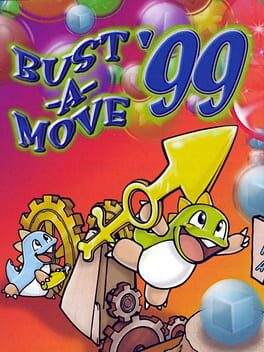
In the tradition of the Bust-A-Move series, Taito's Bust-A-Move '99 is a traditional puzzle game. The main objective is to destroy or get rid of (by dropping) all the bubbles located within the stage. Once you do this, you'll graduate to the next level. While the premise may sound simple, the logic and execution is not. Using a "bubble shooter", you must aim and shoot your bubbles to the top of the screen so that you can bring three bubbles of the same color together. When you do this, the bubbles will pop. One way to earn points is to have the popping bubbles as well as the bubble that was shot fall off the screen (in multi-player, it puts these bubbles on your opponent's side). This also gives you a lot less bubbles to take care of. Bubbles are constantly falling down. Popping them all in a short amount of time is necessary because the longer it takes you to pop them all, the faster they will drop. If you fail to clear out all the bubbles and they reach the bottom of the screen, the game is over. Bust-A-Move '99 contains some new options never seen in the Bust-A-Move series. There are now special bubbles (star, metal and rainbow to name a few), obstructive bubbles and blocks and new backgrounds. You are also given the opportunity to create your very own stages with the create-a-level editor.

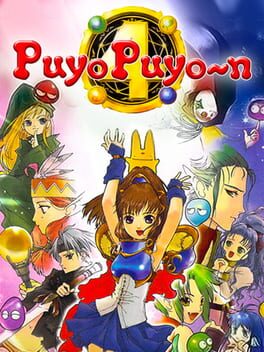
This game was released only in Japan. It is the fourth game in the Puyo Puyo series and the last set during the Madou-era in the main series. Continuing the trend of naming the games after puns, the name comes from a pun on "yon", the Japanese word for the number 4, but this time this is the only reference to the pun. The gameplay in is similar to that of Puyo Puyo 2, but adds super attacks. Clearing chains now builds up a "charge meter" which allows players to use them. The only other addition was a new game mode which could be played with a number of different field sizes, smaller or bigger than the standard 6x12, however, it removes several game modes that were present in Puyo Puyo Sun, i.e. the tournament, task and chain training modes. The art is also vastly different to the previous game in the series and, of course, the Fever series; this style was only otherwise used for Minna de Puyo Puyo.

Puzzle / Strategy / Card & Board Game / Kids / Party
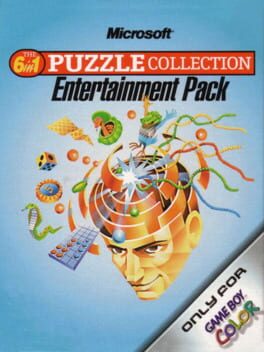
A Game Boy version of the Windows puzzle suite of the same name, featuring 6 of the 10 games released on PC, designed by Alexey Pajitnov, the original Tetris designer, on one Gameboy Color cartridge. Jewel Chase. A level based game. Every level consists of a labyrinth of colored pathways, scattered valuables, locked doors, keys, a thief (the player), on some levels an opposing thief and a door marked exit. The goal is to reach the exit to proceed to the next level, valuables can be 'stolen' for score. If the opposing (computer controlled) thief reaches the exit before the player, the game is lost. Movement is not possible between differently colored tiles, unless a special, multicolor 'bridge' stone is used. 99 levels total. Spring weekend. A rotation puzzle, where a given pattern needs to be recreated by rotating elements on the playfield. Lineup. Using 'Tetris' style blocks, a continuous line from a screen border to an opposite screen border needs to be build. Elements appear on an element stack, and can be selected freely from that and subsequently placed anywhere on screen, without overlapping each other. If the element stack is full, the game is over. As soon as a line is complete, the elements of that line are removed from the screen. Elements appear faster over time. Finty Flush. A grid on top of the screen fills slowly with multicolor balls. The player can pick one out of 4 squares on the bottom of the screen to shift balls in one line into and out of these squares. The squares can be rotated in 90 degree steps. As soon as any square is completely full with balls of the same color, its content empties to make room for more balls. 3 filled square grids grant a bonus point, and the next level begins (tiles appear faster). The game is over when the upper grid is full. Color Collision. A 'Qix' style ray ( no better way to describe this - for the younger audience - imagine a flapping fan ) moves with increasing speed through a screen full of obstacles. The player can only indirectly control it - any time the direction pad is pressed, it gets 'reflected' into the direction that has been indicated. Objective is to hit obstacles with a given color and pattern, avoiding all other elements. To top things of, the patterns change over time. The game ends if the wrong obstacles have been hit too many times. Rat Poker. Little differently colored rats are automatically fed into labyrinths, with labyrinth design changing and getting more complex during level progression. Switches allow rerouting of the rats to arrange certain color combinations ('hands') of rats. If a given combination is achieved, the contributing rats exit the playfield through a door. You progress to the next level if a given number of rats has been removed from the game. The game ends if there is no space left on the playfield for additional rats. .

Puzzle / Arcade / Card & Board Game / Comedy
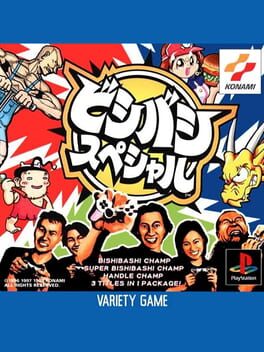
Bishi Bashi Special is a compilation (and conversion) of the Konami arcade titles Bishi Bashi Champ, Super Bishi Bashi Champ and Handle Champ. Gameplay is made up of tons of mini games, all of which use a simple 3-button interface that mimics the arcade originals. The mini games encompass a wide variety of button-mashing, timing and button combination games. The games themselves can be anything from making hamburgers, throwing a pie down a church aisle to balancing a car on a floating narrow gravel road and much more. The game can be played alone, vs a computer player or play up to eight people using a multi-tap and three controllers.