Developed by Park Place Productions for Virgin Games.
Sport / Action / Non-fiction
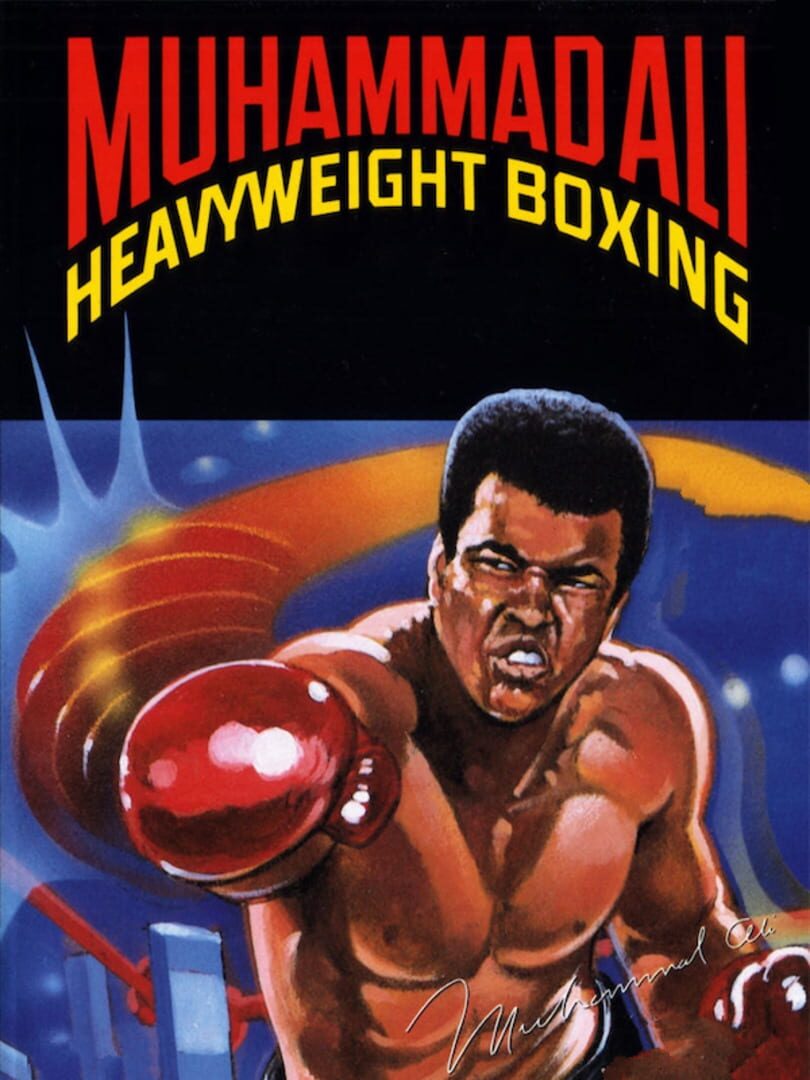
In career mode, the player can choose to fight as any of the game's 10 boxers. They start at rank 10 in the heavyweight division, and fight their way through all the others in order.

Sport / Strategy / Action / Non-fiction
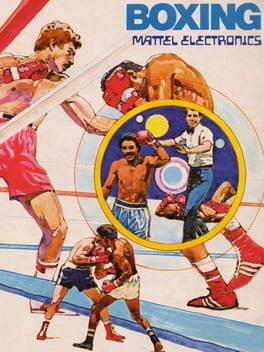
Boxing shows a top-down view of two boxers, one white and one black. When close enough, a boxer can hit his opponent with a punch (executed by pressing the fire button on the Atari joystick). This causes his opponent to reel back slightly. Long punches score one point, while closer punches (power punches, from the manual) score two. There are no knockdowns or rounds. A match is completed either when one player lands 100 punches (a "knockout") or two minutes have elapsed (a "decision"). In the case of a decision, the player with the most landed punches is the winner. Ties are possible. While the gameplay is simple, there are subtleties, such as getting an opponent on the "ropes" and "juggling" him back and forth between alternate punches.

Simulator / Sport / Action / Non-fiction
The game consists of two different soccer simulations, you can carry out a match in the stadium or indoors. The field is always shown from the top and scrolled softly into all directions. Different game modes make for diversity. Up to 15 players can enter their names and then compete with each other in a league. One can also take part in a World Cup, whereby the venue corresponds to the one of a real World Cup. The computer takes over the controls of as many teams as needed. A two-player friendly can be played head to head. The game offers features as "banana kick", "action replay" and weather. The original was developed by Sensible Software for the C64, Electronic Pencil Company were responsible for the Amiga and Atari ST versions.

Fighting / Sport / Action / Comedy
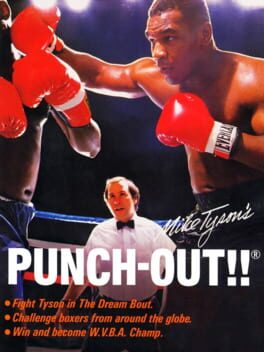
Punch-Out!!, originally released in North America as Mike Tyson's Punch-Out!!, is a boxing sports fighting video game for the Nintendo Entertainment System (NES) developed and published by Nintendo in 1987. Part of the Punch-Out!! series, it is a port of both the Punch-Out!! and Super Punch-Out!! arcade games (particularly the latter) with some variations. Punch-Out!! features a boxer known as Little Mac working his way up the professional boxing circuits, facing a series of colorful, fictional boxers, leading to a final fight with real-life boxer, the then-World Heavyweight Champion, which is Mike Tyson in the original version and Mr. Dream in the later version. Little Mac has a limited repertoire compared to most of his opponents. His punches are limited to left and right jabs, left and right body blows, and a powerful uppercut. The uppercut can only be used once the player earns a star, which is typically accomplished by counter-punching the opponent directly before or after certain attacks are launched. The player can acquire up to three stars. To perform the uppercut, the player needs to press the start button once a star is earned. To defend, Mac can dodge left or right, duck, and block punches by putting up his guard. Little Mac also has a heart meter, which decreases by three upon being struck by an opponent and one upon blocking an attack or an opponent blocking/dodging the player's attack. When the heart meter decreases to zero, Little Mac temporarily turns pink and appears exhausted, leaving the player unable to attack but still able to dodge or block. At this point, Mac can regain some hearts (and his normal color palette) only by avoiding the opponent's punches. He immediately loses all of his hearts upon being knocked down, but can regain some by getting up. A bout can end by knockout (KO), if a fighter is unable to get up within ten seconds after being knocked down; by technical knockout (TKO), if a fighter is knocked down three times in one round; or by decision, if the bout lasts three full rounds without a clear winner. In order to win by decision, the player must accumulate higher than a certain point total by punching the opponent and/or knocking him down (different boxers require different point totals to win by decision). However, some bouts cannot be won in this manner and will automatically result in a loss for the player if the opponent is not knocked out. Mac can only get up three times during any one bout; if he is knocked down a fourth time, he will be unable to rise and thus lose by knockout. When Mac loses his first bout to a ranked opponent, he will have a chance to fight a rematch. However, if he loses a Title Bout, he will fall in the rankings - one place for the Minor or Major Circuits, two places for the World Circuit. Losing a rematch causes him to fall one place (unless he is already at the bottom of his circuit), forcing him to fight his way back up. A third loss (not necessarily a consecutive one) ends the game. The exception is the final fight against Mike Tyson/Mr. Dream; a loss to them automatically results in a game over.
Sport / Action / Non-fiction
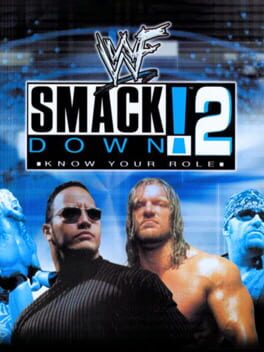
Prepare for the most outrageous WF experience ever created. Brawl in the ring, backstage, in the VIP room, the parking lot of the new WF New York. Let your fury rage in the new Tornado Tag Team mode. If that's not hardcore enough, pull out the tables, ladders or chairs and really get nasty.

Sport / Action / Non-fiction
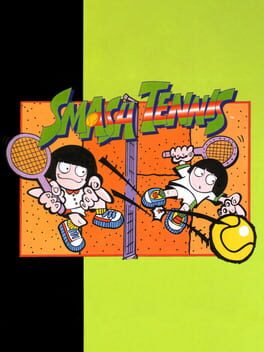
Smash Tennis is a tennis game that was created by Namcot for the Super Nintendo in 1993. It was released in Europe as Smash Tennis by Virgin Interactive. A North American release of the game wouldn’t be seen until February 2020 where it would be part of the Nintendo Switch Online lineup. The controls of Smash Tennis work similar to other tennis games and especially Namco's previous tennis game World Court Tennis: the player moves the athlete over the court and presses buttons with the correct timing in order to win the match. This time there is no story mode, but a tournament mode instead. Here the goal is to win the Grand Slam by playing various tournament matches. However. a match only has a single set. There are 20 athletes (both male and female) to choose from which have different advantages and drawbacks.

Sport / Arcade / Action / Non-fiction
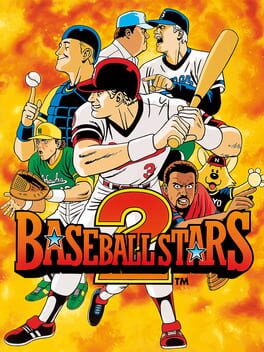
Baseball Stars 2 is the sequel to the very successful Baseball Stars game released for Nintendo in the late 1980s. It was released by SNK for Arcade, as well as the Nintendo Entertainment System. Players can create leagues of up to 125 games (6 teams playing each other 25 times) and view statistics such as League Standings, Average, Home Runs, Runs Batted In, Earned Run Average, Wins and Saves. Players can fire players and upgrade them using the same 15-point system introduced in the original Baseball Stars.

Sport / Strategy / Action / Non-fiction
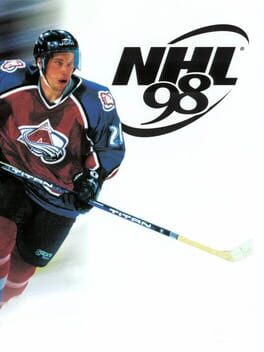
NHL 98 features much faster and refined gameplay (now using four action keys instead of two, removing the need to double-tap to perform some actions), along other new features such as "in-the-fly" tactics developed by Marc Crawford, then manager of the Colorado Avalanche and new commentary lines from Jim Hughson and Darryl Reaugh and a re-worked interface. Graphics are improved from the previous version with the players being less angular, and thanks to 3Dfx support, with less pixels showing in the textures. The in-game presentation follows a TV-style script, zooming in players while displaying stats during clock stoppages. As far as game modes go, in the year of the first Olympic Tournament with professional players, NHL 98 introduced the first real international competition, with 18 International teams to choose from. Other game modes include Season (option to pick between 25 or 82 games) and Playoff (best of 1, 3, 5 or 7 matches) and a Penalty Shootout mode.