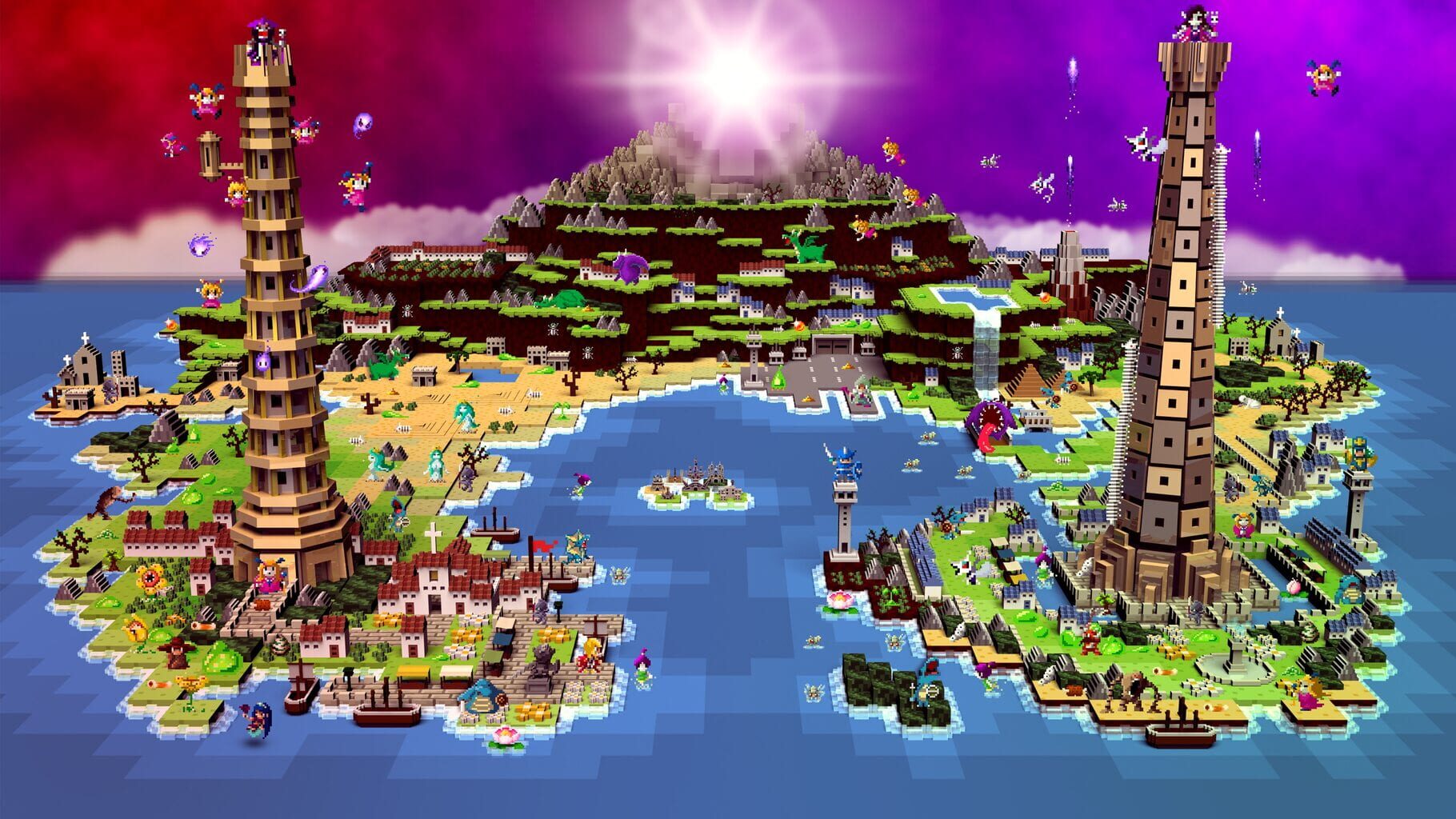
The third installment of Sony's Yuusha no Kuse ni Namaikida series, 3rd Dungeon.
Screenshots & Artwork
Featured in
The third installment of Sony's Yuusha no Kuse ni Namaikida series, 3rd Dungeon.
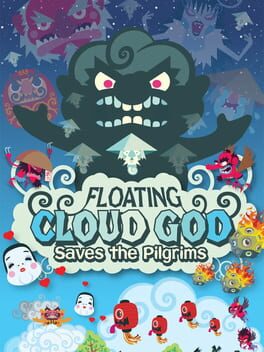
Floating Cloud God Saves the Pilgrims is a Playstation Mini game for PSP and Vita. Floating Cloud God Saves the Pilgrims is exactly that, a 2D shooter built around the eponymous deity (controlled by the player) and his quest to protect eight pilgrims in their journey across perilous territories. Your own shots just knock their hats off, but getting hit by anything else will kill a pilgrim and send their spirit floating off with a sad little wail. This is bad not only because the pilgrims are a de facto health bar (losing them all ends the game) but powering up Cloud God depends on harvesting their love - juicy little hearts that pop up whenever you kill an enemy and increase in size as you blast more. You must get all of the love (given form as hearts) that they release, which then makes you much more powerful than you already are. You increase in size, look more menacing, and your attacks are more powerful. The pilgrims get the most excited when they witness ambushing ghosts and ghouls get annihilated by you. When they are excited, they produce more love, meaning more power to you. However, you have to be very careful when shooting. You grow weaker with every shot, so try not to channel your inner war-freak and have a little restraint, for the good of both yourself and the pilgrims. You also lose some of your steam if you get hit by enemy forces. And sometimes, the situation calls to for you to sacrifice your mightiness and provide cover to the pilgrims from the enemy assault with your own self. There are two types of attack: the normal shot (by pressing X), and the bomb shot (by pressing Circle). The direction of the normal shot depends on what direction you are pressing, so there is some strategy to what part of the screen you should be shooting from. Being too far from your pilgrims is very dangerous but allows you to cover more ground, while launching a full frontal assault can protect your pilgrims by absorbing all the incoming fire. You have to think through, in real time, what tactics you would like to employ. You can always get in the middle, then rush forward, then get to a safe distance; mix and match, and you got yourself going. The bomb shot is used if you are above the enemy. But that’s not all, as some enemies can’t be killed with the bomb shot, only with the normal shot, and vice versa. There are also enemies where you have to inflict bomb shot damage first before switching to the normal shot to take them out. Enemies are varied, and they look good, even if they are vile and evil. There are boss fights, too, to keep you on your toes. The Cloud God's powers and the heart system mesh so well that any enemy can be destroyed in a blink - so they've got to be deceptive, sneaky, and sometimes numerous. Paper lanterns send out an arcing flame on death, red-eyed foxes hide in the scenery, imps swoop to carry off unlucky pilgrims and bobbing doll heads send out swarms of kisses. Hands start clawing up from the ground, crows dive-bomb your crew, and demons with phallic noses launch them as languorous, looping rockets. The cheeky oriental stylings are gorgeous, transforming symbols into everything from freaky momiji to dick-nosed devils. As this suggests, one of the reasons Floating Cloud God is such a pleasure to play is its visual inventiveness, which has room enough for everything from Wario tributes to what looks like a crying poo. This big lump of a thing, which is introduced in a level called The Saddest Enemy, explodes into gobbets of mini-poo that are very useful for building up a heart multiplier. Perhaps they're babies? That would explain the sadness. Floating Cloud God has bags more where that came from, and despite the Minis tag has plenty of room to breathe (there are seven worlds with 27 stages, including boss fights). And it keeps on surprising. The controls are simplicity itself: left stick to move, one button to shoot and one to bomb. But you soon realise the subtlety of how shooting affects movement and vice-versa, which fairly soon you're depending on against every enemy pattern. The pilgrims, too, are loosely tied to Cloud God during some sections, and learning how to manage their momentum is another little learning curve. The final touch is a minor detail that ties up everything. The pilgrims' hats can be improved. There's no in-game benefit to this, beyond looking much more awesome, and it's done by completing stages without losing a single pilgrim. Obviously, if you start this process on the first level and never lose a pilgrim, the hats just keep getting better. Seems like such a small thing, doesn't it? Soon nothing but a perfect run will do. The restart option is accessible, knowing, and tempting. Every time a pilgrim fell, it was too much to take - I didn't see their tiny spirit float off to heaven so much as all my future headwear ambitions. And to be fair, by that point I had four dudes with top hats, two with octopus heads and two with space hero helmets. You can't be replacing any of them with Norman and his brown cap just because some demon gets a lucky shot in. That's the best thing about Floating Cloud God Saves the Pilgrims. You do want to save them, and not just because they represent 'health'. The hats are a big part of it, but just as much is the sense of pride in being a badass god - harvesting power at the right moment to smash through oncoming waves, battling desperate rear-guard actions against hails of deadly kisses and throwing yourself in bodily as a last resort (which sometimes works!). The little yelp as a pilgrim goes down is a sharp reprimand, a blow to the daydreams of an all-conquering deity. This description was compiled from the following reviews: http://www.eurogamer.net/articles/2012-04-19-floating-cloud-god-saves-the-pilgrims-review http://www.pspminis.com/8859/floating-cloud-god-saves-the-pilgrims-review-if-the-indication-of-a-good-game-is-a-lengthy-title-then-that-rule-applies-here/
Strategy / Tactical / Action / Science fiction
BOMBERMAN has arrived to restore peace on the planet, which has been split into five parts by an evil hand! In addition to the nine members of the Bomber Family, the character ROOI shows up to lend a hand. Jump on the EGGS that appear from destroyed SOFT BLOCKS, and you can ride one of five types of ROOI. Each ROOI has different special abilitiesuse these well and youll ride to victory! Bombs that turn according to arrows and other new gimmicks have been added to BATTLE GAME, increased to ten stages. Tag-team matches are now possible, ensuring that this game will be a blast! Bomberman '94 is a video game from the Bomberman series which was developed and published by Hudson Soft for the PC Engine and released on December 10, 1993 in Japan. It was later re-developed by Westone and re-published by Sega as Mega Bomberman on the Sega Mega Drive/Genesis in 1994 in other areas. The PC Engine Bomberman '94 was later released outside Japan through the Wii's Virtual Console and the PlayStation 3's PlayStation Network. The game supports single-player and multi-player modes. In single player, the player navigates several levels of mazes, destroying creatures with bombs. In multi-player mode, players defeat each other with bombs. Bomberman '94 is the final HuCard title to be made and released by Hudson Soft, the original designers of the PC Engine console.
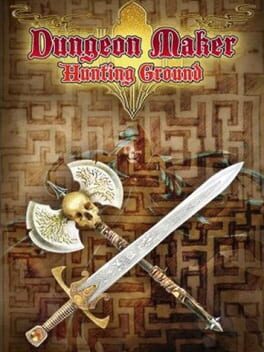
Role-playing (RPG) / Strategy / Hack and slash/Beat 'em up / Action / Historical
Dungeon Maker: Hunting Ground is an action RPG where the player creates their own unique dungeon using purchased pre-crafted pieces. Each day, as the player adds to his dungeon, wandering monsters come to inhabit it. The deeper the player builds his dungeon, the more deadly the monsters and their treasures. A deep and well-crafted dungeon might attract the ultimate evil creature for you to try and defeat using a variety of items, weapons, and spells that have been acquired along the way. The nearby city offers equipment, food, quests, and quirky characters to aid you in your adventure.
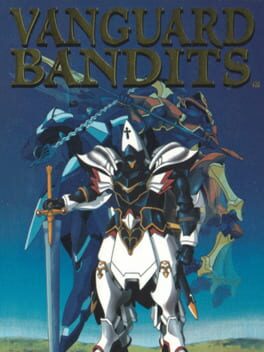
Role-playing (RPG) / Strategy / Fantasy / Science fiction
In a world where technology and mythology are one, a young rebel and his ragtag crew are unwittingly drawn into a holy war being waged by the bloodthirsty General Faulkner and his mercenary forces. Guide the charasmatic Bastion as he realizes his destiny to lead the rebellion against the Junaris Kingdom, and to save the people of his world from an eternity of oppression. Lead powerful squadrons of robotic warriors into battle and take complete command of their actions. Smite your foes with cleaving swords, piercing spears, and sizzling magic spells. Use the terrain to your advantage and maneuver your forces into superior combat positions. Witness the results of your tactical decisions in glorious 3D combat sequences.
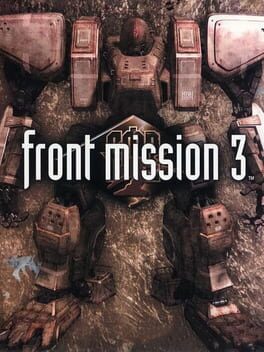
Role-playing (RPG) / Strategy / Turn-based strategy (TBS) / Science fiction / Warfare
Front Mission 3, also known in Japan as Front Mission Third, is a tactical role-playing game developed and published by Square for the PlayStation. It was released in Japan in 1999, and North America by Square Electronic Arts and Europe in 2000. Front Mission 3 is the third main entry and the fifth entry overall in the Front Mission series. Like other Front Mission titles, Front Mission 3 is part of a serialized storyline that follows the stories of various characters and their struggles involving mecha known as wanzers. Front Mission 3 was the first title in the Front Mission series to be released in North America, Europe and Australia.
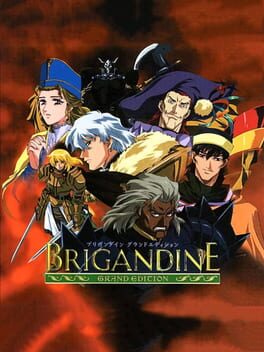
Role-playing (RPG) / Strategy / Fantasy
In 2000, Hearty Robin released a remake of the game called Brigandine: Grand Edition, which included multiplayer support, along other new features. - Multiplayer game mode: allowing up to 6 players, each controlling a nation. - The Esgares Empire became a fully playable nation, and gained plot cut scenes. - Changes on battle mode gameplay: Like on the Fire Emblem series, elements became based on the Rock, Paper, Scissors rule: red is effective against green, green is effective against blue, and blue is effective against red. White and black still oppose each other. - If, after 13 turns of battle, the attacking side has a unit over the defending side's castle, the attacking side now wins. - Monsters became able to equip items. - The player is redirected to a final boss, when the continent is successfully conquered. - The original 3D opening was replaced by an anime opening. - Many dialog-only cut scenes where replaced by anime cut scenes. - 3D battle animations replaced by simpler and faster 2D animations. - Major changes on soundtrack. - New rune knights, character classes, items and monsters. - Voice acting is present with Japanese Seiyu, including the voice talents of Soichiro Hoshi, Mitsuaki Madono and Yuri Shiratori to name a few.
Role-playing (RPG) / Strategy / Turn-based strategy (TBS) / Fantasy
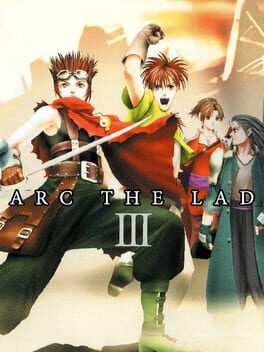
The events of this game take place several years after Elk and Arc faced their ultimate enemy in "Arc the Lad II". You control Alec, a teenager whose entire village was destroyed by an unknown evil - an event that was later called "The Great Disaster". He was saved by a mysterious Hunter. Since then, growing peacefully in a village he was brought to, which was like a new home for the survivors of the Great Disaster, Alec dreams about meeting the Hunter again, and becoming a Hunter himself. Together with his best friend Lutz he tries his luck in nearby towns, receiving small Hunter jobs, until the fate crosses the ways of the two young people with a mysterious organization called the Academy. And there their adventure really begins... The gameplay of this third installment of Arc the Lad series is very similar to that of the predecessor. You fight enemies in turn-based battles, and can move freely on the battlefield, positioning your party members the way you like. You can upgrade your weapons by forging them with special materials, and have a variety of techniques and magic spells at your disposal.
Platform / Puzzle / Strategy / Action / Comedy
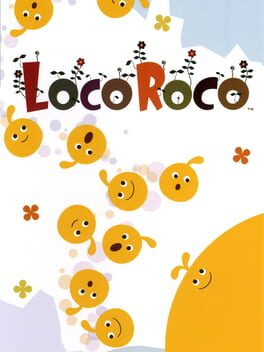
The peaceful world of the LocoRoco are under attack by the not-so-nice Moja Corps! These evil outer space creatures have come to take the LocoRoco from their land of blowing flowers, lively creatures and pastel scenery. As the planet where the LocoRoco inhabit, you must move them through more than 40 levels of slippery slopes, teetering platforms and maze-like passages. The LocoRoco have the uncanny ability to fluidly morph to their landscape, so all you need is to tilt, roll and bounce the happy blob-like creatures to safety!