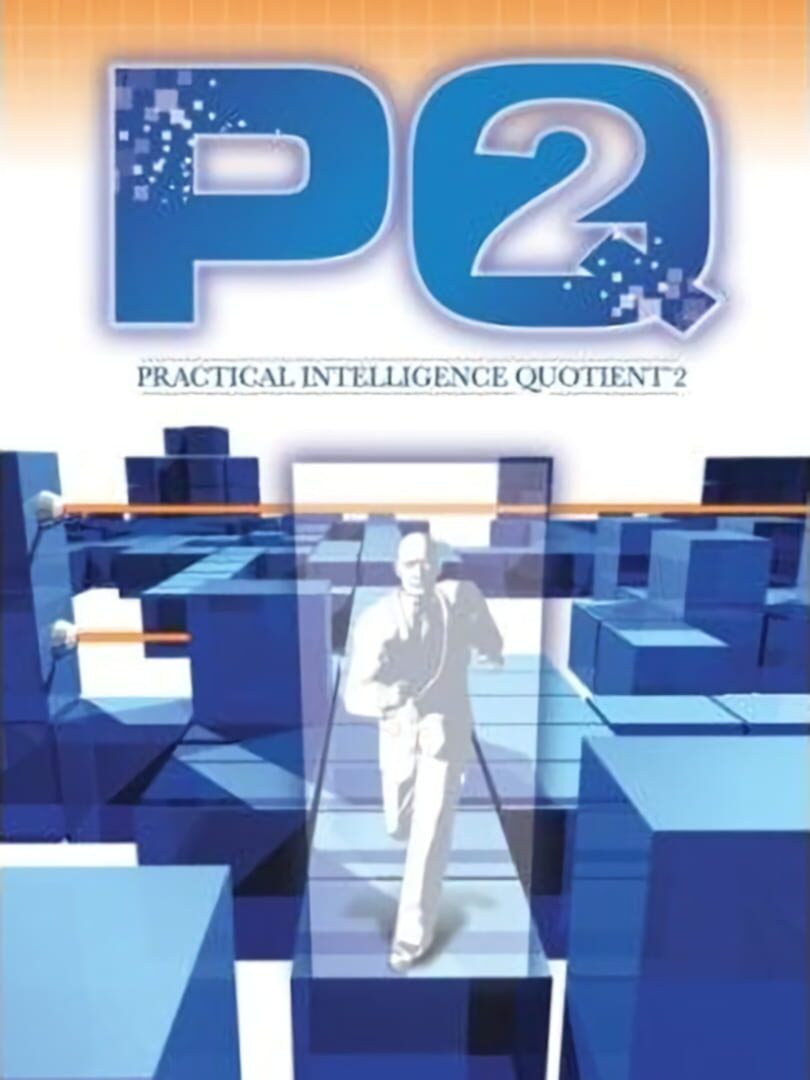

PQ2: Practical Intelligence Quotient 2 (also known as PQ2; Intelligent License 2 in Japan) is a puzzle game for the PlayStation Portable, and a sequel to PQ: Practical Intelligence Quotient. The game is based on testing the model of human intelligence developed by Dr. Masuo Koyasu at Kyoto University. PQ2: Practical Intelligence Quotient 2 shares many features with the first PQ game and similar platform-like puzzle games. In each stage, the player controls a human avatar in a virtual reality world, climbing and dropping from levels, lifting, dropping, pushing and pulling boxes in order to activate switches and lifts, block laser beams, and to create stairways in order to reach an exit point. The player must also avoid guards that make rounds on the level. The main game is presented as an intelligence test of 100 stages. The player is given a total cumulative time of 5 hours to complete all 100 puzzles; time is only counted while the player is performing the puzzles, and the player can save and come back at any time without time penalty. The player's score is based on the number of "moves" (excluding walking around) on the stage, the time it took to complete it, and the number of attempts at that stage. A player can skip a stage with a scoring penalty; levels not completed in the 5 hour limit are also penalized against the player. Once completed, the player can upload their score to worldwide scoring tables to compare their results. Obstacles in levels include: Boxes. Small opaque boxes can be picked up and dropped, and their height is the maximum height that the avatar can climb up on, thus these are commonly used to make stairs. Larger boxes can be pushed or pulled. Glass boxes. These boxes operate like regular boxes, but will shatter if dropped from any height or hit by something dropped on them. They also are translucent and will allow both laser and regular light through. Laser boxes. Like regular boxes but have laser beams that come out of one end. Crossing the beams will prematurely end the level. Switch panels and switch boxes. Colored switches, when active, will activate platforms that may move across the field or that increase height, while deactivating a switch will cause these platforms to return to their original position. Floor panels are active by stepping on them or placing a box on them, while switch boxes require a laser beam to hit them. Teleporters. These can be moved like boxes and will teleport the avatar between the end points. Police officers. These characters roam from one police call box to the next closest one, and shine a line in front of them. Should the avatar be caught in this light, the level must be restarted. The police call boxes can be moved to alter the police officier's behavior. Detectives. These characters will follow a specific roaming path until they discover footprints left by the avatar. At this point, they will follow the footprints until either the trail is lost, they find an obstacle they cannot pass through, or until they catch the avatar (which then will restart the level). Footprints will disappear after a number of steps, but can also be manipulated by using boxes and other obstacles. PQ2: Practical Intelligence Quotient 2 introduces the ability to create one's own levels to share with friends, and a "weekly quiz" that can be downloaded through the Internet.
Puzzle / Strategy / Tactical / Action
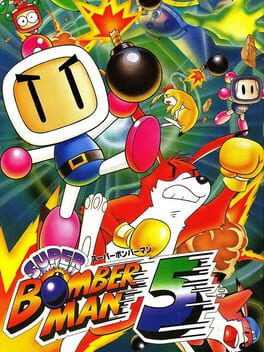
An evil Bomber named Emperor Terrorin who has the power of Time itself has freed various criminal Bombers from their prison cells in orbit around Planet Bomber. Setting them up in a warped time and space, Shirobon, Kurobon, and their Louie (Rui) companions must travel through stages and defeat them before going up against Emperor Terrorin himself. Super Bomberman 5, released by Hudson Soft in early 1997, was the final Bomberman game released on the Super Family Computer - the Japanese version of the SNES. The game was released in two variations: a standard cartridge and a gold cartridge, which was sold exclusively through CoroCoro Comic. The gold cartridge included extra maps in battle mode.

Tetris DX has everything you need to satisfy your puzzle appetite. Play marathon, the classic Tetris game. Try your hand at ultra or 40 lines, two Tetris games with a twist. The vs. game will have you playing for hours!

Puzzle / Adventure / Action / Fantasy
Venture back to Hyrule and an age of magic and heroes. The predecessors of Link and Zelda face monsters on the march when a menacing magician takes over the kingdom. Only you can prevent his evil plot from shattering the land of Hyrule. In your quest, you'll venture into twisting mazes, dungeons, palaces and shadowy forests. Test your mettle with mighty swords and magical weapons. Or heft a boulder and hurl it at your enemies. If the going gets tough, dive into a river - you can swim to escape! Learn powerful spells, locate magical artifacts and solve the mysteries of the evil magician and the hidden realm of Hyrule.

Puzzle / Adventure / Action / Fantasy
The Legend of Zelda: Ocarina of Time is the fifth main installment of The Legend of Zelda series and the first to be released for the Nintendo 64. It was one of the most highly anticipated games of its age, and is listed among the greatest video games ever created by numerous websites and magazines. The gameplay of Ocarina of Time was revolutionary for its time, it has arguably made more of an impact on later games in the series than any of its predecessors even though they had the same cores of exploration, dungeons, puzzles and item usage. Among the gameplay mechanics, one of the most noteworthy is the time-traveling system. The game begins with the player controlling the child Link, but later on an adult Link becomes a playable character as well and each of them has certain unique abilities. Ocarina of Time also introduces the use of music to solve puzzles: as new songs are learned, they can be used to solve puzzles, gain access to new areas and warp to different locations. Dungeon exploration is somewhat more puzzle-oriented than in earlier games but they are not too complex.

Point-and-click / Puzzle / Quiz/Trivia / Mystery
Last Window: The Secret of Cape West is an adventure video game developed by the now-defunct Cing and published by Nintendo for the Nintendo DS handheld game console. It is the sequel to Hotel Dusk: Room 215, starring protagonist Kyle Hyde and placed one year after the events of its predecessor. The game has visual and audio styles similar to that of the first game. In Last Window, Kyle Hyde is living in the Cape West Apartments, Los Angeles, in 1980. The story of this sequel is separate from the first game, even though it includes some connections to it. Last Window was the last game developed by Cing before the company filed for bankruptcy on March 1, 2010.

Experience the world famous Chinese board game! Play your way through numerous tricky levels at different difficulty levels in a setting of beautifully drawn backdrops. Enjoy endless playing pleasure either in Single-Player or 2-Player Mode on a Nintendo DSi system. Use powerful extras such as Dynamite, Whirlwind, and Hourglass and become the uncontested Mahjong champion!