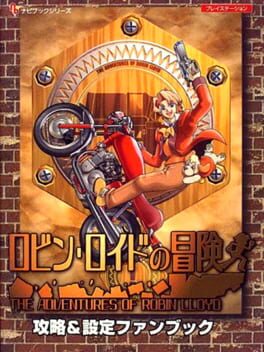
The Adventures of Robin Lloyd is a detective adventure game mixed with some action RPG elements, set in 1926 London, You need to get the clues by talking to various people and interact with objects. The game's main character private detective Robin Lloyd, must solve countless mysterious! A key element of this game is its investigation system that lets you study objects that rouse your suspicion by looking at them from below or behind and even turning them upside down at times.

Shooter / Adventure / Visual Novel / Action / Science fiction
Policenauts is an interactive movie/graphic novel/adventure game with a hard science fiction storyline, written and directed by Hideo Kojima, and published by Konami. It was initially released for the PC-9821 computer platform in 1994, followed by remade versions for the 3DO in 1995, and the PlayStation and Sega Saturn in 1996. The game has never been officially released outside Japan, despite plans for an English localization of the Saturn version. On August 24, 2009 (in honor of the 46th birthday of the game designer, Hideo Kojima), an unofficial English translation patch was released onto the internet. The game is set in a primarily first person perspective and uses a point-and-click interface: the player can move the cursor and have the protagonist (Jonathan Ingram) analyze objects around his environment or talk to other characters in the game. Like in Snatcher, the game features shooting segments where the player must defend their character from incoming enemies. The player can use the shooting trainer at the police department to test their reflex and accuracy. There are numerous puzzles in the game, including an event where the player must dismantle a bomb by following their partner's instructions. The console versions of the game all include support for their respective mouse peripherals. The Saturn version features light gun support for the shooting segments. The game was notable for being an early example of extensive voice recording in video games. It also featured a theme revolving around space exploration and occasional full-motion video cut scenes. The gameplay was largely similar to Snatcher, but with the addition of a point-and-click interface and some first-person shooter segments. Policenauts also introduced summary screens, which act to refresh the player's memory of the plot upon reloading a save, an element Kojima would later use in Metal Gear Solid. The PlayStation version of Policenauts could also read the memory card and give some easter egg dialogues if a save file of Konami's dating sim Tokimeki Memorial is present, a technique Kojima would also later use in Metal Gear Solid.

The first game in the Jinguuji Saburo series was released on the NES in 1987. The series told the different cases of a 32 years old detective named Saburo Jinguuji out to solve deadly crimes, that is supported by a cast which includes his assistant Yoko Misoni and local police inspector Sanzo Kumano.

Puzzle / Adventure / Visual Novel / Mystery
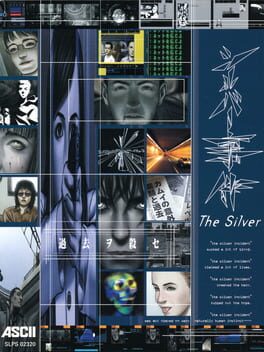
This debut game from developer Goichi Suda (also known as Suda51) follows the investigation of a series of murders which appear to match the profile of the killer responsible for a high-profile series of government assassinations twenty years prior.

Point-and-click / Adventure / Mystery
The Suiri is a mystery solving adventure game where the player tries to solve 18 different cases. Each cases consists of searching various locations for clues and then making deductions and drawing conclusions. The game is viewed from 1st-person perspective with various zoomed-in areas of interest where player can often interact with in more detail.

Point-and-click / Adventure / Visual Novel / Action / Thriller
In Danganronpa, players dive into a series of class trials and expose the lies and contradictions of their classmates to find out who's behind each grisly murder. In each trial, players must use the evidence and testimony collected during their investigation to shoot down their opponent's assertions literally.

Adventure / Visual Novel / Action / Comedy
Himitsu Sentai Metamor V is a visual novel-style adventure game starring a cast of transforming magical girls. The game is divided into chapters and follows the five members of the Metamor V squad, all of them elementary school students and classmates of Sakie's. Much of the game consists of conversation sequences with other characters; the player's reactions and choices will affect Sakie's trust level with her squadmates, and through conversations the player will also learn different key words. Both of these are important during the battle sequences, in which the player must combine words in order to create the most effective special attacks. There is no lose condition, but the player is graded on how quickly they defeat opponents, which affects trust levels and ultimately the game's ending. The later PlayStation "Deluxe" version includes an extra bonus side scenario and additional voice acting, but is otherwise the same game.

The intro starts with Maya on a helicopter being taken to see her dad who is on some kind of ship. During the journey she falls asleep and has a strange dream. Upon arriving she expresses her excitement at wanting to go swimming with the dolphins (or just one particular dolphin). Gameplay: It's divided in two parts: NPC Interaction and Exploration. In the interaction parts, Maya must talk to her father and other researchers from the underwater facility to get clues about the ruins. In the exploration parts, she explores the sea and the ruins. Maya and the dolphin must solve some puzzles together. Strangely enough, Maya doesn't use proper diving equipment, so in order to breathe, she must find some air spots in the ruins. The controls resemble those of Tomb Raider, but underwater.

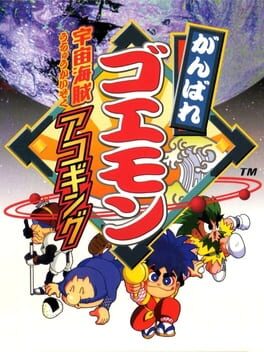
Ganbare Goemon: Uchuu Kaizoku Akogingu is a Ganbare Goemon game released for the PlayStation on March 22, 1996. This is the first Goemon game since Sasuke and Yae's appearance as playable characters that doesn't include either on the playable roster. Instead, they are replaced by the new characters Goroku and Baban. Although Sasuke and Yae are playable characters again in most future games and Goroku and Baban are never seen, mentioned or heard from again after this game. Its unknown why they never appear again, but it is assumed that many fans were upset over Sasuke and Yae being replaced. Gameplay is rather similar to Ganbare Goemon 3, as there's a main map in top-down perspective, which leads to various 2-D sidescrolling levels.