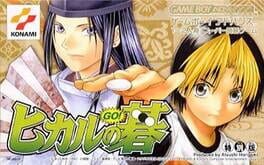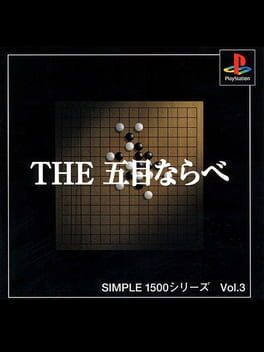

A Japanese exclusive Go game which was the third volume in the Simple 1500 Series. The game is played by two players who alternately place black and white stones on the vacant intersections of a grid of 19×19 lines. Once placed on the board, stones cannot be moved. If they are surrounded by the opponent's stones, they are captured and removed from the board. The object of the game is to surround a larger portion of the board than the opponent. When a game concludes, the controlled points are counted along with captured stones or your own stones (depending on the rule-set) and a predetermined compensation ("komi") to determine who has more points.

Quiz/Trivia / Card & Board Game / Action / Party
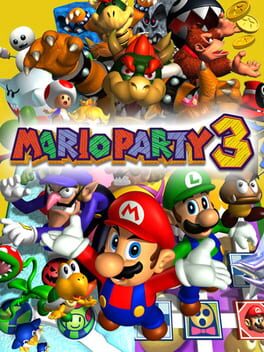
Mario Party 3 is the third and final Mario Party title for the Nintendo 64. A total of eight characters are available to choose from: Mario, Luigi, Princess Peach, Yoshi, Wario, Donkey Kong, and newcomers Waluigi and Princess Daisy. Mario Party 3 features duel maps, in which two players try to lower each other's stamina to zero using non-playable characters such as Chain Chomps. It is the first Mario Party game to feature Luigi's main voice and also it is last Mario game where Princess Daisy appears in a yellow and white dress, and with long hair, as well as the last Mario game (until New Super Mario Bros. Wii) in which Yoshi's "record-scratching" voice is used. It is also the first Mario Party game to have multiple save slots.

Sport / Quiz/Trivia / Card & Board Game
The first game based on the eponymous anime series, which centers on the strategic board game Go.

Platform / Hack and slash/Beat 'em up / Quiz/Trivia / Action
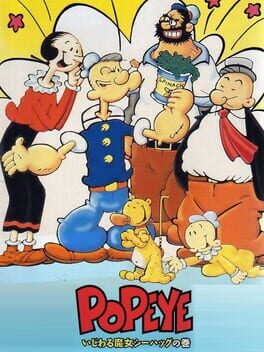
Popeye: Ijiwaru Majo Seahag no Maki is a board game and sidescroller action game in one. The goal is to recover all the hearts scattered around the game board and defeat any mini-bosses presented by Popeye villains, and then finally defeat the seahag. The game's levels which are called stages feature large level maps that appear in the form of a board game in which the player will have to take turns moving around, explore each of its spaces, and obtain the hearts of Popeye's frozen friends. There are also spaces that serves different purposes throughout the game. The beginning of each stage starts with by showing the player which character will have to be saved. Their heart the rises skyward and splits into various pieces, those pieces then scatter onto random spaces of the map which the space will appear as an enclosed heart. When on the map, the player presses the action button a wheel will appear with spaces numbered 1-6 which will help determine the player's moves throughout the game. The game had a cancelled release in North America under the title of "Popeye", but ended up being released in Brazil under said title.

Puzzle / Quiz/Trivia / Card & Board Game / Comedy / Kids
Easter Bunny's Big Day asks children to help the Easter Bunny find and deliver eggs to all the boys and girls of Easter Village. Unfortunately, the floppy-eared rabbit doesn't have enough eggs, so players will have to solve puzzles and play games to find more eggs. Multiple difficulty levels keep the action interesting for children aged four to ten, and several game modes offer additional play options. Parents can play along with children and add assistance with the "helper" feature.

Sport / Quiz/Trivia / Card & Board Game / Non-fiction
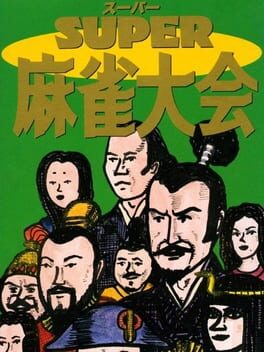
Super Mahjong Taikai is a Miscellaneous game, published by Koei, which was released in Japan in 1992. It was also a view-limited Downloadable game for the Satellaview that was broadcast in at least 4 runs between June 29, 1997 and February 21, 1998.

Quiz/Trivia / Card & Board Game / Non-fiction
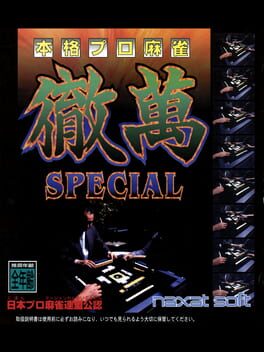
Tetsuman Special is a 4-way riichi mahjong game featuring the endorsement of the Japan Professional Mahjong League and the likenesses of 14 professional mahjong players (15 in the Saturn version). It is the third title in Naxat Soft's Tetsuman mahjong game series. There are two main play modes: Title Conquest mode tasks the player with winning against the pros to increase their rank and earn a total of 48 different professional titles; Free Game lets the player set up a more relaxed exhibition game against any set of opponents. The game also keeps detailed records on the player's performance which can be reviewed at any time.

Sport / Quiz/Trivia / Card & Board Game / Non-fiction
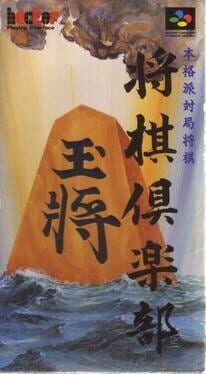
Honkakuha Taikyoku Shogi: Shogi Club is a Miscellaneous game, developed by Natsu System and published by Hect, which was released in Japan in 1995.

Sport / Quiz/Trivia / Card & Board Game / Non-fiction
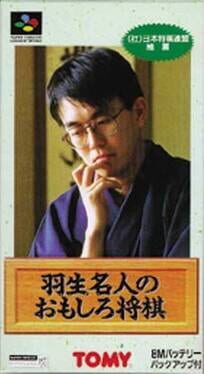
Habu Meijin no Omoshiro Shogi is a Miscellaneous game, developed by Access and published by Tomy Corporation, which was released in Japan in 1995.