Space Invaders Anniversary celebrates the 25th anniversary of the oldest Taito franchise.
Featured in
Space Invaders Anniversary celebrates the 25th anniversary of the oldest Taito franchise.
Shooter / Arcade / Action / Science fiction
Space Invaders Extreme combines the captivating essence of the original game with a stunning alliance of futuristic graphic design and cutting-edge audio. The gameplay experience has been developed to maximise on the consoles' abilities, offering players a whole new range of amazing features including a vast array of new power-ups.
Shooter / Puzzle / Arcade / Action / Science fiction
High-speed action-packed game play returns with the addition of exciting head-to-head battle modes, a challenging new time attack mode, and expanded game play progression that goes beyond Fever Time to SUPER FEVER TIME! Space Invaders Extreme 2 - faster and more exhilarating than ever before!
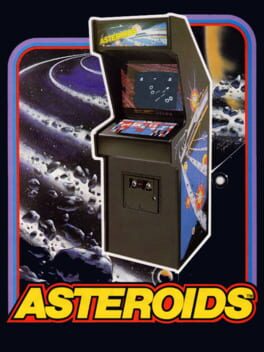
Shooter / Arcade / Action / Science fiction
Asteroids is an arcade space shooter released in November 1979. The player controls a spaceship in an asteroid field which is periodically traversed by flying saucers. The objective of the game is to destroy both, asteroids and saucers. The triangular ship can rotate left and right, fire shots straight forward, and thrust forward. Once the ship begins moving in a direction, it will continue in that direction for a time without player intervention unless the player applies thrust in a different direction. The ship eventually comes to a stop when not thrusting. The player can also send the ship into hyperspace, causing it to disappear and reappear in a random location on the screen, at the risk of self-destructing or appearing on top of an asteroid.
Shooter / Puzzle / Indie / Action / Science fiction
In this vertical scrolling spaceship shooter, you control a ship that can change its polarity at will. As blue/white, the ship can easily destroy red/black enemies, and vice versa. Bullets of your polarity can be collected to fuel your energy gauge, but those opposite will kill you. Destroying an enemy ship causes them to fire revenge bullets which can be absorbed and fired back by the player. Different difficulties exist to change exactly how you interact with polarized points, or how they appear. It is the spiritual successor to Radiant Silvergun, featuring similar level and boss design, as well as it's buddhism inspired themes and aesthetics. Both are directed by Hiroshi Iuchi, who also composed Ikaruga's soundtrack.
Shooter / Platform / Arcade / Action / Science fiction
“METAL SLUG 3”, the masterpiece in SNK’s emblematic 2D run & gun action shooting game series, still continues to fascinate millions of fans worldwide to this day for its intricate dot-pixel graphics, and simple and intuitive game controls!
Shooter / Arcade / Action / Science fiction
R-Type is set in the 22nd century, and the player flies a futuristic fighter craft called the R-9a "Arrowhead", named for its shape, and because it is the ninth model in the 'R' series of fighter craft (but it is the first of the series to actually be used in combat; the previous models were all prototypes). The mission is to 'blast off and strike the evil Bydo Empire'. The R- in the series title originally stood for "ray", as in a ray of light. It was a reference to the many different types of ray-like weapons in the first R-Type. his was later retconned in R-Type Final to refer specifically to the production code as well as a term of endearment for the player fighter craft, the "Round Canopy". The original R-Type was well received by most gaming critics. However, it was also infamous for its relentless difficulty. It earned 7th place in IGN's Top 10 most difficult games to beat. The gameplay of R-Type is noticeably distinct among shoot 'em ups. Invariably the player will lose, not because of an inequality in firepower, but because of the design of the levels themselves. There is usually a 'correct' way to get through a level, but players must learn these by experience - i.e. by losing and restarting from earlier in the level. The game innovated with its weapon system compared to contemporary shooters, featuring a chargeable shot (beam-meter), and detachable 'force' pod; levels were designed to require different tactics and ideal weapons (air-air, diagonal, or air-ground laser).
Shooter / Arcade / Science fiction
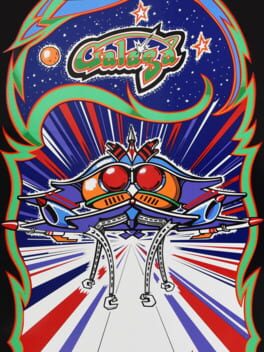
The objective of Galaga is to score as many points as possible by destroying insect-like enemies. The player controls a starfighter that can move left and right along the bottom of the playfield. Enemies swarm in groups in a formation near the top of the screen, and then begin flying down toward the player, firing bombs at the fighter. The game ends when the player's last fighter is lost, either by colliding with an enemy or one of its bullets, or by being captured. Galaga introduces a number of new features over its predecessor, Galaxian. Among these is the ability to fire more than one bullet at a time, a count of the player's "hit/miss ratio" at the end of the game, and a bonus "Challenging Stage" that occurs every few levels, in which a series of enemies fly onto and out of the screen in set patterns without firing at the player's ship or trying to crash into it. These stages award a large point bonus if the player manages to destroy every enemy. Another gameplay feature new to Galaga is the ability for enemies to capture the player's fighter. While the player is in control of just one fighter, a "boss Galaga" (which takes two shots to kill) periodically attempts to capture the fighter using a tractor beam. If successful, the fighter joins the enemy formation. If the player has more lives remaining, play resumes with a new fighter. The captured fighter flies down with the enemy that captured it, firing upon the player just like normal enemies, and can be shot and destroyed. The player can free the fighter by destroying the boss Galaga while in flight, causing the captured fighter to link up with the player's current fighter, doubling his or her firepower but also making a target twice as large. Galaga has an exploitable bug that can cause the attackers to stop firing bullets at the player, due to a coding error. In addition, similar to the famous "Split-Screen bug" in Pac-Man, a bug exists in Galaga in which the game "rolls over" from Level 255 to Level 0. Depending on the difficulty setting of the machine, this can cause the game to stall, requiring that the machine be reset or power-cycled in order to start a new game.
Shooter / Strategy / Science fiction / Survival
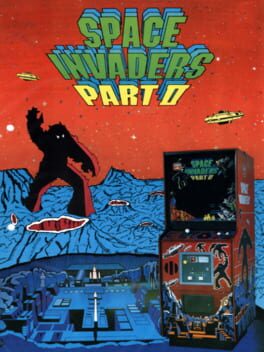
Originally called Space Invaders Part II in Japan, this is the first sequel to the coin-munching hit Space Invaders. This game is notable for introducing the concept of a cut-scene.