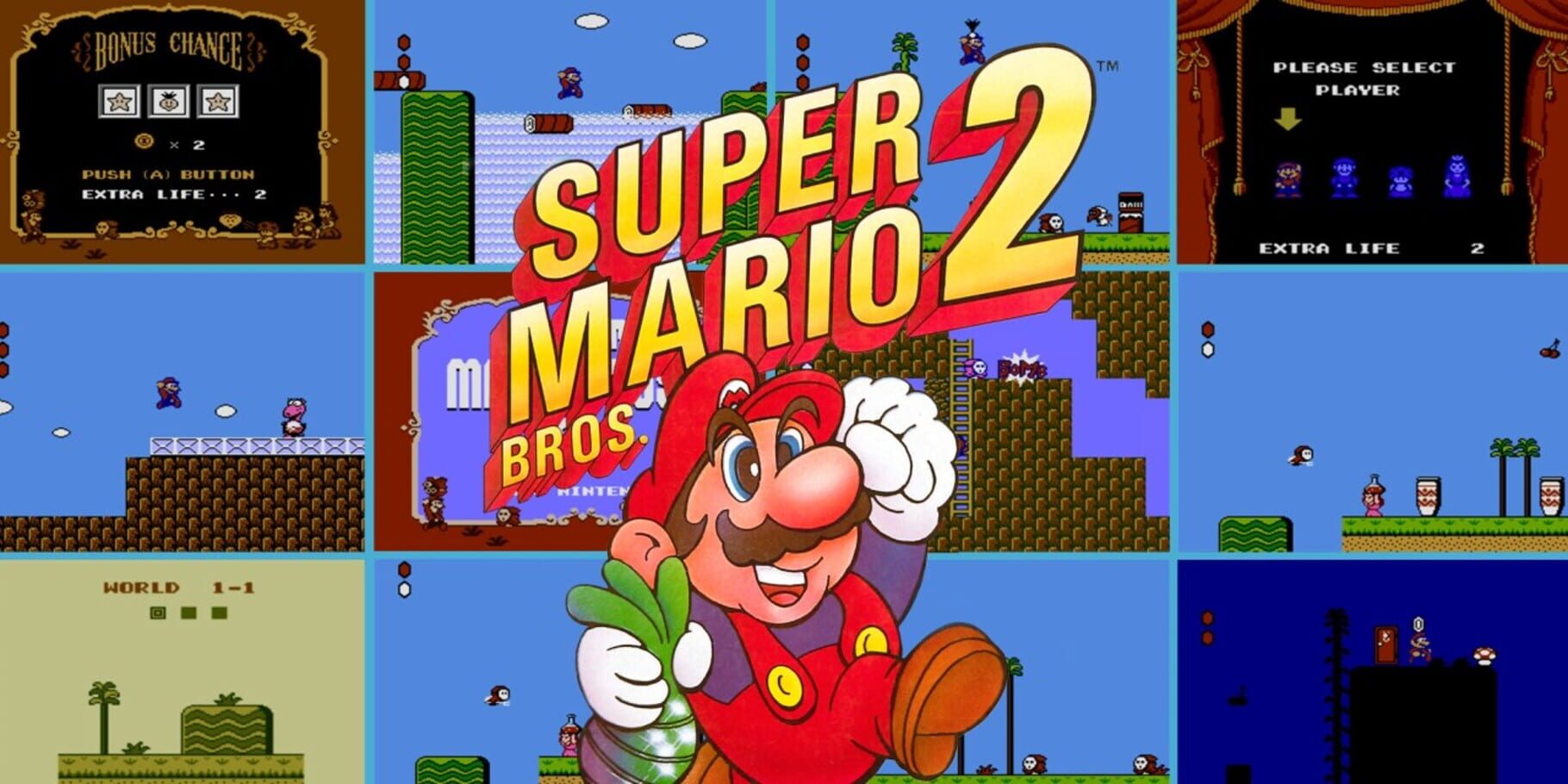

Super Mario Bros. 2, 2D platformer and sequel to Super Mario Bros. (1985), features 4 selectable characters (Mario, Luigi, Princess Peach, Toad) as they navigate the dream world of Subcon to defeat the evil toad king Wart. Super Mario Bros. 2 features different ways interacting with enemies and the world, including an object carrying mechanic and more intricate level designs.
One evening, Mario had a strange dream. He dreamt of a long, long stairway leading up to a door. As soon as the door opened, he was confronted with a world he had never seen before spreading out as far as his eyes could see. When he strained his ears to listen, he heard a faint voice saying, "Welcome to Subcon, the land of dreams. We have been cursed by Wart and we are completely under his evil spell. We have been awaiting your arrival. Please defeat Wart and return Subcon to its natural state. The curse Wart has put on you in the real world will not have any effect upon you here. Remember, Wart hates vegetables. Please help us!" At the same time this was heard, a bolt of lightning flashed before Mario’s eyes. Stunned, Mario lost his footing and tumbled upside down. He awoke with a start to find himself sitting up in his bed. To clear his head, Mario talked to Luigi, Toad and Princess Peach about the strange dream he had. They decided to go to a nearby mountain for a picnic. After arriving at the picnic area and looking at the scenery, they see a small cave nearby. When they enter this cave, to their great surprise, there’s a stairway leading up, up and up. It is exactly like the one Mario saw in his dream. They all walk together up the stairs and at the top, find a door just like the one in Mario’s dream. When Mario and his friends, in fear, open the door, to their surprise, the world that he saw in his dream spreads out before them!
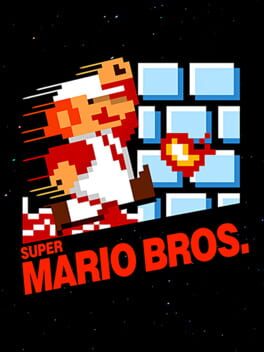
A side scrolling 2D platformer and first entry in the Super Mario franchise, Super Mario Bros. follows Italian plumber Mario as he treks across many levels of platforming challenges featuring hostile enemies to rescue Princess Peach from the evil king Bowser.

Platform / Adventure / Action / Fantasy
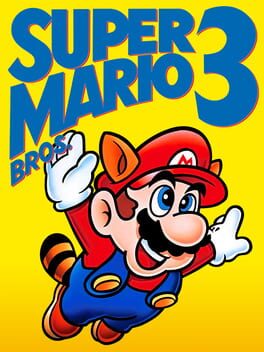
Super Mario Bros. 3, the third entry in the Super Mario Bros. series and Super Mario franchise, sees Mario or Luigi navigate a nonlinear world map containing platforming levels and optional minigames and challenges. The game features more diverse movement options and new items alongside more complex level designs and boss battles.

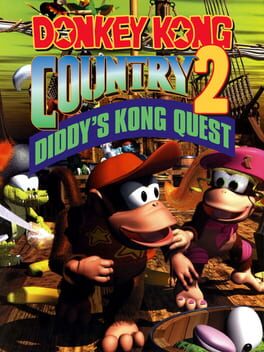
Donkey Kong Country 2: Diddy's Kong Quest is the sequel to Donkey Kong Country. It was developed by Rare and is one of the best selling Super Nintendo games.

Puzzle / Adventure / Action / Fantasy
Venture back to Hyrule and an age of magic and heroes. The predecessors of Link and Zelda face monsters on the march when a menacing magician takes over the kingdom. Only you can prevent his evil plot from shattering the land of Hyrule. In your quest, you'll venture into twisting mazes, dungeons, palaces and shadowy forests. Test your mettle with mighty swords and magical weapons. Or heft a boulder and hurl it at your enemies. If the going gets tough, dive into a river - you can swim to escape! Learn powerful spells, locate magical artifacts and solve the mysteries of the evil magician and the hidden realm of Hyrule.

Puzzle / Adventure / Action / Fantasy
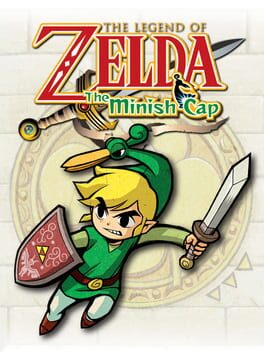
The Legend of Zelda: The Minish Cap is a top-down action adventure game that tells the origins of the evil Vaati from Four Swords. Like most other titles in the series, The Minish Cap features the fully explorable land of Hyrule, although it can be viewed from the eyes of a human or the eyes of a Minish, a race of tiny people and an alternate form that Link can transform into. Unlike the multiplayer focus of the other games in the series, The Minish Cap retains the original form of exploration and dungeons as seen in A Link to the Past, Oracle of Seasons, and Oracle of Ages, as well as returning characters and game mechanics such as Malon and the Spin Attack. New features include fusing Kinstones and shrinking to the size of a Minish.

Platform / Role-playing (RPG) / Adventure / Action / Fantasy
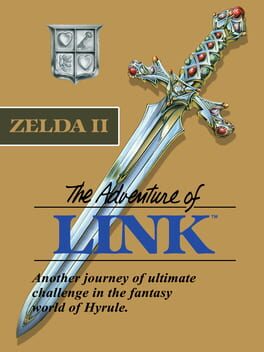
Zelda II: The Adventure of Link is the second major installment in The Legend of Zelda series and the direct sequel to the first game. Like its predecessor, it features dungeons that must be located in the overworld and searched for an item that will prove useful. However, the game presents many very important gameplay changes compared to the previous one, affecting especially the movements and the combat. Moving around the world map involves encounters with enemies that take place on a side-scrolling playfield rather than the top-down perspective for which the series became known.

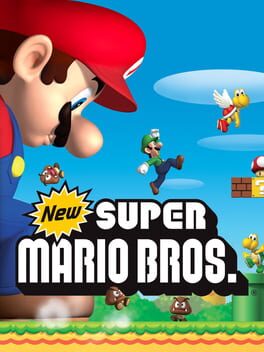
New Super Mario Bros. is a side-scrolling 2.5D action-adventure platformer game for the Nintendo DS, starring Mario and Luigi. The game features a solo story mode with Mario or Luigi, a two-player wireless game Mario Vs. Luigi, as well as a minigame mode for up to four players. The gameplay of New Super Mario Bros. is very much like that of the classic 2D platformers, mostly Super Mario Bros. and Super Mario Bros. 3, and substantially builds upon them to create gameplay both classic and contemporary. As the game is on DS, the touch screen allows players to store an additional power-up and view the distance still to go in a level.

Puzzle / Adventure / Action / Fantasy
The Legend of Zelda: Ocarina of Time is the fifth main installment of The Legend of Zelda series and the first to be released for the Nintendo 64. It was one of the most highly anticipated games of its age, and is listed among the greatest video games ever created by numerous websites and magazines. The gameplay of Ocarina of Time was revolutionary for its time, it has arguably made more of an impact on later games in the series than any of its predecessors even though they had the same cores of exploration, dungeons, puzzles and item usage. Among the gameplay mechanics, one of the most noteworthy is the time-traveling system. The game begins with the player controlling the child Link, but later on an adult Link becomes a playable character as well and each of them has certain unique abilities. Ocarina of Time also introduces the use of music to solve puzzles: as new songs are learned, they can be used to solve puzzles, gain access to new areas and warp to different locations. Dungeon exploration is somewhat more puzzle-oriented than in earlier games but they are not too complex.