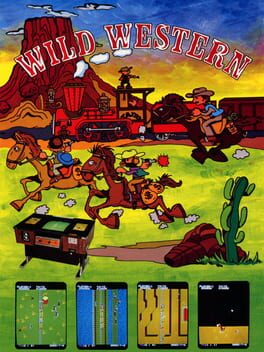
Western Gun, which served as an inspiration for Gun Fight in the USA (they're similar in gameplay and theme, but they're two different games), is a 1975 arcade shooter game designed by Tomohiro Nishikado, and released by Taito in Japan and Europe and by Midway Games in North America. It was the first video game to depict human-to-human combat, while the Midway version was also the first video game to use a microprocessor. Following its November 1975 release in North America, it went on to sell over 8,000 arcade cabinets in the United States. It was ported to the Bally Astrocade video game console as a built-in game in 1977 as well as several home computer platforms. The theme of the game involves two Old West cowboys armed with revolvers and squaring off in a duel. Whoever shoots the other cowboy first wins the duel. Unlike in a real-life duel, however, both cowboys get numerous opportunities to duel in order to score points (one point per successful draw).
Shooter / Arcade / Action / Historical
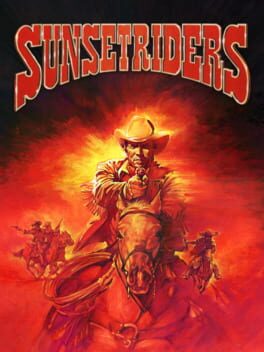
Sunset Riders is a side-scrolling run and gun video game developed and released by Konami in 1991. It is set in the American Old West, where the players take control of bounty hunters who are seeking the rewards offered for various criminals. Each bad guy has a big reward on his head, and they're helped by hordes of bandits, gunslingers, and horse thieves, so pack loads of lead.

Shooter / Hack and slash/Beat 'em up / Arcade / Action / Historical
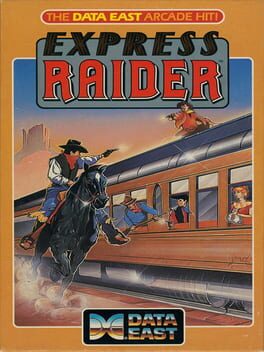
Express Raider was produced by Data East in 1986.

Shooter / Sport / Arcade / Action / Historical
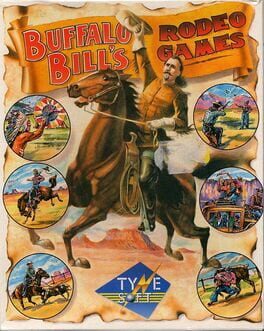
Buffalo Bill presents a collection of six Wild West themed mini-games, which hang together around humour-lead presentation and backdrops.You can play as many or as few of these as you like, and can always have another go at them if you fail. First task is to throw knives at a spinning board upon which a surely-terrified and fortunately-skinny lady is locked - make sure to adjust for the rotation that will occur in the time your shot takes to hit. You get points for missing as many times as possible before hitting. Event 2 is based on shooting ability and is in two stages. First you must shoot the targets of criminals (but not innocents) as they emerge from the ground, next you must shoot the bottles they throw at you from over the horizon. Event 3 is Calf Roping, in which you must position yourself so as to be able to throw your rope around the poor cow's neck. This is followed by Bronco Riding, in which you must adjust your balance to compensate for the Bronco trying to throw you off, by pushing the joystick out to balance two bars. Level 5 starts off like the Cow Roping, as you jump onto a Steer, before a joystick-waggling section starts. Last of all is a side-scrolling game in which you jump onto a stagecoach which has been invaded by Indians, and beat up the hijacker.

Shooter / Arcade / Action / Historical
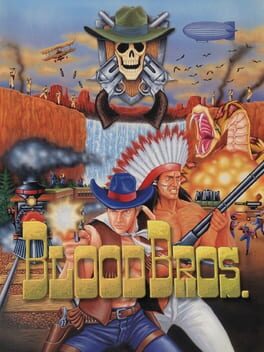
Blood Bros. is a 1990 arcade game developed and published by TAD Corporation in Japan and Europe, while it was later published in North America by Fabtek. It is a spiritual sequel to Cabal, with almost identical mechanics. A bootleg of this game is known as West Story. In 'Blood Bros., two blood brothers, a cowboy and an Indian, team-up to hunt down "the most wanted outlaw in Dodge City," Big Bad John. The gameplay mechanics are extremely similar to TAD Corp.'s earlier machine, Cabal, however this game did not seem to appear as a trackball-controlled variant. The player's characters are seen from behind. Some screens feature protective walls (which can get damaged and shattered by enemy fire). The players have limitless ammunition for their primary gun, but a limited number of sticks of dynamite, with which they must fend off enemy troops. An enemy gauge at the bottom of the screen depletes as foes are destroyed and certain structural features of the screen (usually the ones that collapse when destroyed, rather than simply shattering) are brought down. At the successful completion of a level by fully depleting the enemy gauge, all the remaining buildings onscreen collapse and the player progresses to the next stage, reprising the amusing "victory dance walk" into the horizon from Cabal. Boss fights, however, start from the beginning if a player dies. Power-ups appear from time to time, being released from objects destroyed onscreen or special characters who may run across, such as the small Indian Chief figure or warthogs. Points and weaponry can also be dispensed from the tin can, if you shoot it into the air and juggle it with subsequent shots. Some power-ups give special weapons with increased firepower, others grant extra dynamite or additional points. Two players could play this game, cooperatively, simultaneously.

Shooter / Arcade / Action / Historical
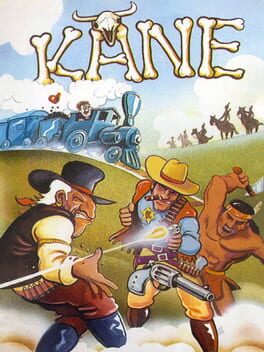
The Wagari Indians are at war with the White Man. The N.A.S.T. Railway Co. now has plans to run a railway line through their burial ground. As Marshall McGraw you must negotiate a peace treaty and take the peace tokens to the President.

Shooter / Arcade / Action / Historical
A sheriff on horseback must protect a train, located in the center of the screen, from groups of bandits. Players must avoid running into obstacles, getting shot, or allowing three bandits to board the train. A bonus game is played between rounds.

Shooter / Arcade / Action / Fantasy
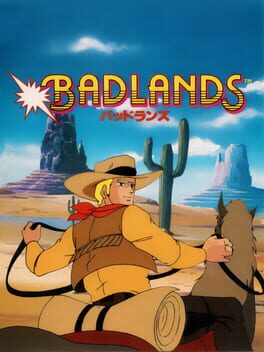
Badlands is a LaserDisc video game developed for the arcades by Konami in 1983 and released in 1984. It is plays similiar to other LaserDisc video games of the time such as Dragon's Lair and Space Ace, having players navigate through various animated sequences by pressing a single button at a precise moment.

Shooter / Arcade / Action / Historical
Wild Gunman is a game that was first released in arcades in 1974 by Nintendo. The original version of the game featured a 16mm-projection screen that had the player shoot the gunman when his eyes blinked. If he or she did so at the right moment, the gunman would be shot down and killed. If they didn't, the player would be shot (in the in-game). The arcade was large and was part of the Simulation System that also included Shooting Trainer, which was much less exciting than its dueling counterpart.