
Developed by Data East.
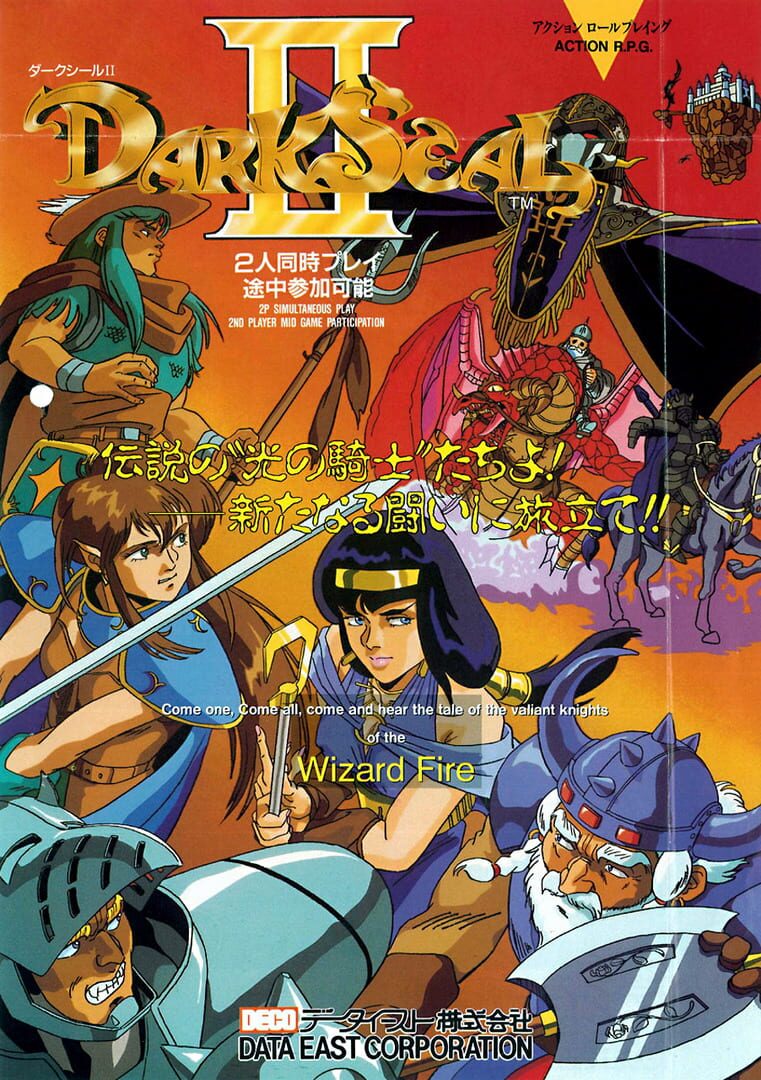
Wizard Fire was released in the US as such, although it is a direct sequel to Gate of Doom and Data East archives still refer to the game as Gate of Doom II. The series is known as Dark Seal in Japan. The class types to choose from are wizard, bard, knight, elf or dwarf. Each of the heroes has a unique standard attack, access to magic and one passive ability. The wizard does maximum magic damage, the bard is resistant to poison, the knight is immune to disease, the elf has increased mobility and the dwarf is resistant to confusion. Unlike the previous game, magic attacks are not unique to each class, though specific characters have a higher chance of using certain attacks. There is also the chance, for any class except the wizard, that the spell will fail and you will transform into a pig for a short time.
In the 4th century A.D., in the Empire of Gaul, the evil Zenon plans to take a hundred and one lives to open the Dragon Shrine and raise an army of undead. As the Sage foretold, the Shining Knights of the Wizard Fire are the ones to sweep the minions of evil.
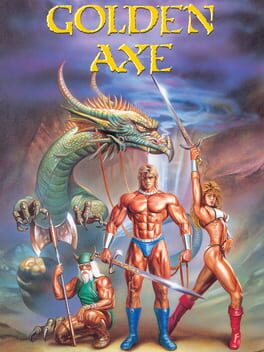
Hack and slash/Beat 'em up / Arcade / Action / Fantasy
Progress is made through the game by fighting through Death Adder's henchmen, including men armed with clubs and maces, skeleton warriors, and knights. Players are able to attack using their weapon, jump and cast spells that hurt all enemies on the screen. The force of this magic depends on the number of "bars" of magic power currently available. The bars are filled by collecting blue 'magic potions' attained by kicking little sprites who then drop the potions. These sprites appear during regular levels and during bonus stages in between levels. The male warrior Ax is able to cast earth spells. The dwarf Gilius, casts lightning spells and the female warrior Tyris casts fire magic. Each character has a different number of maximum magic bars and varying ranges of attack. Various steeds known as bizarrians are found in the game. These can be ridden when the enemy rider is knocked off, or if one is found dormant. The least powerful steed is known as the Cockatrice, which can be used to knock down enemies with a swipe of its tail. The more powerful dragon, which can either shoot fireballs or breathe fire, is found later in the game.

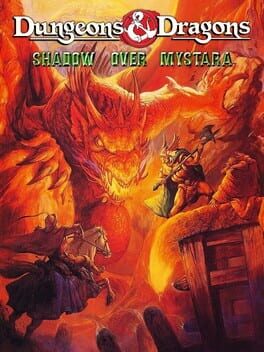
Role-playing (RPG) / Hack and slash/Beat 'em up / Arcade / Action / Fantasy
Shadow over Mystara is a side-scrolling beat-'em-up with role-play elements that make it stand out from other similar games released at the time. In addition to the original four heroes found in its predecessor, Dungeons & Dragons: Tower of Doom (Cleric, Dwarf, Elf and Fighter), Shadow of Mystara adds a Thief and a Magic-User to the selection. Furthermore, with the inclusion of two separate versions of each character's sprite set, the game allows up to two players to select the same character (in Tower of Doom each of the characters could only be selected once), effectively giving the game 12 "different" characters to choose from. The two Clerics and two Magic Users also have subtle differences within their spell books. The controls are using four buttons: Attack, Jump, Select (brings up a small inventory ring around the character allowing the player to choose what item is set in the Use slot) and Use. The Cleric, Elf and Magic-User also have two extra rings for their spells, with the Jump button used to switch from ring to ring. While the game uses the same kick harness as the previous game, the Select and Use buttons are reversed. Shadow over Mystara also introduced a selection of special moves which are executed by moving the joystick and tapping the buttons in certain combinations, in a way similar to the Street Fighter series. The characters (except for the Magic-User) have a Dashing Attack as well as a Rising Attack which can be used to combo monsters or even juggle them in the air. Most characters (again, with the exception of the Magic-User and also Cleric) also have a Megacrush, a move common to nearly all of Capcom side-scrollers, which damages all enemies standing close enough to the character but in turn also damaging the player themselves.

Hack and slash/Beat 'em up / Arcade / Action / Fantasy
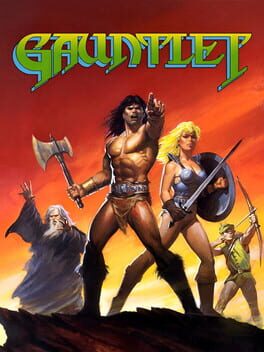
The players, up to four at once in the arcade version, select among four playable fantasy-based characters; Thor the Warrior, Merlin the Wizard, Thyra the Valkyrie, or Questor the Elf. Each character has his or her own unique strength and weaknesses. For example, the Warrior is strongest in hand-to-hand combat, the Wizard has the most powerful magic, the Valkyrie has the best armour and the Elf is the fastest in movement. Upon selecting a playable character, the gameplay is set within a series of top-down, third-person perspective mazes where the object is to find and touch the designated exit in every level. An assortment of special items can be located in each level that increase player's character's health, unlock doors, gain more points and magical potions that can destroy all of the enemies on screen. The enemies are an assortment of fantasy-based monsters, including ghosts, grunts, demons, lobbers, sorcerers and thieves. Each enters the level through specific generators, which can be destroyed. While there are no bosses in the game, the most dangerous enemy is "Death", who can not only drain a character's health, but is difficult to destroy. As the game progresses, higher levels of skill are needed to reach the exit, with success often depending on the willingness of the players to cooperate by sharing food and luring monsters into places where they can be engaged and slaughtered more conveniently. While contact with enemies reduces the player's health, it also slowly drains on its own, thus creating a time limit. When a character's health reaches zero, that character dies. The character can be revived in place with full health by spending a game credit (i.e. inserting a coin) within a certain short time window after it died. This allows even the least proficient players to keep playing indefinitely, if they are willing to keep inserting coins.

Hack and slash/Beat 'em up / Arcade / Action / Fantasy
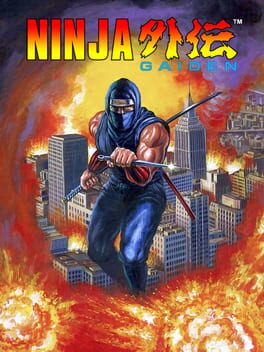
Ninja Action! The stage is set for conspiracy, mystery and evil in America. Come with Ninja Ryu as he takes you on his fateful journey. Tecmo's unique cinema display system develops the story stage by stage. You piece together the puzzle, while watching the movie-like graphics. Decide what action to take. Use the secret sword and items collected during the action scenes to fight your way to the goal!

Role-playing (RPG) / Hack and slash/Beat 'em up / Arcade / Action / Fantasy
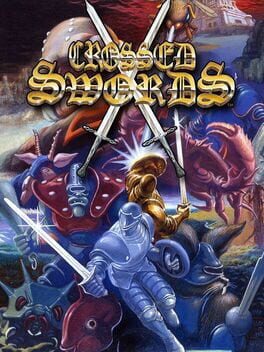
Crossed Swords is a hack & slash action RPG arcade game developed by Alpha Denshi and published by SNK for the Neo Geo arcade system in 1990 and Neo Geo console in 1991. Its gameplay was similar to SNK's earlier 1990 first-person shooter and beat 'em up game, The Super Spy, but with role-playing game elements and hack & slash combat instead of shooting and fist-fighting.[1] The game allowed cooperative gameplay with up to two players on the same screen.[1] As only the player characters' silhouettes are visible on screen as wire-frame models, much like Punch-Out!!,[2] the game's perspective may be considered either first-person[1] or third-person.[3] The game was later cited as an inspiration for the 2010 first-person fighting game Rage of the Gladiator.[4] A sequel of the game entitled Crossed Swords 2 was released in Japan on May 2, 1995 for the Neo-Geo CD, and was one of the few games designed specifically for the Neo-Geo CD, rather than being an arcade port.[5]

Role-playing (RPG) / Hack and slash/Beat 'em up / Action / Fantasy
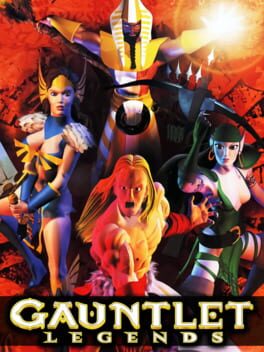
Gauntlet Legends is an arcade game released in 1998 by Atari Games. It is a fantasy themed hack and slash styled dungeon crawl game, a sequel to 1985's popular Gauntlet and 1986's Gauntlet II and marks the final game in the series to be produced by Atari Games. Its unusual features for an arcade game included passwords and characters that could be saved, enabling players to play over the course of a long period.

Role-playing (RPG) / Hack and slash/Beat 'em up / Arcade / Action / Fantasy
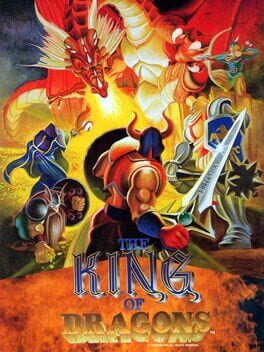
The game has 16 levels, though many are quite short. Much like Capcom's Knights of the Round, King of Dragons features an role-playing video game-like level advancement system. Points scored for killing monsters and picking up gold count towards experience, and the character gains levels at regular intervals. With each level, the character's health bar increases, other attributes such as range improve, and the character also becomes invulnerable for a few seconds. Along the way, different weapon and armor upgrades for each character may also be picked up. King of Dragons features a simple control system that consists of a single attack button, and a jump button. By pressing both buttons, the character unleashes a magical attack that strikes all enemies in screen (its strength varies according to the character used) at the expense of losing energy. The fighter, cleric and dwarf can also use their shield to block certain attacks by tilting the joystick back right before the impact. This is one of the many Capcom games to feature the yashichi power-up item. There are three such power-ups hidden throughout the game, each giving the player an extra continue.

Hack and slash/Beat 'em up / Adventure / Arcade / Action / Fantasy
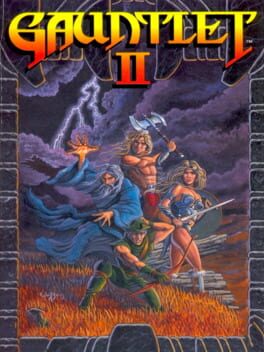
The gameplay is very similar to the original Gauntlet, a topdown dungeon crawl supporting up to four players. The biggest difference from the original game is that players can choose identical classes, instead of being limited to a particular one for each joystick; each player is differentiated by color. Thus, instead of having a "warrior", "wizard", and "valkyrie" (for instance), in Gauntlet II there could be a "red wizard", a "blue elf" and a "green warrior". In addition to the new "class" system, new level designs were added, including the possibility of encountering them in altered ways by having the play-field turned in steps of 90°. Other new features included the enemy "It", which upon contact would make a player "It" and draw all enemies towards him/her. The only way to release this curse is by touching another player or entering the exit, turning any level containing "It" into a fantasy filled game of tag. Other notable additions include the ability to ricochet shots off walls by means of a special pick-up, acid puddles that caused large, predetermined amounts of damage and a large dragon which would occupy multiple squares and require multiple hits to destroy. New level elements were also added, adding more variety to the original game. These included "all walls are invisible", "magic walls" which changed into monsters or items when hit, "stun tiles" which stunned the player, and fake exits. Another challenge in the game is the possibility to find a "secret room". This can be found by completing specific achievements within the level (e.g., "don't be fooled", means that you must find the real exit first). The secret room contains items such as food and magic potions (extra shot power, extra shot speed, extra magic power, extra speed, extra armor and extra fight power). This sequel was also the first to feature what is now known as the Gauntlet theme tune, which resembles a simplified Baroque fugue.