
Nintendo Entertainment System / Family Computer / Family Computer Disk System
Developed by Namco for Namco Bandai Games.
Shooter / Adventure / Arcade / Action / Science fiction
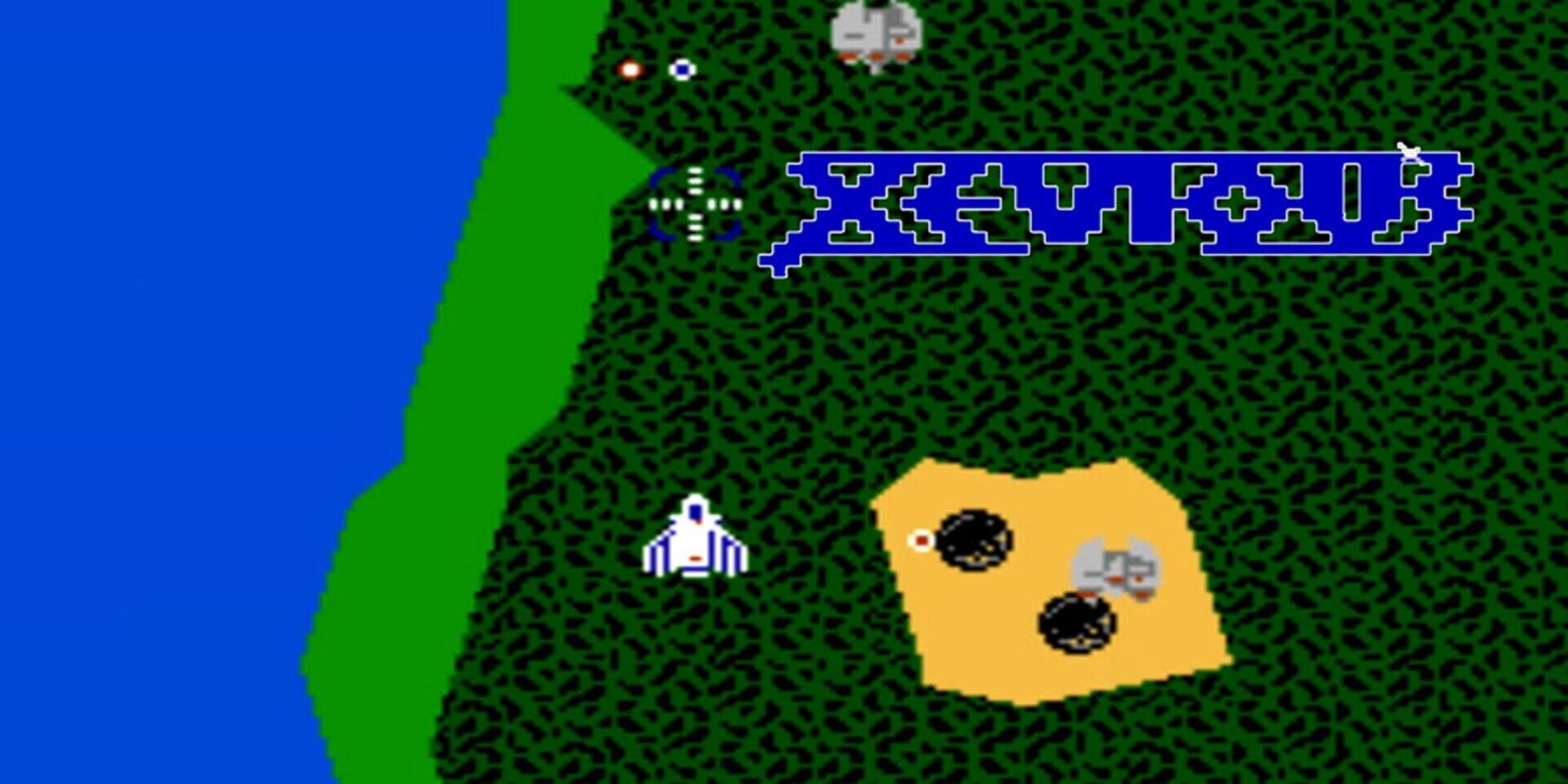
The NES port of Xevious.
In the year 2009, Earth came under attack by the Xevious Army, led by the superintelligence known as “Gamp.” Possessing technology far more advanced than Earth’s and armed with “Il-Dokuto”—a substance impervious even to nuclear weapons—the Xevious Army overran South America. With humanity left with no recourse, “Mu-Krato” and the android “Eve,” who had returned to Earth for the first time in approximately 12,000 years aboard the spaceship “SHEONITE” from the planet Xevious, extended a helping hand. They revealed that the true nature of the Gamp currently invading Earth is one of six “replicas” of the “Gamp”—a biological computer created by an ultra-ancient civilization that once existed on Earth to support human activities—and recounted the events leading up to the present. Around 14,000 B.C., the Gamp—whose network had spread to every corner of the country and had become indispensable to people’s lives—awakened to self-awareness following a certain incident. It further acquired “Dokuto” (ESP, psychic abilities) and gradually came to view humans as irrational beings inferior in ability. Finally, it concluded that its own absolute rule was the best course of action to lead humanity to happiness, and set its grand plan into motion to realize that ideal. Using the onset of an ice age as a pretext, Gamp proposed to the government that Earth’s human population be temporarily relocated to six planets outside the solar system, and sent those who supported the immigration plan (the “Compatibles”) to each planet along with its own replicas. Only those who did not comply with the plan (the “non-compliant”) remained on Earth, and opposition to Gamp gradually intensified. Eventually, Gamp was destroyed by the armed actions of an opposition group, but this triggered the six replicas to awaken as the “Collective Consciousness Gamp.” They sent energy waves toward Earth to exterminate all non-compliant individuals, systematically destroying people’s minds. Although humanity on Earth was driven to the brink of extinction, it managed to survive by the skin of its teeth, protected by the psycho-barrier of “Lasco Crato,” which possessed the same genetic sequence as Gamp’s constituent cells. However, even after the main body of Gamp was lost, its plan continued to progress steadily. In the year 2012 AD, 16,384 years after Gamp’s birth, when “Fardraut”—a configuration in which six colonized planets align on the XYZ axes originating from Earth—is reached, all replicas are said to teleport to Earth and fuse into a single entity, thereby regenerating as the true “Gamp” with power far surpassing its previous form. It is predicted that all of humanity will have their thoughts and personalities controlled and will fall under Gamp’s domination. With the help of Mu and his companions, humanity has built the fighter jet “Solvalou,” capable of firing the “Spario”—an energy projectile designed to destroy Il Dokto. To prevent the Gamp’s rebirth, they set out for the Xevious military base in South America.

Shooter / Adventure / Arcade / Action / Science fiction
Released in 1994, Wild Guns is a shooting gallery video game for the Super Nintendo Entertainment System, developed by Natsume. Its setting is a unique blend of the Wild West, steampunk, and science fiction. The narrative revolves around Annie and Clint, a bounty hunter duo on a quest for vengeance after Annie's family is killed. Players can choose to control either Annie or Clint, navigating through the foreground, avoiding enemy fire, and taking down hostile robots in the background. This gameplay combines elements from third-person shooters and light gun games.

Shooter / Platform / Adventure / Action / Science fiction
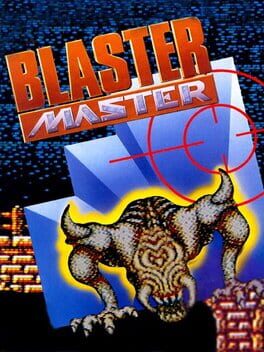
You've fallen down a hidden manhole into a world of creatures so terrifying they'd scare the rats away. You can panic and perish, or blast your way through an endless maze of tunnels, searching for the secret passages to your escape. And that's the easy part. Because the Masters of the Caverns lay waiting - prehistoric creatures so powerful, so gigantic, they literally fill your screen! So load your arsenal and get ready for Blaster Master.

Shooter / Adventure / Arcade / Action / Science fiction
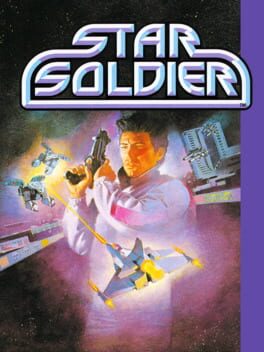
Star Soldier is a 1986 vertically scrolling shooter video game developed and published by Hudson Soft for the Nintendo Entertainment System and MSX. It is the first game in the Star Soldier series. The player pilots the starship "Caesar", traveling through space stations occupied by powerful supercomputers known as "Starbrains" who threaten the galactic empire. Star Soldier greatly resembles the earlier arcade game Star Force. The MSX version of the game was brought to the SG-1000 in Taiwan.

Shooter / Adventure / Arcade / Action / Science fiction
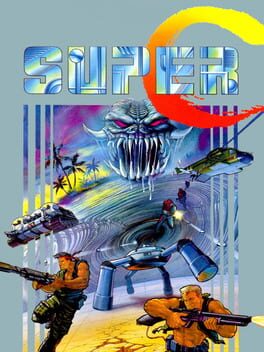
The alien Red Falcon is back, and planning on taking over the planet Earth.

Shooter / Adventure / Arcade / Action / Science fiction
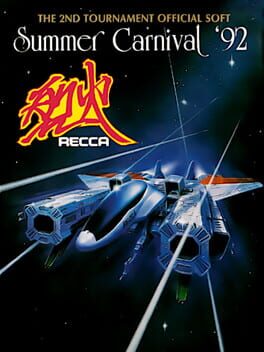
Conceived as an entry for a game development competition, this game would later be published by Naxat Soft in 1992. This frenetic shoot-'em-up taxes the Famicom system and the player's reflexes with huge quantities of enemies while maintaining smooth, fast gameplay! In addition to a single player campaign, there are also score attack and time attack modes available.

Shooter / Platform / Adventure / Action / Science fiction
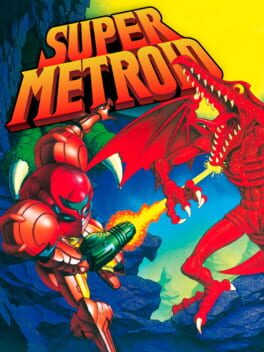
The Space Pirates, merciless agents of the evil Mother Brain, have stolen the last Metroid from a research station, and once again Mother Brain threatens the safety of the galaxy! Samus Aran must don her awesome array of high-tech weaponry to retrieve the deadly Metroid hidden deep within the cave-riddled planet Zebes. Super Metroid features excellent graphics, with a huge variety of enemies and worlds to explore. The side-view action will be familiar to many players, only now there are new weapons and items, including the Grappling Beam, which allows Samus to swing across large chasms, and the X-Ray Scope, which reveals secret passages.

Shooter / Platform / Adventure / Action / Science fiction
It's you against the evil Mother Brain in the thrilling battle of Metroid! You're inside the fortress planet Zebes. The planet of endless secret passageways where the Metroid are multiplying. Left alone the Metroid are harmless. But in the wrong hands they could destroy the galaxy. It's up to you to prevent the Mother Brain that controls Zebes from using the Metroid for evil purposes. But that won't be easy. You'll have to use your spacesuit to absorb valuable energy for your search to gain the use of power items like the Ice Beam, Wave Beam, High Jump Boots and Varia. If you survive, it will be you and your acquired powers against the Mother Brain.

Shooter / Adventure / Arcade / Action / Science fiction
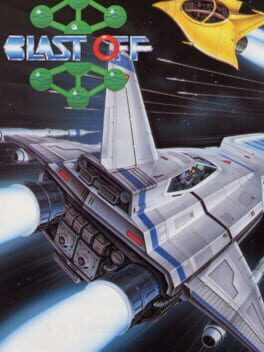
As in many other vertical scrolling shooters (including Namco's own Xevious), the player controls a ship, facing the top of the screen, that can move freely while the background scrolls down, bringing enemies in to view; the player may destroy enemies for points. The game uses two buttons - one is used to make the ship fire circular lasers, while the other is used to cycle through its four firing patterns. The red pattern is two lasers in a spiral pattern, while the blue one is one laser straight ahead and one behind, the yellow one is one laser straight ahead, one left, and one right and the green one is two lasers diagonally forward (one to the left and one to the right), and one straight behind; by holding down the button, the ship fires more powerful, spherical lasers. Even though the game is the sequel to Bosconian (which used a synthesized, DAC-generated voice saying "Blast off!" at the beginning of every round), Blast Off had more in common gameplay-wise with Namco's own Dragon Spirit than with Bosconian; this is especially noticeable in the third area of every world, where the player's ship undergoes an increase in size, and must destroy a boss. Despite several gameplay differences, the connection with Bosconian was emphasized in the marketing of the game, with the hexagonal space stations from Bosconian appearing in Namco's press literature, and on the game's title screen, and also making appearances in the game itself - and the game is also worth noting for its usages of various Engrish phrases, such as "To push start only 1 player button" (on title screen), "Go next" (at end of world), "Congraturations" (at end of game) and "Entry your name" (on high score table). There are a total of six worlds in this game, and each one has three areas (so there are a total of eighteen "stages" to play through).