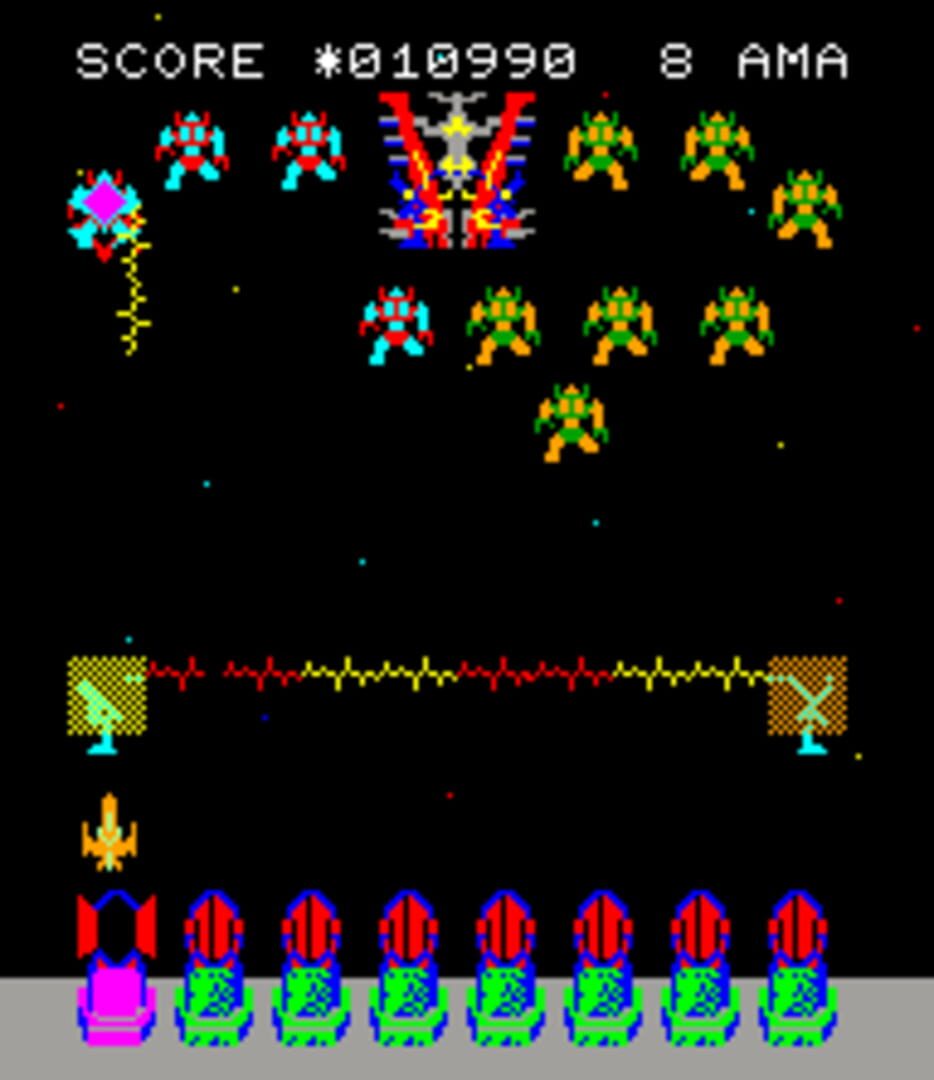
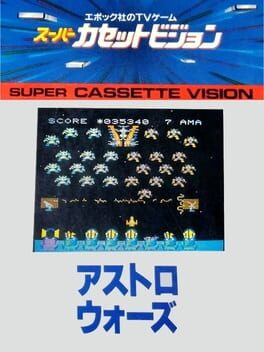
Astro Wars (subtitled Invader From Space on the title screen) is a space shooter for the Super Cassette Vision.
Screenshots
Featured in
Astro Wars (subtitled Invader From Space on the title screen) is a space shooter for the Super Cassette Vision.
Shooter / Arcade / Action / Science fiction
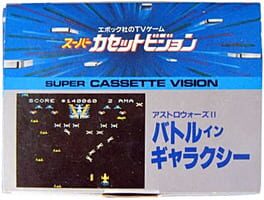
Astro Wars II: Battle in Galaxy is the follow-up to Super Cassette Vision's previous space shooter.
Shooter / Arcade / Action / Fantasy
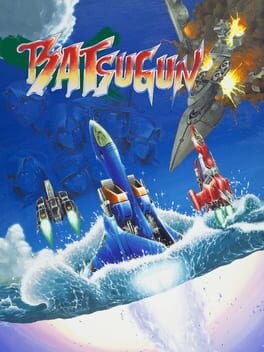
Batsugun is a vertically scrolling shoot 'em up video game created by the now-defunct Japanese game developer Toaplan. The title translates to "exceptional" or "extraordinary". It was the final game created before Toaplan's dissolution, and has been regarded as a key title in the development of the modern manic shooter, with elements of the game such as the size of the player's hitbox, the scale of their firepower, and the complexity of enemy bullet patterns all having an influence on future titles in the sub-genre. Members of the development team also went on to work on other successful manic shooters, most notably lead artist Junya Inoue.
Shooter / Arcade / Action / Science fiction
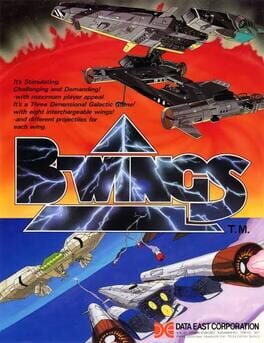
Battle Wings, known in Japan either as B-Wing (ビー・ウィング) or B-Wings (ビー・ウィングズ), is a vertically scrolling shooter first released as an arcade game by Data East in 1984. The game was ported by Data East to the Family Computer in 1986, and was Data East's very first home release for this platform. The game consists of 45 levels (30 in the Family Computer version), and no background story or plot is given. The player controls a ship called the FX-1, and collects power-up parts (called a "wing") to progress through the levels and ultimately defeat the Gobunasu armored mobile fortress in the final level. The game consists of two different top-view screen levels, where the player can press the second button to descend to the ground whenever they do not have a power-up. The player is unaffected by attacks from airborne units while they are playing on the ground level, but the ship is automatically brought back into the air after a certain period of time. The player can still be hit by attacks from ground units while they are on the ground level, and can also lose their ship by crashing into obstacles. The 8-way joystick controls the player's movements, and one button is used for shooting, and the other is used for descending to the ground (or un-equipping wings). The background image continues infinitely when the player scrolls in the horizontal directions. Completing the final level of the game causes the score counter to increase to 9,999,999 points, which the player can enter as their high score. The player can also score cheap points by equipping and un-equipping their power-up. Pressing the button twice while the un-equipping animation is occurring cause the player to gain 2,000 points. The player gains an extra life every 40,000 points, so it is possible to gain lives almost infinitely. If the player gains over 10,000,000 points in this way before completing the final level, the counter takes over 20 minutes to increase to 99,999,999 points.
Shooter / Arcade / Action / Fantasy
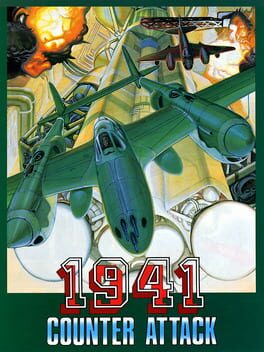
The year: 1941. The place: 20,000 feet in the air over the North Atlantic. Lightning flashes across the skies of war-torn Europe. Your mission: beat back the imperial forces before they can use their new weapon! In 1941: Counter Attack, the goal is to shoot down enemy airplanes and collect weapon power-ups. It is the prequel to 1942, and the third game in the 19XX series.
Shooter / Adventure / Arcade / Action / Science fiction
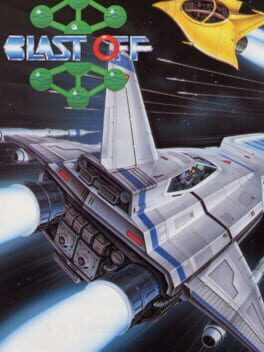
As in many other vertical scrolling shooters (including Namco's own Xevious), the player controls a ship, facing the top of the screen, that can move freely while the background scrolls down, bringing enemies in to view; the player may destroy enemies for points. The game uses two buttons - one is used to make the ship fire circular lasers, while the other is used to cycle through its four firing patterns. The red pattern is two lasers in a spiral pattern, while the blue one is one laser straight ahead and one behind, the yellow one is one laser straight ahead, one left, and one right and the green one is two lasers diagonally forward (one to the left and one to the right), and one straight behind; by holding down the button, the ship fires more powerful, spherical lasers. Even though the game is the sequel to Bosconian (which used a synthesized, DAC-generated voice saying "Blast off!" at the beginning of every round), Blast Off had more in common gameplay-wise with Namco's own Dragon Spirit than with Bosconian; this is especially noticeable in the third area of every world, where the player's ship undergoes an increase in size, and must destroy a boss. Despite several gameplay differences, the connection with Bosconian was emphasized in the marketing of the game, with the hexagonal space stations from Bosconian appearing in Namco's press literature, and on the game's title screen, and also making appearances in the game itself - and the game is also worth noting for its usages of various Engrish phrases, such as "To push start only 1 player button" (on title screen), "Go next" (at end of world), "Congraturations" (at end of game) and "Entry your name" (on high score table). There are a total of six worlds in this game, and each one has three areas (so there are a total of eighteen "stages" to play through).
Shooter / Arcade / Action / Fantasy
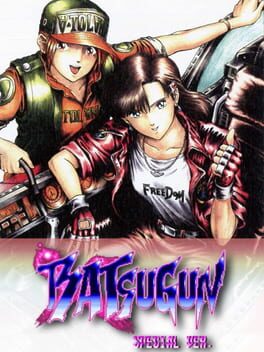
A second edition, titled Batsugun Special Version, was showcased to attendees at the 1994 AOU Show in Japan but it was never officially released in arcades, as Toaplan slid into bankruptcy and this special version appeared on the secondary video game collecting market after the company vanished. The special version featured a number of changes compared to the original version including a much smaller hitbox, a shield protecting the player from one hit, more powerful bombs, new scoring items, and the addition of multiple loops of increasing difficulty after completing the initial loop, among other changes.
Shooter / Arcade / Action / Science fiction
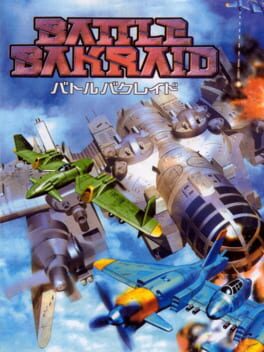
The capitalist nation of Randa has long had a history of excellence in the creation of aircraft, attracting the best of engineers in aerodynamics, artillery, and structuring from the world over. Once, even this interest had waned, until the creation of the air show Bakraid, in which the capabilities of the fighters could be demonstrated outside of simulations for all to see. Around the time of the seventh Bakraid, a nearby nation, Deneb, had attained an expansionist attitude, forcibly subjugating and annexing several of its neighbors with the assistance of the Shtarterra Security Council. Recently, Deneb has asked to participate in Bakraid. Randa's defense council, perfectly aware that this is just a pretext for Deneb to get its and the SSC's engines of war into Randan borders and more easily prosecute their war from there, give their blessing. However, the council secretly contacts the other Bakraid participants, offering even more prize money than normal if they will perform in a special version of Bakraid--genuine war conditions. In other words, use their own top-of-the-line planes to shatter Deneb's schemes. In all, nine pilots accept this plan, and begin Bakraid two weeks early to catch Deneb unaware...
Shooter / Arcade / Action / Science fiction
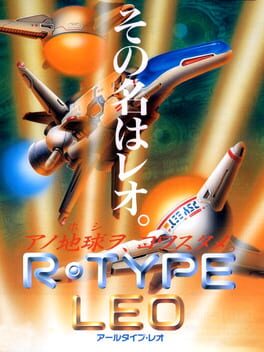
R-Type Leo is a horizontally scrolling shooter arcade game. It is a spin-off of the R-Type series and the last entry to be released in Arcades. R-Type Leo was initially an original shoot 'em up game in development by Nanao before Irem retooled it into an R-Type project instead. It is also the first R-Type game to feature simultaneous two player gameplay.