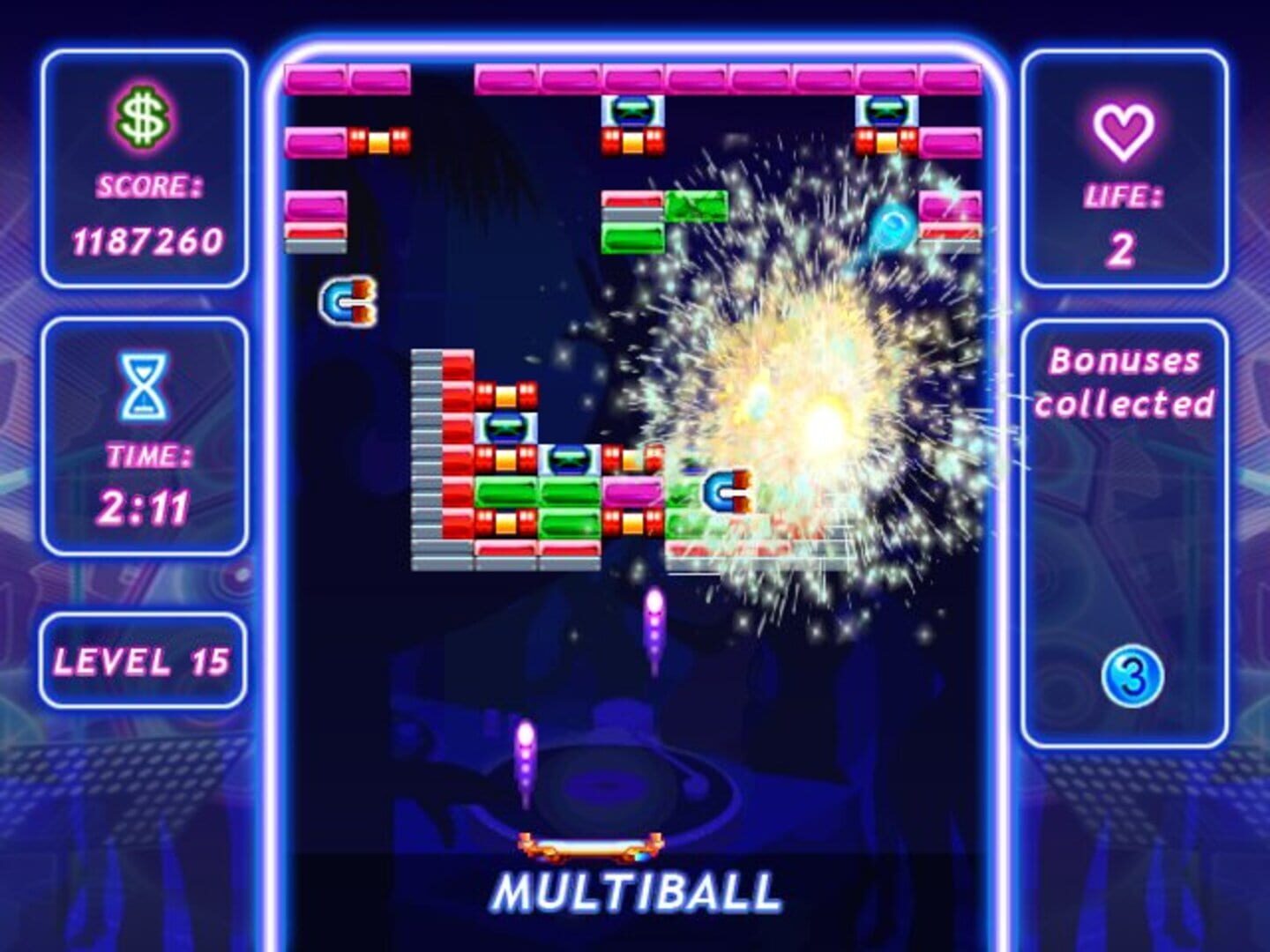
Prepare for the frenzy of the coolest block-breaker game ever. Block Breaker Deluxe is a reinvention of the classic arcade brick-breaker game with a trendy graphical style, fun atmosphere and an exclusive multiplayer mode. Lively characters and amazing graphics provide distinctive settings of the jet-set nightlife, including a cool bar, dance club, casino and more. Special bricks, multiple bonuses, secret weapons, paddle size options and ball-speed variations make this fascinating game even more challenging. The Block Breaker Deluxe rage has arrived.

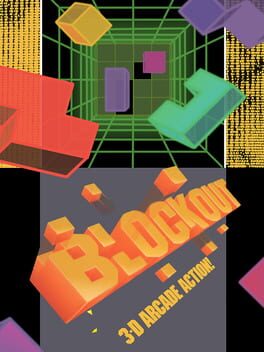
Blockout is a puzzle videogame, created in 1989 by Polish developer - California Dreams, designed by Aleksander Ustaszewski and Mirosław Zabłocki. The game is the logical extension of Tetris into the third dimension. In Tetris, the player manipulates a set of tetrominoes which fall into a two-dimensional pit (seen from the side). The aim is to solve a real-time packing problem by forming complete rows, which then disappear and score points. Poor play leads to incomplete rows, caused by inefficient arrangements of tiles; these rows do not disappear, giving the player progressively less space and less time to play subsequent pieces. Similarly, in Blockout, the player manipulates a set of polycubes which fall into a three-dimensional pit (seen from above; the pieces appear in the foreground and fall away). The pieces can be rotated around all three axes, and moved horizontally and vertically. The aim is to form complete layers.

Point-and-click / Strategy / Arcade / Action / Science fiction
Arkanoid Returns is an arcade game released by Taito in 1997 as part of the Arkanoid series. It was the fourth overall, and third to be released in arcades. The game was since ported to the PlayStation, with an updated home release being released afterwards titled Arkanoid R 2000. All versions were released exclusively in Japan, currently making it the only game in the series to never receive an international release. The enemy known as 'DOH' still did not get the message and after many years of silence decides to attack once again. The 'Vaus' space vessel better be ready to face new, yet familiar challenges, in order to stop 'DOH' once again. The gameplay remains similar to Arkanoid: Doh it Again, the previous game in the series released for the Super Nintendo, in that it features the same powerups , some re-used level designs, and the same board size. The initial arcade game contains only 50 levels, the environment changing every 9 levels.

Puzzle / Arcade / Action / Comedy
Take your best shot with energizing arcade fun! Aim, shoot, clear the orange pegs, then sit back and cheer as 10 whimsical teachers guide you to Peggle greatness. Conquer 55 fanciful levels with 10 mystical Magic Powers, racking up bonus points and shots you'll smile about for weeks. Face off against your friends in Duel Mode, or tackle 75 extra-tricky challenges. It's luck and skill and joyous thrills, and amidst all this fevered action only one question remains: Can you become a Peggle Master?

Arcade / Action / Science fiction
The objective of the game is to destroy a multilayered wall of bricks at the top the screen. Upon hitting the bricks with a ball which bounces off of a paddle at the bottom of the screen the bricks are destroyed. If the player misses the ball with his horizontally moveable paddle the ball is lost. After loosing five balls the game is over.

Shooter / Arcade / Action / Science fiction
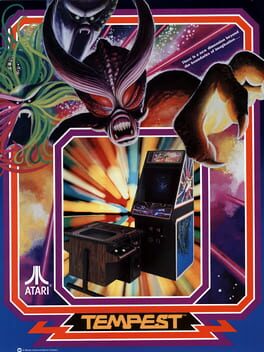
Tempest is a 1981 arcade game by Atari Inc., designed and programmed by Dave Theurer. It takes place on a three-dimensional surface, sometimes wrapped into a tube, which is viewed from one end and is divided into a dozen or more segments or lanes. The player controls a claw-shaped spaceship (named Blaster) that crawls along the near edge of the playfield, moving from segment to segment. Tempest was one of the first games to use Atari's Color-QuadraScan vector display technology. It was also the first game to allow the player to choose their starting level (a system Atari dubbed "SkillStep"). This feature increases the maximum starting level depending on the player's performance in the previous game, essentially allowing the player to continue. An official port was released for the Atari ST. An official port that bears the Atari logo was released by Superior Software for the BBC Micro and Acorn Electron in 1985, and another by Electric Dreams for the ZX Spectrum and Amstrad CPC in 1987. Versions for the Atari 2600 and 5200 were in the works in Atari, Inc. during 1984, and unfinished prototypes exist for both of them.
Puzzle / Arcade / Action / Science fiction
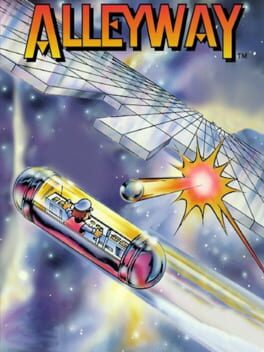
Interstellar ping-pong with a deadly energy ball! Your spaceship is at the gate of the Alleyway. Use your vessel to repel the energy ball. Atomize space grids with your return shots. Destroy the entire field and move on to even more challenging targets. You're in command in the Alleyway!