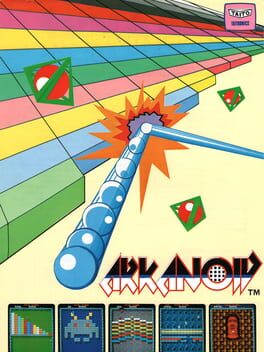
The objective of the game is to destroy a multilayered wall of bricks at the top the screen. Upon hitting the bricks with a ball which bounces off of a paddle at the bottom of the screen the bricks are destroyed. If the player misses the ball with his horizontally moveable paddle the ball is lost. After loosing five balls the game is over.

Arcade / Action / Science fiction
Arkanoid is an arcade game developed by Taito in 1986. It expanded upon Atari's Breakout games of the 1970s by adding power-ups, different types of bricks, and a variety of level layouts. The title refers to a doomed "mothership" from which the player's ship, the Vaus, escapes.

Puzzle / Arcade / Action / Science fiction
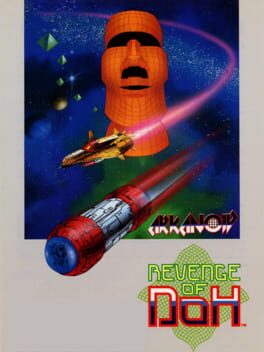
Arkanoid - Revenge of Doh (a.k.a. Arkanoid 2) is an arcade game released by Taito in 1987 as a sequel to Arkanoid. The mysterious enemy known as DOH has returned to seek vengeance on the Vaus space vessel. The player must once again take control of the Vaus (paddle) and overcome many challenges in order to destroy DOH once and for all. Revenge of Doh sees the player battle through 34 rounds, taken from a grand total of 64. NEW FEATURES: Revenge of Doh differs from its predecessor with the introduction of "Warp Gates". Upon completion of a level or when the Break ("B") pill is caught, two gates appear at the bottom of the play area, on either side. The player can choose to go through either one of the gates - the choice will affect which version of the next level is provided. The fire-button is only used when the Laser Cannons ("L") or Catch ("C") pill is caught. The game also features two new features for bricks. Notched silver bricks, like normal silver bricks, take several hits to destroy. However, after a short period of time after destruction, they regenerate at full strength. Fortunately, clearing a level does not require that any notched bricks be destroyed. Also, some bricks move from side to side as long as their left and/or right sides are not obstructed by other bricks. The US version features an entirely different layout for Level 1 that feature an entire line of notched bricks, with all colored bricks above it moving from side to side. The game features a mini-boss in the form of a giant brain, which will help you practice for DOH. Home versions of Revenge of DOH also featured a level editor, where players could create their own levels or edit and replace existing levels, with the exception of two levels: the mini-boss and DOH.

Shooter / Arcade / Action / Science fiction
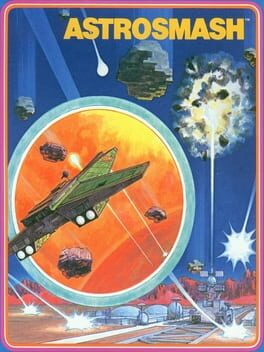
In Astrosmash you control a laser canon at the bottom of the screen; your goal is to earn as many points as possible by destroying the various incoming meteors, bombs, and other objects. Points are earned for destroying objects, while points are lost for letting them get past you. Meteors are the most common item you need to defend yourself against. They come in various sizes and colors, and some even split into two smaller meteors when shot. Mixed in with the meteors are white spinning bombs. While letting a meteor get past you will only lower your score, you have to shoot the spinners. If one gets past, you will lose a life. On the more difficult levels, ufo's and guided missiles will also appear occasionally and attempt to destroy your canon.

Point-and-click / Strategy / Arcade / Action / Science fiction
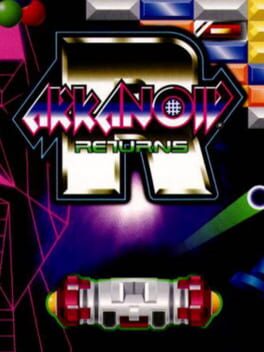
Arkanoid Returns is an arcade game released by Taito in 1997 as part of the Arkanoid series. It was the fourth overall, and third to be released in arcades. The game was since ported to the PlayStation, with an updated home release being released afterwards titled Arkanoid R 2000. All versions were released exclusively in Japan, currently making it the only game in the series to never receive an international release. The enemy known as 'DOH' still did not get the message and after many years of silence decides to attack once again. The 'Vaus' space vessel better be ready to face new, yet familiar challenges, in order to stop 'DOH' once again. The gameplay remains similar to Arkanoid: Doh it Again, the previous game in the series released for the Super Nintendo, in that it features the same powerups , some re-used level designs, and the same board size. The initial arcade game contains only 50 levels, the environment changing every 9 levels.

Shooter / Arcade / Action / Science fiction
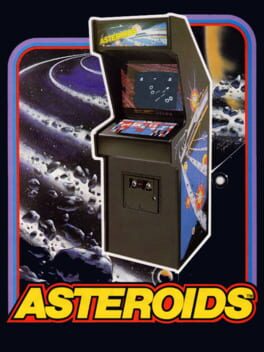
Asteroids is an arcade space shooter released in November 1979. The player controls a spaceship in an asteroid field which is periodically traversed by flying saucers. The objective of the game is to destroy both, asteroids and saucers. The triangular ship can rotate left and right, fire shots straight forward, and thrust forward. Once the ship begins moving in a direction, it will continue in that direction for a time without player intervention unless the player applies thrust in a different direction. The ship eventually comes to a stop when not thrusting. The player can also send the ship into hyperspace, causing it to disappear and reappear in a random location on the screen, at the risk of self-destructing or appearing on top of an asteroid.

Shooter / Arcade / Action / Science fiction
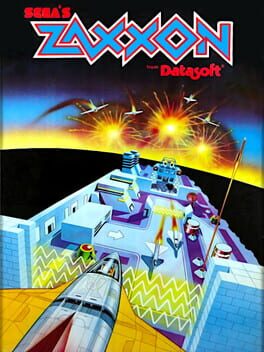
Zaxxon is a 1982 isometric shooter arcade game developed and released by Sega. The game gives the player the experience of flying a fighter craft through a fortress while shooting at enemy entities (missiles, enemy gunfire, etc.) The object of the game is to hit as many targets as possible without being shot down or running out of fuel, which can be replenished paradoxically, by blowing up fuel drums.

Shooter / Arcade / Action / Science fiction
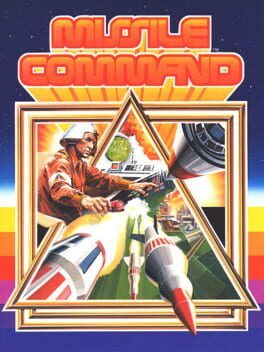
As a regional commander of three anti-missile batteries, the player must defend six cities in their zone from being destroyed. The player's six cities are being attacked by an endless hail of ballistic missiles, some of them even splitting like multiple independently targetable reentry vehicles (MIRVs). New weapons are introduced in later levels: smart bombs that can evade a less than perfectly targeted missile, and bomber planes and satellites that fly across the screen and launch missiles of their own.

Shooter / Arcade / Action / Science fiction
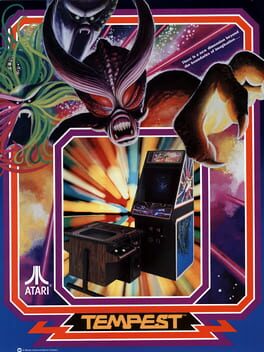
Tempest is a 1981 arcade game by Atari Inc., designed and programmed by Dave Theurer. It takes place on a three-dimensional surface, sometimes wrapped into a tube, which is viewed from one end and is divided into a dozen or more segments or lanes. The player controls a claw-shaped spaceship (named Blaster) that crawls along the near edge of the playfield, moving from segment to segment. Tempest was one of the first games to use Atari's Color-QuadraScan vector display technology. It was also the first game to allow the player to choose their starting level (a system Atari dubbed "SkillStep"). This feature increases the maximum starting level depending on the player's performance in the previous game, essentially allowing the player to continue. An official port was released for the Atari ST. An official port that bears the Atari logo was released by Superior Software for the BBC Micro and Acorn Electron in 1985, and another by Electric Dreams for the ZX Spectrum and Amstrad CPC in 1987. Versions for the Atari 2600 and 5200 were in the works in Atari, Inc. during 1984, and unfinished prototypes exist for both of them.