Similar Games
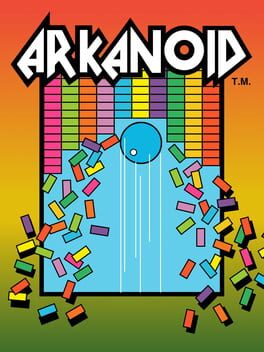
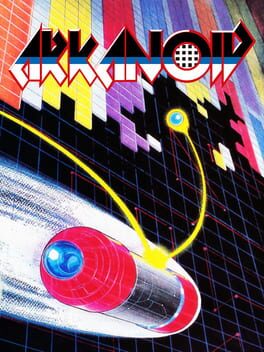
NES port of Arkanoid. The original Breakout concept involves controlling a bat at the bottom of the screen and using it to catch and direct a ball so as to hit all the bricks which are arranged at the top of the screen. It was unpopular for over a decade, before Taito revived it with some new ideas in this arcade game. The game's plot redefines the bat as a Vaus spaceship, the ball as an energy bolt, and the bricks form a mysterious wall stopping the ship from progressing to safety. By the mid-80s, power-ups were popular in most types of arcade games, and Arkanoid features them. They are caught by positioning the bat below them as they fall (meaning that you risk missing the ball if you go for them at the wrong time). The power-ups include lasers (which are mounted to each side of the ship and allow you to shoot out the blocks), a catching device (so as to be able to fire the ball off at a different angle every time you hit it) and one that slows the bolt down.
Arcade / Action / Science fiction
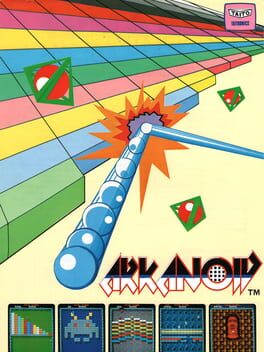
Arkanoid is an arcade game developed by Taito in 1986. It expanded upon Atari's Breakout games of the 1970s by adding power-ups, different types of bricks, and a variety of level layouts. The title refers to a doomed "mothership" from which the player's ship, the Vaus, escapes.
Puzzle / Arcade / Action / Science fiction
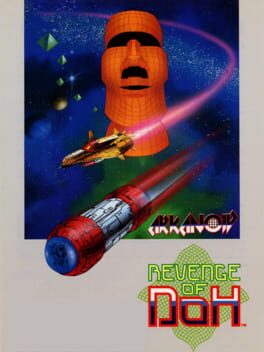
Arkanoid - Revenge of Doh (a.k.a. Arkanoid 2) is an arcade game released by Taito in 1987 as a sequel to Arkanoid. The mysterious enemy known as DOH has returned to seek vengeance on the Vaus space vessel. The player must once again take control of the Vaus (paddle) and overcome many challenges in order to destroy DOH once and for all. Revenge of Doh sees the player battle through 34 rounds, taken from a grand total of 64. NEW FEATURES: Revenge of Doh differs from its predecessor with the introduction of "Warp Gates". Upon completion of a level or when the Break ("B") pill is caught, two gates appear at the bottom of the play area, on either side. The player can choose to go through either one of the gates - the choice will affect which version of the next level is provided. The fire-button is only used when the Laser Cannons ("L") or Catch ("C") pill is caught. The game also features two new features for bricks. Notched silver bricks, like normal silver bricks, take several hits to destroy. However, after a short period of time after destruction, they regenerate at full strength. Fortunately, clearing a level does not require that any notched bricks be destroyed. Also, some bricks move from side to side as long as their left and/or right sides are not obstructed by other bricks. The US version features an entirely different layout for Level 1 that feature an entire line of notched bricks, with all colored bricks above it moving from side to side. The game features a mini-boss in the form of a giant brain, which will help you practice for DOH. Home versions of Revenge of DOH also featured a level editor, where players could create their own levels or edit and replace existing levels, with the exception of two levels: the mini-boss and DOH.
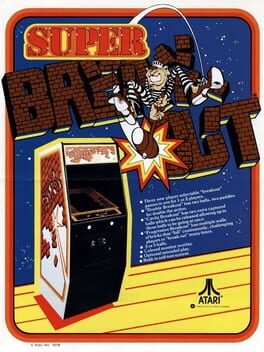
Super Breakout is an arcade game released by Atari in 1978. It utilizes a Motorola M6502 (running up at 375 KHz) and, as the name suggests, is the sequel to Breakout, which was released two years earlier. There are three different modes to choose from: Double Breakout, the playfield for which contains in fifty-two orange blocks (5-14 points), fifty-two green blocks (1-6 points), two paddles and two balls, Cavity Breakout, which contains in forty-four orange blocks (7-21 points), and fifty-two green blocks (1-9 points), one paddle, and three balls (the second and third of which have to be freed before they come into play) and Progressive Breakout which contains fifty-two blue blocks (7 points) and fifty-two green blocks (5 points), one paddle, and one ball - and the blocks shall be lowered down towards the paddle, at a rate determined by the number of times the ball lands on your paddle, but as the ball destroys them, additional rows of blocks shall appear at the top of the screen and be lowered down towards the paddle at an increasing rate. This is also the only mode for which it's possible for a player to receive an infinite amount of points by playing, but the score display shall roll over at 10000.
Point-and-click / Puzzle / Arcade / Kids / Party
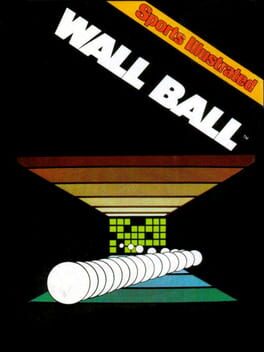
Break through the "flat" habit and experience a new dimension in video games. Play with the speed, control, and skill of handball, but without leaving home. Start slow or start fast, but don't be surprised if WALLBALL gives you a good workout! Wallball - 9 levels of 3-D racquet-and-ball simulation for the Atari 2600.
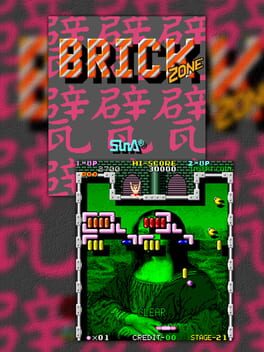
Breakout-style game by SunA Co. that features several famous arts in the background (some with nudity) and some well-known songs such as "Chorando Se Foi"/"Lambada" and "Ode to Joy". As you progress through the stages, the player will also come across bizarre bosses, such as a clown's head with stretching arms.
Block Kuzushi Kowashite Help! is a wacky & fun breakout game in which 1 or 2 players can play (in cooperative mode) to advance through the game levels.