

Dokidoki Shutter Chance☆ is a jigsaw puzzle game with a competitive action twist, one of many such games produced by Nippon Ichi. Two players compete to assemble three small picture puzzles as quickly as possible. Placing pieces will earn energy to use items which can help that player or hinder their opponent, and each of the nine playable characters has a different selection of items available. The game includes a single-player story mode in which Shunsuke challenges a series of girls to puzzle matches; if he wins, the girl allows her photo to be taken, which the player can adjust the framing of and save to an album. There is also a two-player versus mode where any character and set of puzzles can be chosen.
Shunsuke Saeki is a photographer with Monthly Photo School, but he's long been frustrated with their strict rules and longs to take photos of a particular favorite subject: cute young girls in swimsuits. Coincidentally, an opportunity to do just that has appeared, but then he realizes he doesn't know any girls who could model for the photographs! With only 10 days until the deadline, he'll need to do whatever he can to find willing models and get the pictures he needs.
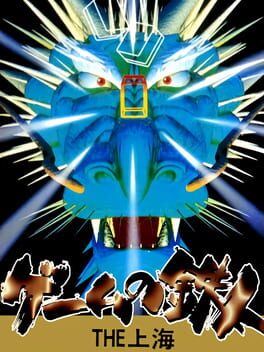
Game no Tetsujin: The Shanghai is a Puzzle game, published by SunSoft, which was released in Japan in 1995.


Puzzle / Arcade / Card & Board Game / Comedy
Bishi Bashi Special is a compilation (and conversion) of the Konami arcade titles Bishi Bashi Champ, Super Bishi Bashi Champ and Handle Champ. Gameplay is made up of tons of mini games, all of which use a simple 3-button interface that mimics the arcade originals. The mini games encompass a wide variety of button-mashing, timing and button combination games. The games themselves can be anything from making hamburgers, throwing a pie down a church aisle to balancing a car on a floating narrow gravel road and much more. The game can be played alone, vs a computer player or play up to eight people using a multi-tap and three controllers.

Puzzle / Strategy / Card & Board Game / Comedy / Kids
"GORYUZIN ELECTRO" is a board game acknowledged for its quality by the Good Toy Committee in Japan in 1997. Based on the legend of the dragon, you have to compete connecting special frames and see to what extend can you proceed into your opponent's territory. No matter how many times you play, it is a fun game for everyone. The gameplay is difficult to explain, the goal of the game is to use all of the player pieces or use the ones that the player needs to reach to other part of the board, (for example the player starts in the bottom of the screen and have to reach the top) the harder part is to that before the opponent do it, both players compete to use their pieces to create obstacles that avoid the opponent to reach the other side, using the opening (that is too the closing piece) to close the line and get a point (or more depending of the pieces used). The game got a challenging gameplay but the difficulty level is really hard.

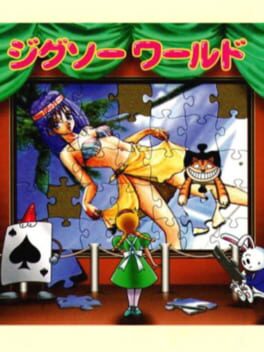
Jigsaw Island is a jigsaw puzzle game, and the third title in Nippon Ichi's jigsaw series. As in Jigsaw Party and Jigsaw World, it combines the jigsaw puzzle with elements of arcade puzzle games, tasking two players (or a player and the computer) with solving a set of puzzles as quickly as possible. Pieces are supplied to each player in a specific order, and there are also power-ups that can be used to hinder the other player. A localize port removing the anime storyline, "Jigsaw Madness" was released in the west.

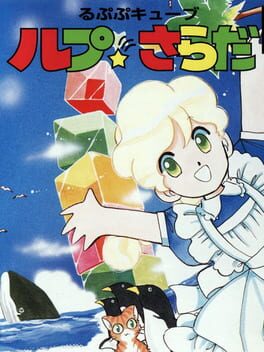
Rupupu Cube: Lup Salad is a block-pushing puzzle game developed by Fupac for the PlayStation in Japan only until it offered in the US through PSN Import Classic. It has been ported to both the DS and the PSP in Japan as well. The characters were designed by Izumi Takemoto.

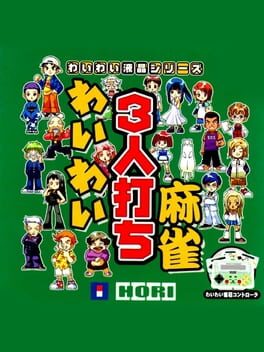
Wai Wai 3-nin Uchi Mahjong (also known as Wai Wai Sanninuchi Mahjong) is a 3-Player mahjong game that allows up to 3 human players to play at the same time using the multi-tap function. The game features 9 different characters to choose and different game modes. Mahjong is a game for four players that originated in China. Mahjong involves skill, strategy, and calculation, as well as a certain degree of chance. Depending on the variation which is played, luck can be anything from a minor to a dominant factor in success. In Asia, mahjong is also popularly played as a gambling game. In the game, each player is dealt either thirteen or sixteen tiles in a hand (depending on the variation being played). On their turn, players draw a tile and discard one, with the goal of making four or five melds (also depending on the variation) and one pair, or "head". Winning comes "on the draw", by drawing a new or discarded tile that completes the hand. Thus a winning hand actually contains fourteen (or seventeen) tiles. 3-Player (or 3-ka) Mahjong is a simplified 3-person Mahjong which involves hands of 13 tiles, and total tiles of 84 on the table and uses Joker tiles as well. It only includes the tong zhi tiles or circular shapes of patterns on the tiles for which is different from the conventional Chinese mahjong which has bamboo patterns, 10-thousand and the tong zhi tiles. It has jackpot or Royal Flush rules of winning, in which whoever accumulates a point of 10 is considered to hit the jackpot, with that some would double the winning stake. There are advantages of playing this version of game because you need fewer people to start a game and the turnaround time of a game is short, hence it is considered a speedfast game.

Things fall puzzle-battle to fight schoolgirl eight 6 units closed betting honor and pride of the affiliation. Adopt a simple, straightforward rules to manipulate the "ball" has fallen from the top of the field becomes two pair, side-by-side to erase the "balls" of the same color. Let's storm the lumps "disturb" a lot of the other party caused the chain stretch and rotate the ball well two types of "lumps" small "lumps" large.