

Game no Tetsujin: The Shanghai is a Puzzle game, published by SunSoft, which was released in Japan in 1995.
Screenshots & Artwork
Featured in
Game no Tetsujin: The Shanghai is a Puzzle game, published by SunSoft, which was released in Japan in 1995.

Puzzle / Strategy / Card & Board Game / Comedy / Kids
"GORYUZIN ELECTRO" is a board game acknowledged for its quality by the Good Toy Committee in Japan in 1997. Based on the legend of the dragon, you have to compete connecting special frames and see to what extend can you proceed into your opponent's territory. No matter how many times you play, it is a fun game for everyone. The gameplay is difficult to explain, the goal of the game is to use all of the player pieces or use the ones that the player needs to reach to other part of the board, (for example the player starts in the bottom of the screen and have to reach the top) the harder part is to that before the opponent do it, both players compete to use their pieces to create obstacles that avoid the opponent to reach the other side, using the opening (that is too the closing piece) to close the line and get a point (or more depending of the pieces used). The game got a challenging gameplay but the difficulty level is really hard.

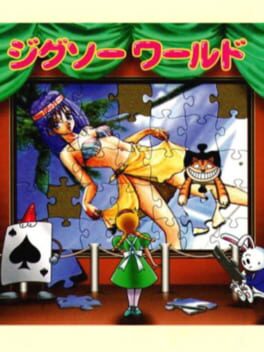
Dokidoki Shutter Chance☆ is a jigsaw puzzle game with a competitive action twist, one of many such games produced by Nippon Ichi. Two players compete to assemble three small picture puzzles as quickly as possible. Placing pieces will earn energy to use items which can help that player or hinder their opponent, and each of the nine playable characters has a different selection of items available. The game includes a single-player story mode in which Shunsuke challenges a series of girls to puzzle matches; if he wins, the girl allows her photo to be taken, which the player can adjust the framing of and save to an album. There is also a two-player versus mode where any character and set of puzzles can be chosen.

Puzzle / Arcade / Card & Board Game / Comedy
Bishi Bashi Special is a compilation (and conversion) of the Konami arcade titles Bishi Bashi Champ, Super Bishi Bashi Champ and Handle Champ. Gameplay is made up of tons of mini games, all of which use a simple 3-button interface that mimics the arcade originals. The mini games encompass a wide variety of button-mashing, timing and button combination games. The games themselves can be anything from making hamburgers, throwing a pie down a church aisle to balancing a car on a floating narrow gravel road and much more. The game can be played alone, vs a computer player or play up to eight people using a multi-tap and three controllers.
Card & Board Game / Non-fiction
Pro Mahjong Kiwame Plus is a mahjong game, and is the first game in the series released for the Sony PlayStation console. The game features 16 different real mahjong players as opponents and the game mode is a 4 player vs mahjong. The game features 3 game modes: Professional, Gamble & Training.

Card & Board Game / Non-fiction
Simple 1500 Series vol. 39: The Mahjong 2 is a four players mahjong game in which the player can compete against three computer opponents to see if he can win the matchs. The game features also a quiz mode and a tutorial.
Pro Mahjong Kiwame is a four player Riichi mahjong game, unlike most one-on-one Mahjong games released at the time and the modern casual games. Players take and discard tiles until they've completed hands by forming groups and pairs.

Card & Board Game / Non-fiction
Pro Mahjong Kiwame Plus II is a mahjong game and is the second game in the series released for the Playstation One console. The game features 16 different real mahjong players as opponents and the game mode is a 4 player vs mahjong. The game got 3 game modes: Professional, Gamble & Training. Mahjong is a game for four players that originated in China. It was called, meaning sparrow in ancient China, which is still the name most commonly used in some southern Chinese dialects such as Cantonese and Minnan, as well as in Japanese. However, most Mandarin-speaking Chinese now call the game má jiàng. Mahjong involves skill, strategy, and calculation, as well as a certain degree of luck (depending on the variation played, luck can be anything from a minor to a dominant factor in winning). In Asia, mahjong is also popularly played as a gambling game. In the game, each player is dealt either thirteen or sixteen tiles in a hand, depending on the variation being played. On their turn, players draw a tile and discard one, with the goal of making four or five melds (also depending on the variation) and one pair, or "head". Winning comes "on the draw" by drawing a new or discarded tile that completes the hand. Thus, a winning hand actually contains fourteen (or seventeen) tiles.