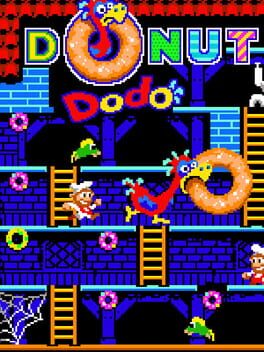
Donkey Kong is a Game Boy game which starts out with the premise of being a straight remake of the original Donkey Kong arcade game. Although at first it appears to be just a port, the familiar levels from the arcade game are just a prelude to the real platform jumping adventure. There are 97 levels spread out over 9 worlds. These levels are much more complex than the originals, featuring scrolling backgrounds, numerous objects to collect, and enemies to avoid. Along the way, you will encounter several boss style battles with Donkey Kong, as well. When played on a Super Game Boy, the game is colorized, digitized speech is added and the ending music takes advantage of the SNES sound chip.
The large ape Donkey Kong kidnaps Mario's lady friend Pauline and carries her off to a construction site. In a repeat of the 1981 arcade classic, Mario follows him up to the highest point and makes Donkey Kong fall off the platforms by pulling out the rivets supporting them, causing Donkey Kong to fall a height of 100m, reuniting Mario and Pauline, just like the events that took place 13 years ago. However, Donkey Kong unexpectedly recovers, takes Pauline, and escapes with her into the Big-City. Mario pursues the two.
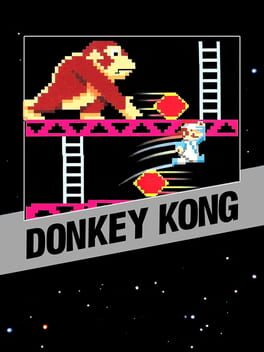
Donkey Kong has kidnapped Pauline, and it is up to Mario, the fearless carpenter, to come to her rescue. Throwing fate to the wind, Mario tries desperately to climb the labyrinth of structural beams from the top of which Donkey Kong taunts him. Help our hero ascend the metal structure by dodging an assortment of fireballs, steel beams, and exploding barrels the angry ape hurls at him. Prepare yourself for a never-ending adventure as Donkey Kong takes Pauline away to the next level every time Mario gets to the top. Based on the arcade game of the same name, this classic will keep hardcore and casual gamers entertained for hours. This Donkey Kong port differs from the arcade game, having only three stages instead of four.

Platform / Puzzle / Adventure / Action / Comedy
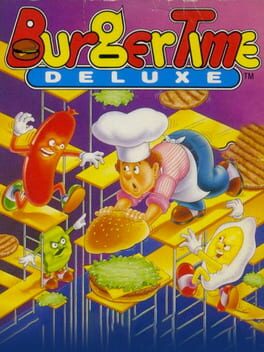
Based on BurgerTime, the Arcade classic from 1982, BurgerTime Deluxe once again puts you in the role of chef Peter Pepper, a guy who can really build a burger. You maneuver the cook up and down ladders and left and right across floors in order to walk across various parts of giant hamburgers, such as large lettuce, big buns and massive meat patties. After you cross any section of any hamburger, it will drop one level and push any other burger part within that stack down a floor as well. The object of the game is to build all the hamburgers in each stage by dropping all the makings of each burger into completed stacks at the bottom of the screen. As you go about your burger building business, Food Foes Mr. Pickle, Mr. Egg and Mr. Hot dog (also known as Frank N. Furter) will chase after you. You can destroy these culinary cutups by trapping them in falling burger parts or by tricking them into walking on a burger part you are in the process of dropping. To freeze the Food Foes, you can sprinkle a dash of pepper on them. You begin the game with a small pepper supply and can pick up additional pepper shakers that appear throughout the levels. You can also pick up bonus points (in the guise of cups and saucers) and extra lives. Unlike the original BurgerTime, which had less than 10 different non-scrolling screens, BurgerTime Deluxe has seven levels with four stages in each level for a grand total of 28 screens, most of which scroll to some degree. A password feature enables you to return to the beginning of last level you played. Also, this version of the game features a two-player competitive mode (as long as you have two copies of the game, an extra Game Boy, and a link cable).

Platform / Puzzle / Arcade / Action / Comedy
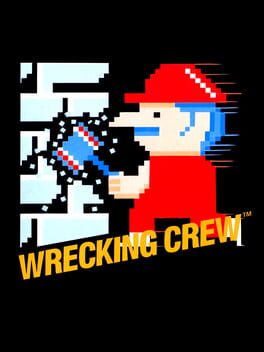
Wrecking Crew is a platform action game for one or two players. The player controls Mario (Player 2 as Luigi) working on a demolition site. The goal is to break down all of the stone walls on each stage. The game features a custom level maker, where players can make their own Wrecking Crew levels. The game had the ability to save those custom levels. However, the required peripherals (the keyboard and Data Recorder accessories) were released only in Japan.

Platform / Puzzle / Arcade / Action / Fantasy
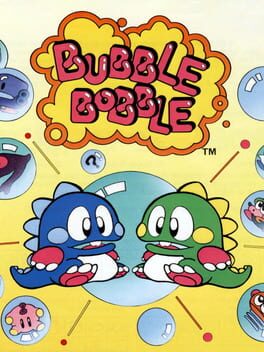
In the game, each player controls one of the two Bubble Dragons, Bub and Bob. The player can move along platforms, as well as jump to those above and to the side, similar to most platform games. The player can also blow bubbles. These can trap enemies, who are defeated if the bubble is then burst by the player's spiny back. Bubbles that contain enemies can be popped at the same time resulting in different foods being projected around the level. Each enemy trapped in a bubble equates to a different food. Food is consumed and transferred to points (an increasing scale of 1000 points is awarded for each enemy burst in tandem with another meaning: one enemy burst equals one food item worth 1000 points, two enemies burst equals two food items worth 1000 and 2000 points, three enemies burst equals three food items worth 1000, 2000 and 4000 points, and so on), which results in earning lives. These same bubbles also float for a time before bursting, and can be jumped on, allowing access to otherwise inaccessible areas. Players progress to the next level once all enemies on the current level are defeated. Enemies turn "angry" — becoming pink-colored and moving faster — if they are the last enemy remaining, escape from a bubble after being left too long or a certain amount of time has been spent on the current level. A monster will also become angry if either player collects a skull (the only negative item in the game), and the monster is hit by the resulting comet crossing the screen (however, this is a rare occurrence). After a further time limit expires, an additional invincible enemy appears for each player, actively chasing them using only vertical and horizontal movements. These do not need to be defeated to complete the level, and disappear once a player's life is lost. Contact with enemies and their projectiles (rocks, lasers, fireballs, etc.) results in death.

Platform / Puzzle / Arcade / Action / Fantasy
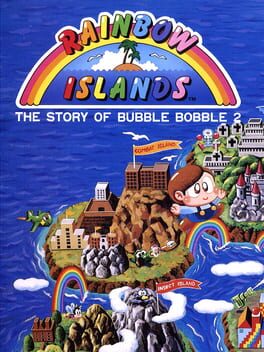
Rainbow Islands is a 1987 arcade game developed and published by Taito. The arcade version was licensed to Romstar for North American manufacturing and distribution. The game is subtitled "The Story of Bubble Bobble 2" and is the sequel to Taito's hit game Bubble Bobble from the previous year. It is the second of four arcade games in the Bubble Bobble series. The game was ported for numerous home computers and game consoles.