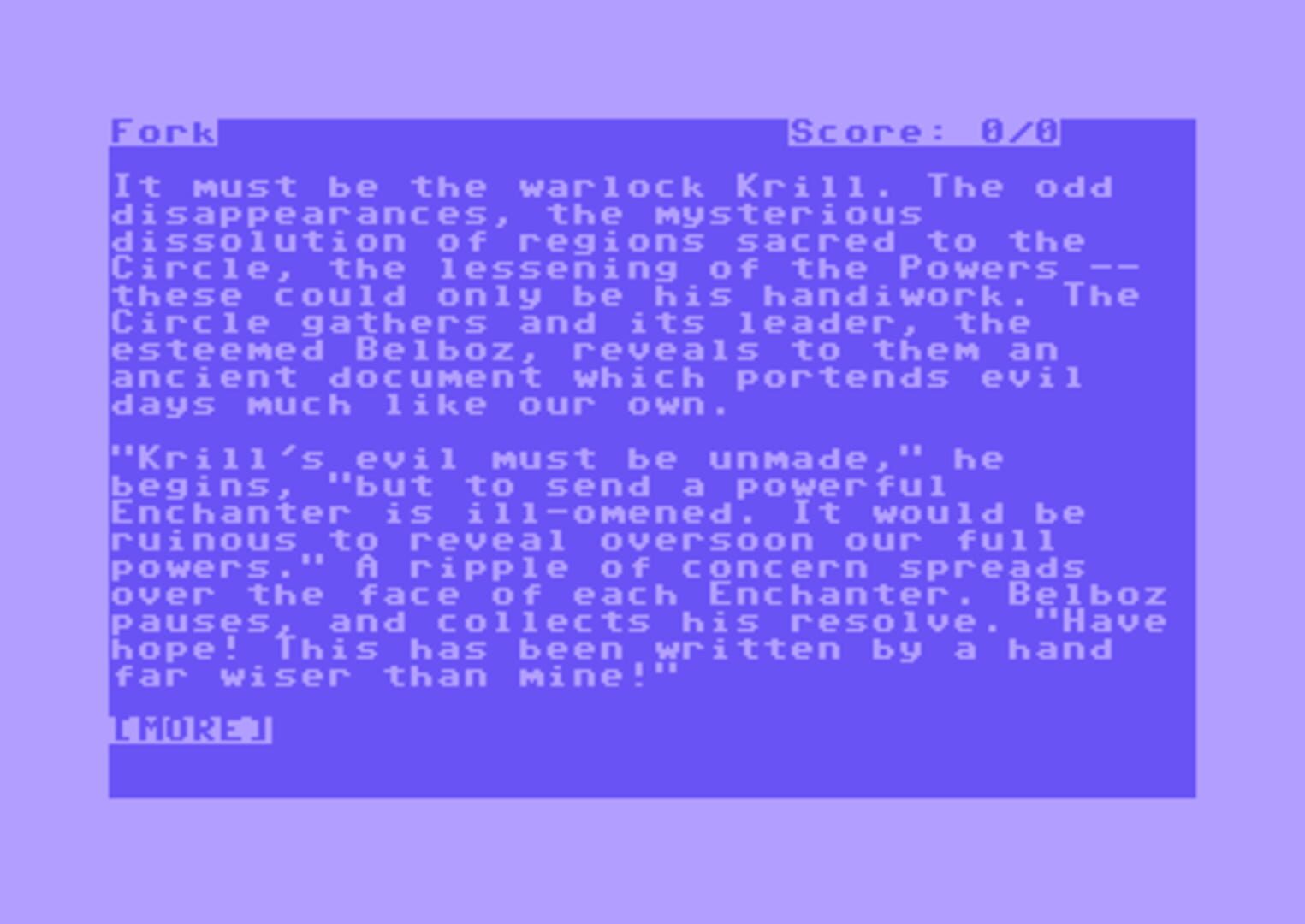

Enchanter is a 1983 interactive fiction computer game written by Marc Blank and Dave Lebling and published by Infocom. It belongs to the fantasy genre and was the first fantasy game published by Infocom after the Zork trilogy (it was originally intended to be Zork IV). The game had a parser that understood over 700 words, making it the most advanced interactive fiction game of its time. It was Infocom's ninth game. Krill, an incredibly powerful evil warlock, is spreading chaos and destruction. None of the more experienced members of the Circle of Enchanters dare to attempt to stop him. In desperation, the player, a novice Enchanter with only a few weak spells in his spell book, is sent in hopes that Krill will either fail to detect him or dismiss him as harmless. More powerful spells can be found on scrolls hidden in various locations, but as the player becomes more of a threat, Krill will respond accordingly. This game features an innovative new spell system based partially on Ursula K. Le Guin's Earthsea series and partially Dungeons and Dragons' Vancian spell system, where spells must be prepared through "memorization" before being cast. As in the Earthsea series, each spell is represented by some nonsense "magic word" which is treated as a verb by the game's text parser, so that one can use the FROTZ spell (which causes objects to glow and give off light) by typing >FROTZ BOOK, in exactly the same way as one might type >PICK UP BOOK or >READ BOOK.
Welcome to the world of the Enchanter saga - a world where magic is commonplace, a world where guilds of professional magic-users spend their lifetimes mastering the intricacies of thaumaturgy, a world where great forces of evil must constantly be held at bay. An Evil Warlock has subjugated the land to his power. All who have opposed him have failed. But many years ago, in another age, the great Elders of the Circle of Enchanters foresaw the possibility of these dreaded occurrences. They realized that no fully accomplished Enchanter could penetrate the Warlock's defenses unrecognized, and knew that the task of freeing the land would fall to a journeyman conjurer. You have been identified as the Apprentice Enchanter who must save the land from the Warlock. As a fledgling Enchanter, you have learned your lessons but have not faced all your tests. You possess great power, but in the ranks of necromancers you are a lowly and ignorant person indeed. You have been well trained in the basics of magic, and you will be greatly aided by the spells you know and the spells you will learn. But you must also rely on your powers of observation and quick wits.
Many centuries ago, the Earth was ruled by Sorcerers and Wizards. They possessed mystical powers capable of both good and evil. The most respected influences in the land were from the good Sorcerers. This fact continually disturbed the evil Wizards, and they eventually decided to use their power to conquer the countryside and enslave its people. They devised a plan to systematically eliminate the good Sorcerers by sending wave after wave of diabolical creatures to ravage the world. As the bravest of the good Sorcerers you have been asked to destroy these forces and save the planet. As a reward for your bravery: whenever you overcome or destroy a creature, you will receive a treasure. Knowing your bravery the Wizards have done everything within their power to keep you from succeeding. They don't believe you will survive their first three waves of evil, but just in case you do they have several surprises waiting, Only you can discover through bravery and talent how evil they can become. To give you more power over the Forces of Evil the good Sorcerers have provided a magical Flying Platform. When you start on your journey you should first catch this elusive platform. You can continue without it, but only the foolish would dare to do so. Once on the Flying Platform you can go anywhere on the screen to avoid or destroy the enemy. The good Sorcerers have also given you four lives to use against the Forces of Evil.

Wishbringer: The Magick Stone of Dreams is an interactive fiction computer game written by Brian Moriarty and published by Infocom in 1985. It was intended to be an easier game to solve than the typical Infocom release and provide a good introduction to interactive fiction for inexperienced players, and was very well received.

In the third game of the adventure game series Zork, you are once again a nameless adventurer, only this time you won't travel through a beautiful magical land, but are immediately cast into a deep dungeon. Like in a dream, you hear a mysterious voice telling you that you have passed all the tests but one. When conscience returns to you, you find yourself on the endless spiral of stairs, with only your trusty lantern near you... will you be able to survive the horrors of the Dungeon?

Spellbreaker is an interactive fiction computer game written by Dave Lebling and released by Infocom in 1985, the third and final game in the "Enchanter Trilogy". Like most of Infocom's games, it was released for many of the time's popular computer platforms, such as the Commodore 64, Atari ST and Apple II. It is Infocom's eighteenth game. Over the course of events in the trilogy's earlier games from 956 to 957 GUE (Enchanter and Sorcerer), the player's character has progressed from a novice wizard possessing a few weak spells to the leader of the Circle of Enchanters. Now, in 966 GUE (ten years after the events of Enchanter), the very foundations of Magic itself seem to be failing, and the leaders of all the Guilds in the land have gathered to demand answers. In the midst of this impassioned meeting, the crowd is suddenly transformed into a group of toads and newts. Everyone present is affected except for the player and a shadowy figure who flees the hall.

The adventure begins in the Barrow from "Zork I" armed only with the trusty brass lantern and sword of elvish antiquity. The purpose of the game is not initially clear. Like its predecessor, Zork II is essentially a treasure hunt. Unlike the previous game, the ten treasures are tied together by a crude plot. Finding the treasures does not end the game, nor are all the treasures needed to finish the game. Instead, the adventurer must figure out a way to use the treasures in order to reach the game's finale.

Role-playing (RPG) / Adventure / Fantasy
Beyond Zork: The Coconut of Quendor is an interactive fiction computer game written by Brian Moriarty and released by Infocom in 1987. It was one of the last games in Infocom's Zork series It signified a notable departure from the standard format of Infocom's earlier games which relied purely on text and puzzle-solving: among other features, Beyond Zork incorporated an on-screen map, the use of character statistics and levels, and RPG combat elements. The game, Infocom's twenty-ninth, was available on the Amiga (512kb), Apple (128kb), Atari ST, Commodore 128, and IBM (192kb), and the Macintosh (512kb) computers The player explores the Southlands of Quendor somewhat aimlessly at first. Soon, however, a task is bestowed by the Implementors, a group of godlike creatures jokingly based on Infocom's game designers. The Coconut of Quendor, an incredibly powerful artifact that embodies the whole of Magic, has fallen into the claws of an unspeakably foul beast: an Ur-grue. Rumoured to be the spirits of fallen Implementors, Ur-Grues can surround themselves in a sphere of darkness that only sunlight can pierce. The player must recover the Coconut from this monster's grasp or face the unthinkable consequences.

Adventure / Fantasy / Historical
Hearing your father has taken ill, you rush to his aid in this 17th century island romance tale.