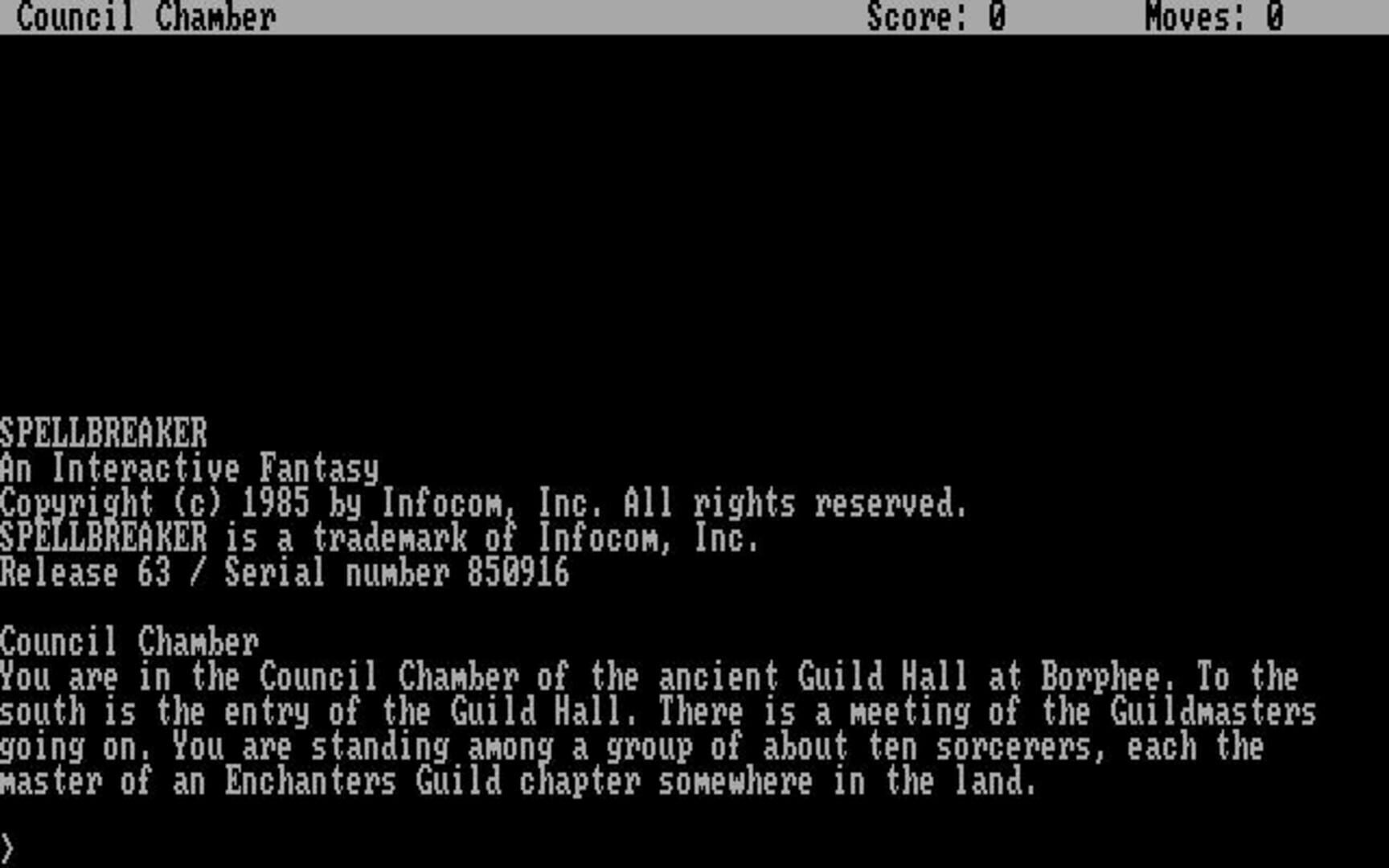

Spellbreaker is an interactive fiction computer game written by Dave Lebling and released by Infocom in 1985, the third and final game in the "Enchanter Trilogy". Like most of Infocom's games, it was released for many of the time's popular computer platforms, such as the Commodore 64, Atari ST and Apple II. It is Infocom's eighteenth game. Over the course of events in the trilogy's earlier games from 956 to 957 GUE (Enchanter and Sorcerer), the player's character has progressed from a novice wizard possessing a few weak spells to the leader of the Circle of Enchanters. Now, in 966 GUE (ten years after the events of Enchanter), the very foundations of Magic itself seem to be failing, and the leaders of all the Guilds in the land have gathered to demand answers. In the midst of this impassioned meeting, the crowd is suddenly transformed into a group of toads and newts. Everyone present is affected except for the player and a shadowy figure who flees the hall.
You distinguished yourself among the young Enchanters by defeating the evil warlock Krill, whose attempt to subjugate the land was thwarted by your cleverness, as your inexperience allowed you to succeed where others might have failed. This earned you a place on the Circle of Enchanters, second only to the great Belboz the Necromancer. Then Belboz himself was nearly destroyed, and your rescue of him from the evil demon Jeearr earned you the ultimate honor given a mage, the leadership of the Circle of Enchanters. Now, a crisis has befallen the kingdom. Magic itself seems to be failing. Spells fail to work or go strangely awry, the populace is confused and restive, and even the Enchanters Guild is baffled. A great conclave of the Guildmasters is ordained, and it is at this conclave that the final conflict between good and evil begins to unfold.
Wishbringer: The Magick Stone of Dreams is an interactive fiction computer game written by Brian Moriarty and published by Infocom in 1985. It was intended to be an easier game to solve than the typical Infocom release and provide a good introduction to interactive fiction for inexperienced players, and was very well received.

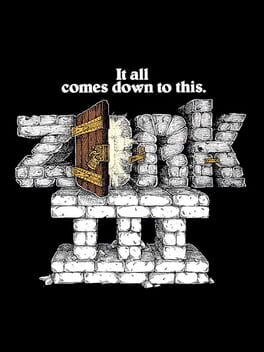
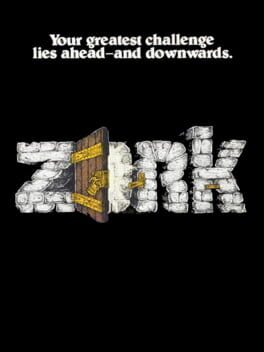
In the third game of the adventure game series Zork, you are once again a nameless adventurer, only this time you won't travel through a beautiful magical land, but are immediately cast into a deep dungeon. Like in a dream, you hear a mysterious voice telling you that you have passed all the tests but one. When conscience returns to you, you find yourself on the endless spiral of stairs, with only your trusty lantern near you... will you be able to survive the horrors of the Dungeon?

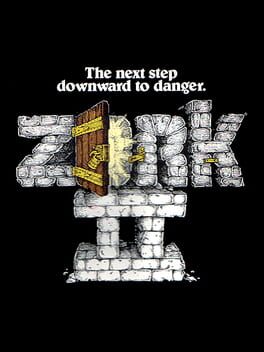
The adventure begins in the Barrow from "Zork I" armed only with the trusty brass lantern and sword of elvish antiquity. The purpose of the game is not initially clear. Like its predecessor, Zork II is essentially a treasure hunt. Unlike the previous game, the ten treasures are tied together by a crude plot. Finding the treasures does not end the game, nor are all the treasures needed to finish the game. Instead, the adventurer must figure out a way to use the treasures in order to reach the game's finale.

Role-playing (RPG) / Adventure / Fantasy
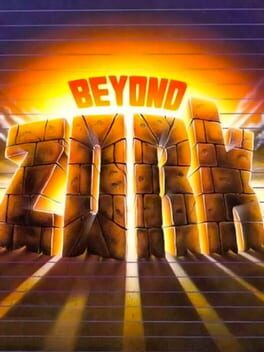
Beyond Zork: The Coconut of Quendor is an interactive fiction computer game written by Brian Moriarty and released by Infocom in 1987. It was one of the last games in Infocom's Zork series It signified a notable departure from the standard format of Infocom's earlier games which relied purely on text and puzzle-solving: among other features, Beyond Zork incorporated an on-screen map, the use of character statistics and levels, and RPG combat elements. The game, Infocom's twenty-ninth, was available on the Amiga (512kb), Apple (128kb), Atari ST, Commodore 128, and IBM (192kb), and the Macintosh (512kb) computers The player explores the Southlands of Quendor somewhat aimlessly at first. Soon, however, a task is bestowed by the Implementors, a group of godlike creatures jokingly based on Infocom's game designers. The Coconut of Quendor, an incredibly powerful artifact that embodies the whole of Magic, has fallen into the claws of an unspeakably foul beast: an Ur-grue. Rumoured to be the spirits of fallen Implementors, Ur-Grues can surround themselves in a sphere of darkness that only sunlight can pierce. The player must recover the Coconut from this monster's grasp or face the unthinkable consequences.

Adventure / Fantasy / Historical
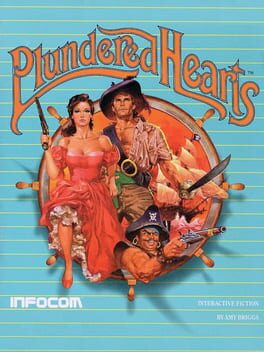
Hearing your father has taken ill, you rush to his aid in this 17th century island romance tale.

Adventure / Thriller / Mystery
The Witness was the seventh game released by interactive fiction pioneers Infocom. The player character is a detective who has been summoned to the Cabeza Plana, California office of Mr. Linder, a millionaire. Linder fears that his life is in danger... and indeed, as he sits in his office with the player, he is murdered before the player's eyes. The player then must solve the murder.

Adventure / Science fiction / Comedy
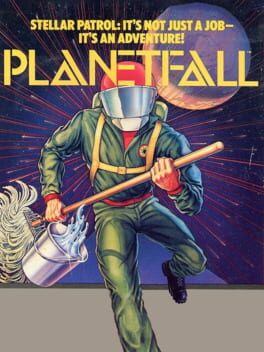
Planetfall is a science fiction interactive fiction computer game written by Steve Meretzky, and the eighth title published by Infocom in 1983. Like most Infocom games, thanks to the portable Z-machine, it was released for several platforms simultaneously. The original release included versions for the PC (both as a booter and for DOS) and Apple II. The Atari ST and Commodore 64 versions were released in 1985. A version for CP/M was also released. Although Planetfall was Meretzky's first title, it proved one of his most popular works and a best-seller for Infocom; it was one of five top-selling titles to be re-released in Solid Gold versions including in-game hints. Planetfall utilizes the Z-machine originally developed for the Zork franchise and was added as a bonus to the "Zork Anthology". The word planetfall is a portmanteau of planet and landfall, and occasionally used in science fiction to that effect. The book Planetfall written by Arthur Byron Cover, uses the game image on the cover, and is marketed "In the bestselling tradition of THE HITCHHIKER'S GUIDE TO THE GALAXY.[2] A sequel, Stationfall, was released in 1987. Planetfall teleports you 12,000 years into an outrageous future. You joined the Stellar Patrol to explore the galaxy, but all you've seen is the end of a mop - until your ship explodes and you're jettisoned onto a mysterious, deserted planet. Luckily, you have Floyd, a lovable multi-purpose robot with the personality of a mischievous 8-year-old. He's the ideal companion with whom to brave your new world, as you dare its dangers and uncover its secrets.