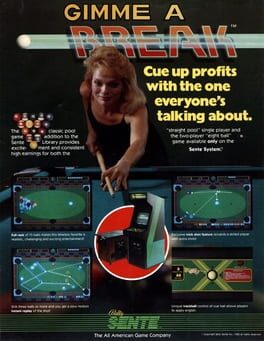

Gimme a Break is a cue sports arcade game which was released by Bally and Sente in 1985; it was the first of the second batch of games to run on that company's SAC-I hardware, and the player must use a singular button to position the cue ball, with a trackball to control it during each shot. In a two-player game, one player must aim for the solid-coloured balls (1 to 7), while the other must aim for the white ones with a coloured stripe across them (9 to 15) - and in a one-player game there will also be bonus rounds where the player must pot bonus balls to earn extra shots. If players should pot three or more balls, with a single shot, they'll get treated to a slow-motion "action replay" of it; it is also worth noting that if a certain dip switch is set to "on", this game will show pictures of children who were missing at the time in its attract mode (and this also applies to that other Bally/Sente game for 1985, Mini Golf).
Sport / Arcade / Non-fiction
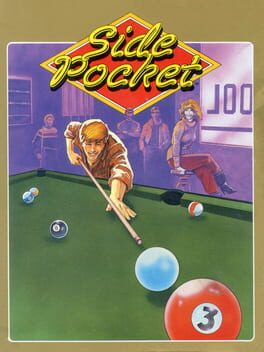
Side Pocket is a pocket billiards video game originally released into arcades by Data East in 1986. The arcade version was eventually ported to six home console platforms and two sequels to the game were produced, as well as a spin-off series called Pocket Gal. G-Mode currently owns the intellectual property rights to the Side Pocket series, and licenses these games globally.

Sport / Arcade / Non-fiction
The updated version to the classic Golden Tee franchise. This game has a wireless internet connection that allows players to compete in scheduled online tournaments against players all over the world for cash and prizes. Allows players to customize their characters.

Sport / Arcade / Non-fiction
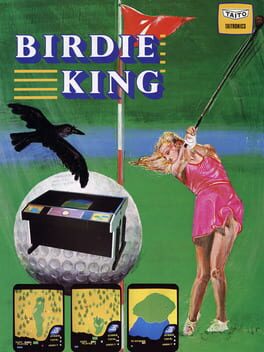
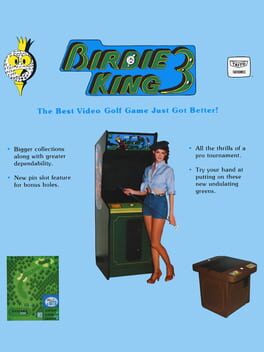
A golf arcade game released in 1982 by Taito. It was followed by two sequels: Birdie King 2 in 1983, and Birdie King 3 in 1984.

Sport / Arcade / Non-fiction
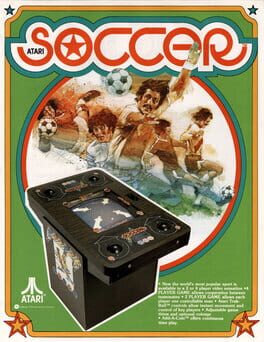
Atari Soccer is, as the naming implies, a soccer arcade game that was released by Atari in 1980; it utilizes a Motorola M6502 (running at 750 KHz), and the players must use a trackball to take control of a player (two on each team, and if there are only two players, the CPU shall fill in for 3P and 4P), with two buttons for kicking the ball with their left and right feet. The human-controlled players will be indicated by the "squares" (1P and 3P) and "crosses" (2P and 4P) upon their heads - and just like in real association football, whoever has the most goals when the timer has run out wins the game. 1P and 2P's team is black, and 3P and 4P's team is white; and as with the four-player version of Atari's earlier American football game, one credit buys a two-player game and two buy a four-player game.

Sport / Arcade / Non-fiction
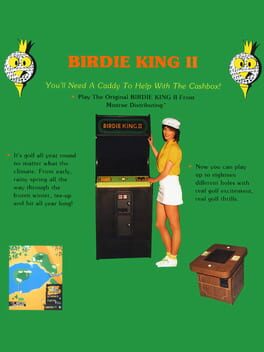
The 1983 second installment to Taito Corporation's Golf franchise.

Sport / Arcade / Non-fiction
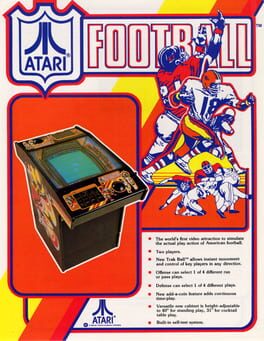
Atari Football is a 2-player 1978 arcade game in which the sport of American football is accurately emulated, with players represented by Xs and Os. The game was one of the most popular arcade games in its day and is credited with popularizing the trackball. Twenty-five cents would allow 90 seconds of playtime, while adding more quarters would allow longer play. Considered physically exhausting to play, Atari Football involves spinning the trackball as fast as possible to win the game. Just 90 seconds of play could result in sore palms, and longer could cause blisters.

Sport / Arcade / Non-fiction
The 1984 third installment in Taito Corporation's Golf franchise.

Sport / Arcade / Action / Non-fiction
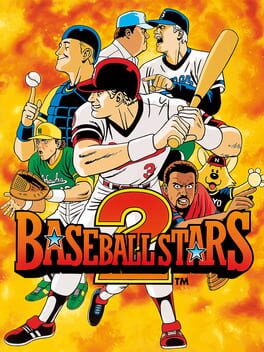
Baseball Stars 2 is the sequel to the very successful Baseball Stars game released for Nintendo in the late 1980s. It was released by SNK for Arcade, as well as the Nintendo Entertainment System. Players can create leagues of up to 125 games (6 teams playing each other 25 times) and view statistics such as League Standings, Average, Home Runs, Runs Batted In, Earned Run Average, Wins and Saves. Players can fire players and upgrade them using the same 15-point system introduced in the original Baseball Stars.