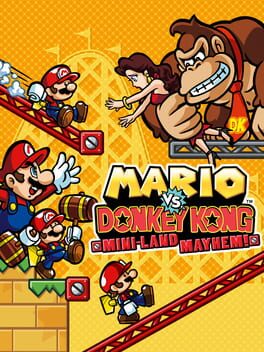
At the grand opening of Mario's third theme park, the first 100 guests receive a new Mini Pauline toy. Donkey Kong arrives as the 101st guest and finds himself out of luck. He grabs Pauline and heads into the park with Mario and his Mini Marios in hot pursuit. The fourth game in the series adds new challenges and new opportunities for users to share what they have created.

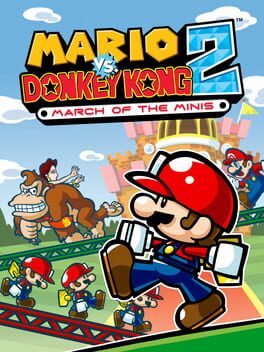
It seems folks love those Mini Mario toys. So much so that the Mario Toy Company has expanded the line to include Mini Donkey Kong, Mini Toad and Mini Peach figures to the series. With all these toys bringing him more money than he knows what to do with, Mario decides to fulfill his lifelong dream and open a theme park called Super Mini Mario World. The opening-day crowd includes Pauline and Donkey Kong, who immediately falls head over heels for the lovely lass. The proud ape tries to show off his Mini DK toy to Pauline, but she picks the Mini Mario toy over his and the jealous Donkey Kong becomes enraged. He smashes the displays, destroys the toys and takes Pauline to the top floor of the amusement park. Players must find Pauline and save the day. Mario vs. Donkey Kong 2 allows players to create their own maps with a new level editor. Once a map is created, players can send it across the world via Nintendo Wi-Fi Connection. Players also can use Nintendo Wi-Fi Connection to download maps created by others, check out a player-ranking system and access special bonuses. These unique features are sure to be a smash hit with puzzle fans everywhere.

Shooter / Platform / Puzzle / Action / Survival
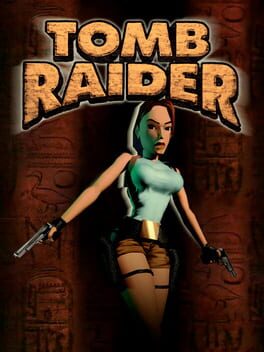
Tomb Raider is a 3D action game developed by Core Design and published by Eidos Interactive. The game follows the exploits of Lara Croft, a British female archaeologist in search of ancient treasures. The objective of Tomb Raider is to guide Lara through a series of tombs and other locations in search of treasures and artifacts. On the way, she must kill dangerous animals and other creatures, while collecting objects and solving puzzles to gain access to an ultimate prize, usually a powerful artifact. The game was critically acclaimed and widely influential, it spawned a number of sequels and a franchise of related media.

Shooter / Platform / Puzzle / Action / Fantasy
Humorous action-platformer that does away with the tedious item collection found in most games in the genre. Instead, BFD employs a combination of standard jump, run and explore mechanics and context-sensitive gags and actions. For instance, in the beginning of the game, by pressing the B button on the first pad he encounters, Conker drinks some Alka-Seltzer to wipe out his hangover, at which point players can proceed forward. Later on these pads are used to activate a slingshot and throwing knives; to turn Conker into an anvil and drop downward; to shoot automatic, double-handed guns; to activate a The Matrix-inspired slow-motion effect and flip through the air shooting enemies; and much, much more.

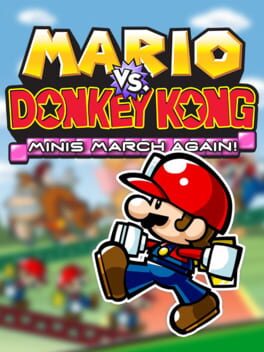
Mario vs. Donkey Kong: Minis March Again! is a puzzle video game for the Nintendo DSi. Announced at the Electronic Entertainment Expo 2009, it is the third game in the Mario vs. Donkey Kong series. It was released via the Nintendo DSiWare download service in North America on June 8, 2009, in Europe and Australia on August 21, 2009 and in Japan on October 7, 2009. It is the first DSiWare game to feature a level editor in which players can create custom-made levels and send them to players on other devices via a wireless Internet connection.

Puzzle / Adventure / Action / Fantasy
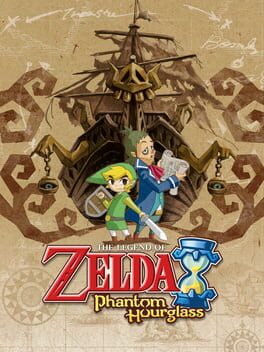
The Legend of Zelda: Phantom Hourglass is the first Zelda game for the Nintendo DS and a direct sequel to The Wind Waker. The art direction is the same cel-shaded style as the Wind Waker but is displayed from a classic top-down perspective. The gameplay is structured similarly to other games in the series and is divided into two major gameplay sections: sailing between islands and exploring the islands and their dungeons on foot. The touch screen is used to make Link move and attack instead of buttons, you can also make notes of secret treasures and items on the map simply by writing them down. The game received critical acclaim from reviewers, who agreed that the game was a worthy sequel to The Wind Waker.

Platform / Puzzle / Hack and slash/Beat 'em up / Action
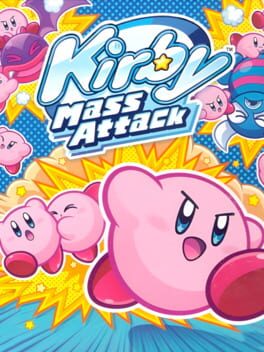
One day, an evildoer with a magic cane appears and splits Kirby into 10 pieces. Kirby sets off on a journey to return to his original form. Players use the touch screen to control a mass of Kirby characters in a new and novel way. Swipe the touch screen to launch them in a mass attack against enemies, then tap the enemies into submission.

Platform / Puzzle / Hack and slash/Beat 'em up / Action / Horror
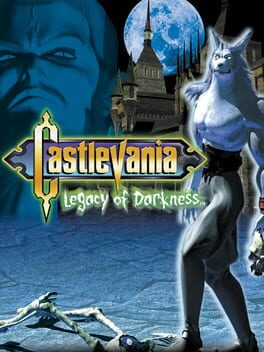
Castlevania: Legacy of Darkness is a video game that was developed and published by Konami for the Nintendo 64. It was first released in North America on November 30, 1999 and is a prequel and expanded version to the first Castlevania game on the Nintendo 64, but also contains a remake of the original game with improved graphics, added villains (Spider Queen, Medusa), and alternate versions of some levels (Forest of Silence, Tower of Science, Tower of Execution, Clock Tower).

Platform / Puzzle / Role-playing (RPG) / Action / Fantasy
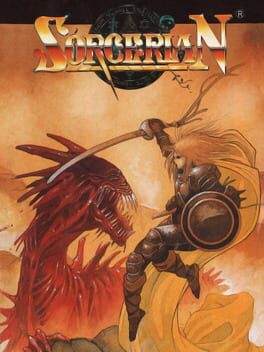
Sorcerian is a side-scrolling action-RPG. The player can create up to ten characters, from whom up to four members can be present in a party at the same time. Each character is highly customizable, with four different classes/races (fighter, wizard, elf, and dwarf) and over 60 possible jobs/occupations (ranging from clown to exorcist) available for them to perform; each has its own strengths and weaknesses, affecting the seven primary attributes (strength, intelligence, protection, magic resistance, vitality, dexterity, and karma) in different ways, as well as different equipment limitations. The player can choose from fifteen different scenarios, or quests, to play through in the order of their choice. The party must battle enemies and perform tasks within the given levels to clear each scenario, before moving onto another scenario of their choice. The player controls the entire party at the same time, with all four members running in a line, jumping in sequence, and attacking in unison. The party members follow behind in a manner similar to the Options in the arcade shooter Gradius (1985). Sorcerian also employs class-based puzzles, such as using a high-strength character to force open doors. All the characters have a default starting age of 16. Each time a player begins a new scenario, a year passes by, while additional time passes by in towns as a character goes through training or enchants items. The characters age at different rates depending on their race, with humans reaching old age at 60, dwarves at 100, and elves at 200. Upon reaching old age, for every year that passes, a character can die permanently at a random time. There is also an “Advance Time” to speed up the flow of time. Another new feature of Sorcerian was its episodic format that extended across various expansion packs. Besides the default fifteen scenarios that come with the game, there were a number of additional scenario packs released. The aging system was created with the additional scenario packs in mind.