
Developed by Technos Japan for Million.
Fighting / Hack and slash/Beat 'em up / Adventure / Action / Comedy
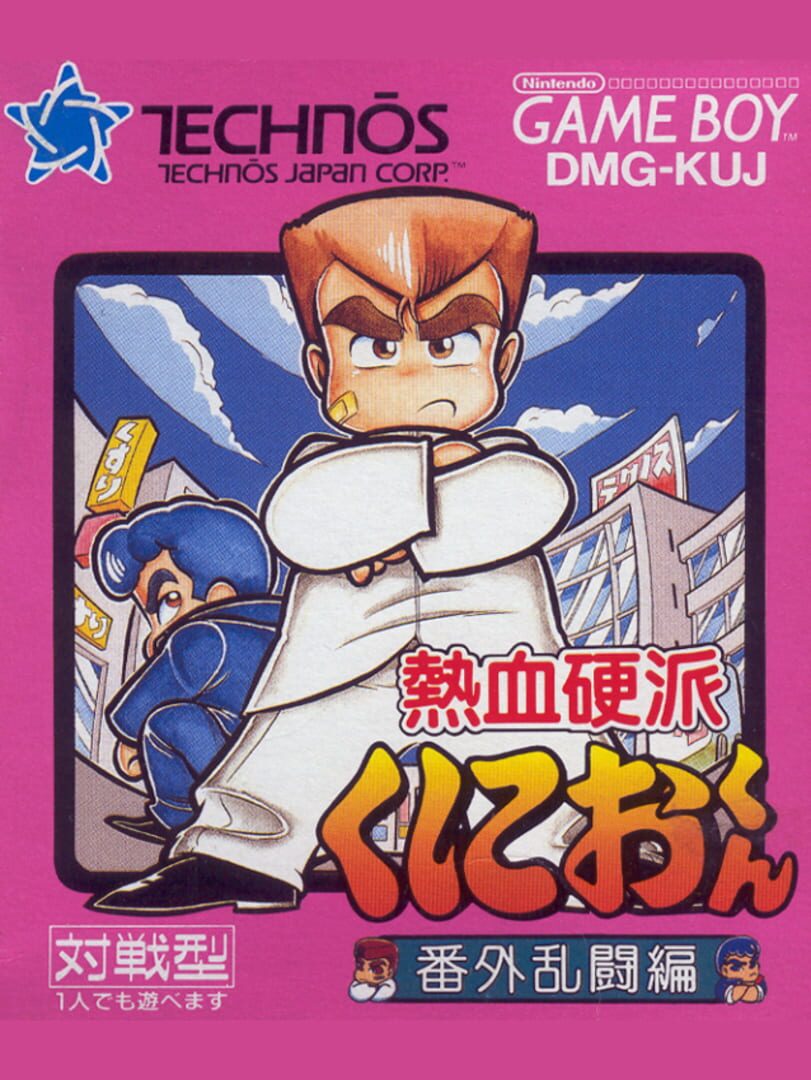
Nekketsu Kouha Kunio-kun: Bangai Rantou-hen is the first game in the Kunio-kun series released by Technōs Japan for the Game Boy. It is a sequel to Nekketsu Kouha Kunio-kun, but uses the graphical style of Downtown Nekketsu Monogatari, which was previously released on the Famicom. This is the second game in the Kunio-kun series that has Kunio and Riki joining forces against a common threat, which would become a standard in later games.
Players assume the role of Kunio, who must avenge the beating of his friend Hiroshi at the hands of Yūji Munakata, the only son of the chairman of Munakata Industries. Yūji has also been terrorizing Hanazono High School, so Riki joins Kunio as well, provided that another player has another copy of the game and the Game Link Cable. Though the game was released after Downtown Nekketsu Monogatari and uses similar graphics, they game doesn't give the player an option to choose between Kunio or Riki (the first player always controls Kunio and he is the only playable character in a single player game, only the second player can use Riki, though both characters play the same).
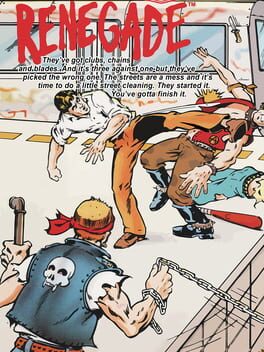
Fighting / Hack and slash/Beat 'em up / Adventure / Action / Survival
Unlike Technos' subsequent game Double Dragon, the playing field is limited to one two-screen-wide area (a subway platform, a harbor, an alley, a parking lot and the hideout of a gang) and does not scroll continuously. Out of the four stages in the game, the first, second and third each begin with the player fighting a group made up of two different types of small fry enemies: one with fewer hit points and a stronger attack (usually armed with a weapon) and one with more hit points, but with a weaker attack and the ability to grab the player from behind, making him vulnerable to other enemies' attacks. When only three underlings remain (in any combination of the two) their boss will come in from the sidelines and join the fight. When the boss is defeated, any remaining enemies retreat off the bottom of the screen, and the stage ends. The second stage follows this same formula, but begins with a series of enemies riding motorcycles trying to run the player down, and brings in the normal enemies once the bikers have been defeated. The third stage is a gang of women; their boss is a very large woman who cannot easily be knocked to the ground. The fourth stage features a single type of knife-wielding enemy who can kill the player with one hit. Once the player has defeated this first wave of enemies, the main character proceeds to enter a building at the far right of the stage. There, he faces three more knife-wielding enemies and the final boss, a mobster whose gunfire is also deadly with one hit. Once the final boss is defeated, the main character exits the building and is greeted by his rescued girlfriend, who proceeds to give him a kiss. The game then begins the next cycle with an increased difficulty. In addition to an eight-direction joystick, there are three buttons; left attack, right attack, and jump. Pressing the attack in the direction the character is facing will punch, while attacking in the opposite direction will perform a rear kick. Jumping, followed immediately by one of the attack buttons, which will perform a jumping kick in the direction of the attack. Pressing the joystick twice quickly either left or right will cause the player to run, at which point attacking in the direction of the run will perform a running punch, jumping will automatically perform a flying kick, and attacking in the opposite direction will bring the player to a sudden halt and perform a back-kick. Pressing down over a downed enemy will make the player sit on top of the enemy, at which point attacking toward the enemy will cause the player to pummel him. The bosses can only be sat on if all normal enemies have been defeated, and unless the boss' energy level is low enough, he'll throw the player off.

Fighting / Hack and slash/Beat 'em up / Adventure / Action / Comedy
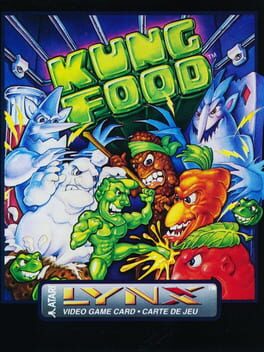
The ultimate food fight! Mutant munchies from your freezer invade your kitchen, your life, and your world. Speed and your martial arts skills are required to overcome the vicious veggies!

Fighting / Hack and slash/Beat 'em up / Adventure / Action / Comedy
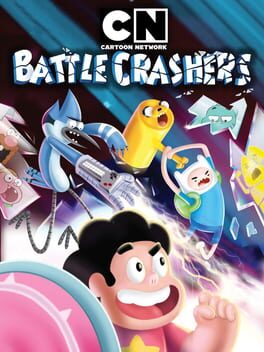
A cancelled DS port of Cartoon Network: Battle Crashers.

Platform / Hack and slash/Beat 'em up / Adventure / Action / Fantasy
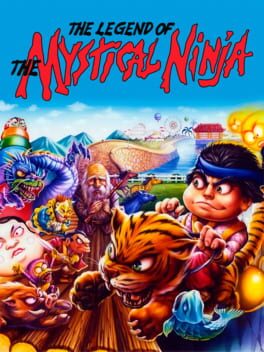
The Legend of the Mystical Ninja is a light-hearted action-adventure game for 1-2 players by Konami, and was released for the Super Nintendo Entertainment System in 1991. It is the first game in the Japanese video game series Ganbare Goemon to have a Western release. It underwent several changes compared to its Japanese counterpart Ganbare Goemon: Yukihime Kyuushutsu Emaki. The protagonists were renamed for the Western release, and some content was altered to comply with Nintendo’s strict censorship policies at the time, such as the removal of certain characters and cutscenes.

Fighting / Hack and slash/Beat 'em up / Adventure / Action
Technōs created once again a vastly different experience with Double Dragon II on the NES. The experience system was dropped, but the moveset still underwent a few changes. The elbow attack and turning jump kick are gone, but with the standard kick directed backwards they seemed a bit redundant anyway. There are two new ways to make enemies in a grapple suffer, elbow smashes to the head, and a high kick to propel them away. In the brief time window when the Lee brothers are crouching after a jump or after getting knocked down, it’s possible to perform a rising uppercut or a knee jump attack. The timing for these isn’t easy, but they are the most powerful moves in the game. On the NES, Double Dragon II is a much more innovative and unique sequel than in the arcade, but it marks also the time Double Dragon started its schizophrenic shifting between wildly different tones and gameplay styles. In a way it’s one of the best games to bear the Double Dragon name, but it’s hard to shake the feeling that Technōs had already started to loose a cohesive vision of what it meant to be Double Dragon, both in tone and in gameplay.

Fighting / Hack and slash/Beat 'em up / Adventure / Action / Fantasy
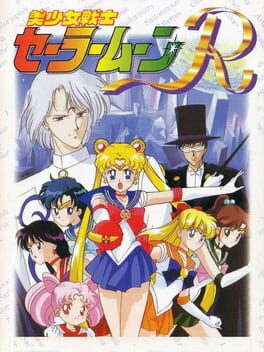
Bishoujo Senshi Sailor Moon R is a video game released for the Super Famicom by Bandai in 1993. It serves as a sequel to Bishoujo Senshi Sailor Moon. Upon starting the game, the player can choose one of 5 characters (2 can be selected for co-op). The game is divided into four levels; each level being divided further into two sub-levels. The player will fight numerous enemies, mostly consisting of default Droids based on their manga incarnations. At the end of each level, a boss must be defeated to proceed. Pressing a special button makes the character use a devastating attack that kills all lesser enemies on screen and causes significant damage to a boss character, although the use of the attack is limited. Bonus items can be picked up from the ground or found in breakable objects, usually in the form of food items that replenishes the life meter to varying degrees. Chibiusa Mode is synonymous with an "Easy Mode". Chibiusa's sprite is too short to be hit by most attacks, and the enemies are also made easier to beat. There is also bonus Battle Mode, which acts as a 1v1 arcade fighter for 2 players. Selecting this mode with only one player allows it to work as a training mode, with the other character remaining motionless.

Fighting / Hack and slash/Beat 'em up / Adventure / Action
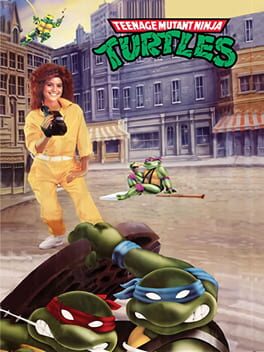
NOTE: This is the original 4-Player Arcade release, not the NES Title. The player chooses from one of the four Ninja Turtles: Leonardo, Michelangelo, Donatello, and Raphael. After Shredder kidnaps the Turtles' friend April O'Neil and their mentor Splinter, they must give chase, save their comrades, and defeat the evil Shredder. The player chooses from one of the four Ninja Turtles: Leonardo, Michelangelo, Donatello, and Raphael. Depending on the version of the game, the characters are either, chosen at the start of the game or assigned by control panel. After Shredder kidnaps the Turtles' friend April O'Neil and their mentor Splinter, they must give chase, save their comrades, and defeat the evil Shredder. Up to four players (two in some versions) can take control of any of the Turtles. Donatello has slower attacks but a longer range, Michelangelo and Raphael have faster attacks but a shorter range, and Leonardo is a well-rounded Turtle with average range and speed. The eight-way joystick controls the movements of the Turtle, the jump button makes them jump and the attack button makes them hit in front of them using their weapon. In addition to this, some combinations are possible. The Turtles can throw Foot soldiers overhead, and by pressing the jump and attack buttons, a special attack is performed. Raphael rolls along the ground and finishes with a kick, while the other Turtles do a sweeping jump attack with their weapons. Turtles can also spring off the wall in certain areas. Enemies can be defeated more quickly by slamming them into walls or solid objects. Many objects such as traffic cones, parking meters, fire hydrants and exploding oil drums can be hit or damaged with attacks in order to help defeat nearby enemies. In the attract mode, the game showed the first part of the cartoon opening, along with a portion of the Teenage Mutant Ninja Turtles theme song. Most of the enemies the Turtles face are the Foot Soldiers, all color-coded to indicate their attack patterns and weapon of choices. Some enemies, such as the standard purple-clad Foot Soldiers and Roadkill Rodney robots, have the ability to restrain the Turtles' mobility and drain their health, leaving the player open to attack for other enemies. The bosses in the game include Rocksteady and Bebop (individually at first in that order, and later the two of them together), Baxter Stockman, Granitor, General Traag, Krang, and Shredder himself.

Fighting / Hack and slash/Beat 'em up / Adventure / Action
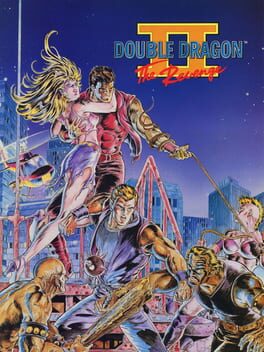
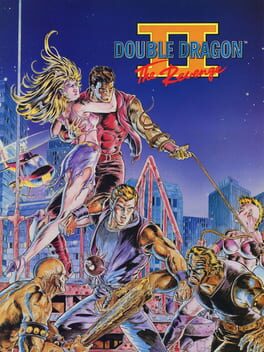
The original arcade version of "Double Dragon II" is essentially an improved version of the first game. The biggest change in the game's controls are in the replacement of the original's punch and kick buttons with two directional-based attack buttons (Left Attack and Right Attack) similar to Renegade. Pressing the attack button of the player's current direction will do a standard series of punches, while pressing the opposite attack button will perform a back kick. A few new moves are added as well, including a Hurricane Kick. Like in the original game, the arcade version of Double Dragon II is divided into four missions: a heliport, a lumber storehouse, a wheat field, and the new hideout of the boss. Each stage has its own boss character with his own theme. After defeating Willy (the final boss from the original game) in the fourth stage, the player will confront a double of their own character for the game's final battle. If two players reach the end together, then both will each to have to face their own clone for the final battle.