
Developed by Cinematronics for GCE.
Shooter / Arcade / Action / Science fiction
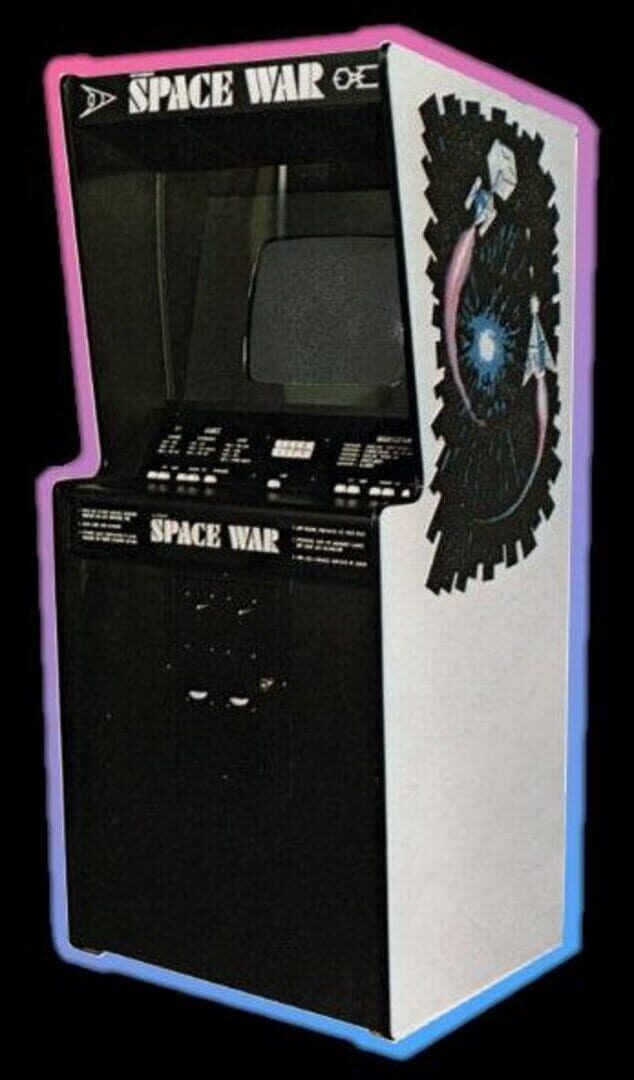
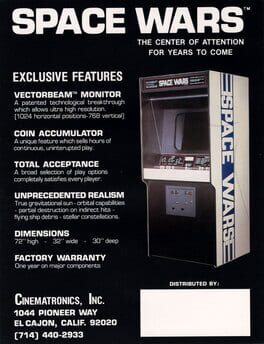
Space Wars is an early vector graphics arcade game. It is based on Spacewar!, a PDP-1 program. It was ported to the Vectrex in 1982. Space Wars was the brainchild of Larry Rosenthal, an MIT graduate who was fascinated with the original Spacewar! and developed his own custom hardware and software so that he could play the game. Cinematronics worked with Rosenthal to produce the Space Wars system. Two players controlled different ships. One button rotated the ship left, another rotated the ship right, one engaged thrust, one fired a shell, and one entered hyperspace (which causes the ship to disappear and reappear elsewhere on the playfield at random). The game offered a number of gameplay options, including the presence or absence of a star in the middle of the playfield (which exerted a positive or negative gravitational pull), whether the edges of the playfield "wrapped around" to their opposite sides, and whether shells bounced. Three other fascinating features were unique to this game. First, the game could not be played in "one player" mode; a human opponent was required. Second, the player's ship could take a glancing hit without dying, but would suffer damage; a cloud of loose ship fragments would break off and float away, after which the ship would be visibly damaged on screen and would turn and accelerate more slowly. Third and most memorable was that the duration of play for any contest was solely governed by the amount of money deposited; each quarter bought a minute and a half of play. A dollar bought six minutes, and for a ten dollar roll of quarters two players could play non-stop for an hour.
Shooter / Arcade / Action / Science fiction
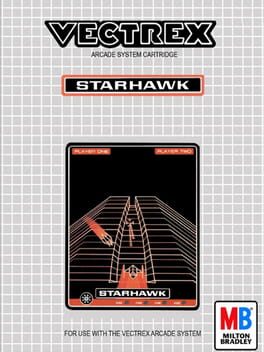
Starhawk is a 1979 vector arcade game by Cinematronics. Starhawk is a shoot 'em up with a fixed environment. The game was unique at the time as it presented the graphics in a pseudo-three dimensional way. Essentially, the game is a simple video game version of the Star Wars: Episode IV trench run. The game was later ported to the Vectrex video game console in 1982. The game is remembered as having quite advanced graphics for the time and being the first video game based upon or to have noticeable references to Star Wars.

Shooter / Arcade / Action / Science fiction
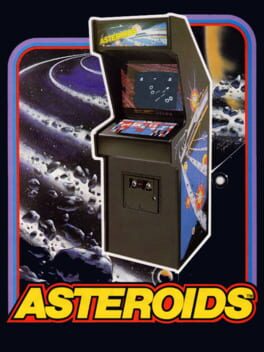
Asteroids is an arcade space shooter released in November 1979. The player controls a spaceship in an asteroid field which is periodically traversed by flying saucers. The objective of the game is to destroy both, asteroids and saucers. The triangular ship can rotate left and right, fire shots straight forward, and thrust forward. Once the ship begins moving in a direction, it will continue in that direction for a time without player intervention unless the player applies thrust in a different direction. The ship eventually comes to a stop when not thrusting. The player can also send the ship into hyperspace, causing it to disappear and reappear in a random location on the screen, at the risk of self-destructing or appearing on top of an asteroid.

Shooter / Adventure / Arcade / Action / Science fiction
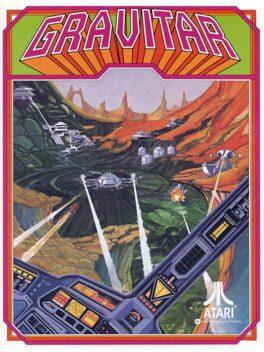
Gravitar is a color vector graphics arcade game released by Atari, Inc. in 1982. The player controls a small blue spacecraft in a fictional solar system with several planets to explore. If the player moves his ship into a planet, he will be taken to a side-view landscape. Unlike many other shooting games, gravity plays a fair part in Gravitar: the ship will be pulled slowly to the deadly star in the overworld, and downward in the side-view levels. In the side-view levels, the player has to destroy red bunkers that shoot constantly, and can also use the tractor beam to pick up blue fuel tanks. Once all of the bunkers are destroyed, the planet will blow up, and the player will earn a bonus. Once all planets are destroyed, the player will move onto another solar system.

Shooter / Arcade / Action / Science fiction
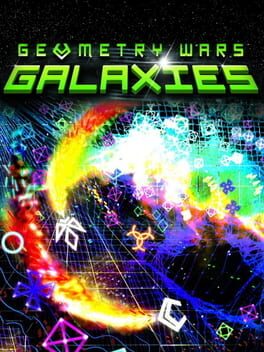
Geometry Wars: Galaxies is set in a space-like environment where the player must shoot geometrical shapes in order to score points, gain lives, acquire bombs and survive as long as possible. The game is played to an upbeat electro soundtrack.

Shooter / Arcade / Action / Science fiction
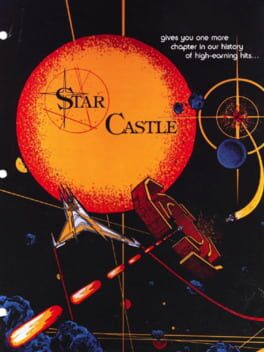
Star Castle is a 1980 vector arcade game by Cinematronics. The game involves obliterating a series of defenses orbiting a stationary turret in the center of the screen. The game was designed by Tim Skelly and programmed by Scott Boden. Tim Skelly also created a number of other Cinematronics titles, including Starhawk, Armor Attack and Rip-Off. As with many other titles by the company, Star Castle was ported to the Vectrex video game console in 1983.

Shooter / Arcade / Action / Science fiction
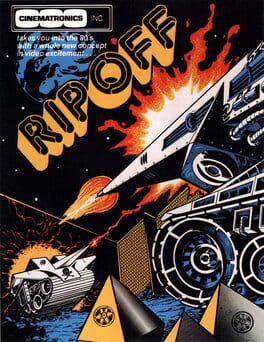
Rip-Off is a vector shoot 'em up released in arcades by Cinematronics in 1980. It is the first shoot 'em up arcade game to feature cooperative gameplay and the first game to exhibit "flocking" behavior. The objective is to prevent computer-controlled enemies from stealing eight canisters set in the center of the screen. One or two players control tank-like vehicles while game-controlled "pirate" tanks rush onto the field and attempt to drag the canisters off the edge of the screen. Enemies can be defeated by shooting or colliding with them. The game speed and difficulty increase with each successive wave until all the canisters have been taken ("ripped off").

Shooter / Strategy / Arcade / Action / Science fiction
Defend your bases by shooting the oncoming alien swarms.

Shooter / Simulator / Arcade / Action / Science fiction
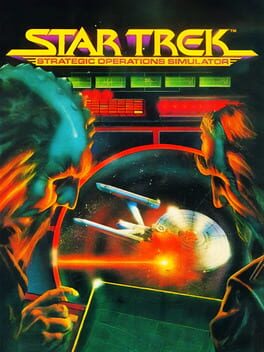
Star Trek: Strategic Operations Simulator is an arcade action game where you take control of the Starship Enterprise. Your mission is to save the Federation from NOMAD! Before you get a chance at destroying NOMAD, you'll have to battle your way through ten levels (each consisting of multiple rounds). In each round you may encounter Klingon fighters, deadly anti-matter saucers, asteroid fields, and deadly meteors, all of which are capable of depleting the Enterprises energy. The game ends when your energy supply has completely run out. To fight these dangers, the Enterprise is equipped with an unlimited supply of phasers and a limited supply of photon torpedoes. Each round also contains one or more starbases; if you dock at a starbase, some of your supplies (such as energy and torpedoes) will be replenished. The game is played from two points of view; the top of the screen contains a third person view of the Enterprise (along with the ships gauges), and on the bottom of the screen is a first person point of view