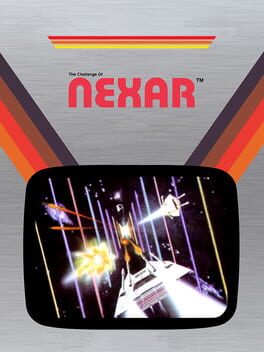
Your assault ship was specially designed to destroy Hyperion Military Bases. Destroy as many as possible. You can fire missiles in the gaps in the Force Field or from inside the Force Field. If you are able to sneak inside, you must quickly destroy the bace before the Force Field closes on your ship. This is no easy task!

Shooter / Arcade / Action / Science fiction
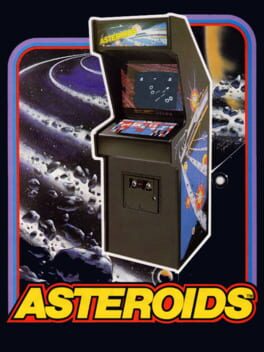
Asteroids is an arcade space shooter released in November 1979. The player controls a spaceship in an asteroid field which is periodically traversed by flying saucers. The objective of the game is to destroy both, asteroids and saucers. The triangular ship can rotate left and right, fire shots straight forward, and thrust forward. Once the ship begins moving in a direction, it will continue in that direction for a time without player intervention unless the player applies thrust in a different direction. The ship eventually comes to a stop when not thrusting. The player can also send the ship into hyperspace, causing it to disappear and reappear in a random location on the screen, at the risk of self-destructing or appearing on top of an asteroid.

Shooter / Arcade / Action / Science fiction
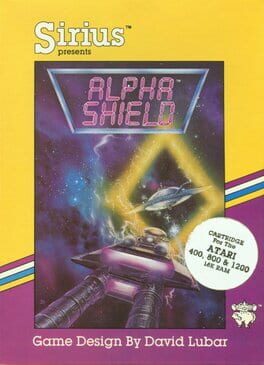
A single screen crosshair shooter written by David Lubar.

Shooter / Strategy / Arcade / Action / Science fiction
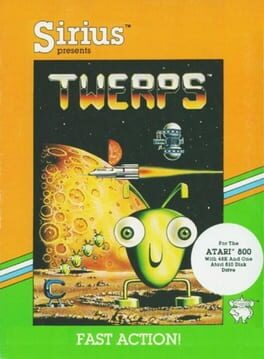
A single-screen shoot'em up in which the player has to destroy the space station of the Aspherions, the most feared space raiders of all time.

Shooter / Arcade / Action / Science fiction
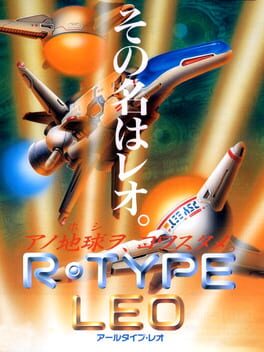
R-Type Leo is a horizontally scrolling shooter arcade game. It is a spin-off of the R-Type series and the last entry to be released in Arcades. R-Type Leo was initially an original shoot 'em up game in development by Nanao before Irem retooled it into an R-Type project instead. It is also the first R-Type game to feature simultaneous two player gameplay.

Shooter / Arcade / Action / Science fiction
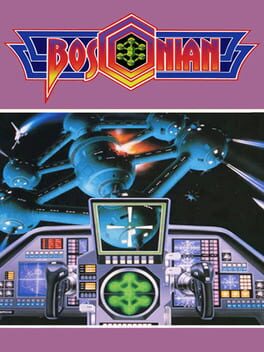
The object of Bosconian is to score as many points as possible by destroying enemy bases and ships. The player controls a small fighter ship that can move in eight directions and can fire both forward and backward. Each level consists of a number of green space stations that must all be destroyed to advance to the next level (a semi-transparent mini-map helps identify their location). Each station consists of six cannons arranged in a hexagon, surrounding a central core. The player must either destroy all six cannons or shoot the core to destroy a station, and in later levels the core is capable of defending itself. Additionally, the player must avoid or destroy asteroids, mines, and a variety of enemy missiles and ships that attempt to collide with the player's ship. Enemies occasionally launch formation attacks — destroying the leader causes all remaining enemies to disperse, but destroying all enemies in a formation scores extra bonus points. A spy ship (worth a random bonus value) also appears occasionally, which must be destroyed or the enemies will go berserk.

Shooter / Arcade / Action / Science fiction
Space Invaders Extreme combines the captivating essence of the original game with a stunning alliance of futuristic graphic design and cutting-edge audio. The gameplay experience has been developed to maximise on the consoles' abilities, offering players a whole new range of amazing features including a vast array of new power-ups.

Shooter / Arcade / Action / Science fiction
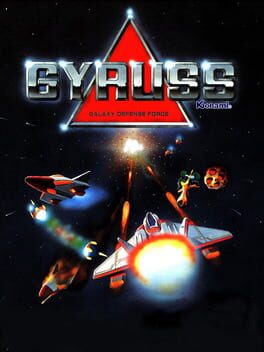
Gyruss is a shoot 'em up video arcade game developed by Konami, and released in 1983. It was designed by Yoshiki Okamoto, who had earlier created Time Pilot for Konami. Gyruss was licensed to Centuri in the United States, and was ported to numerous games consoles and home computers. It follows in the tradition of space war games such as Space Invaders and Galaga. Gyruss was the second and last game Yoshiki Okamoto designed for Konami, after Time Pilot. Due to pay disputes, he was fired after the release of this game, and soon joined Capcom, where he would write 1942 and the first Street Fighter game. The game's background music is an electronic, fast-paced arrangement of J. S. Bach's Toccata and Fugue in D minor, BWV 565; this particular arrangement is similar in sound to "Toccata", a rock arrangement by the UK-based instrumentalist group Sky. Gyruss is notable for using stereo sound, which according to the bonus material for Konami Arcade Classics, was achieved by utilizing discrete audio circuits. The game used three microprocessors: two Z80 microprocessors and one 6809, as well as an 8039 microcontroller. For the sound, five AY-3-8910 PSG sound chips and a DAC. Gyruss was released in both upright and cocktail cabinets. R.Hirst "KOO", M.Jones, "BOX" and the Elliott Brother's are arguably considered some of the best Gyruss players of the 1990's.