Developed by Capcom.
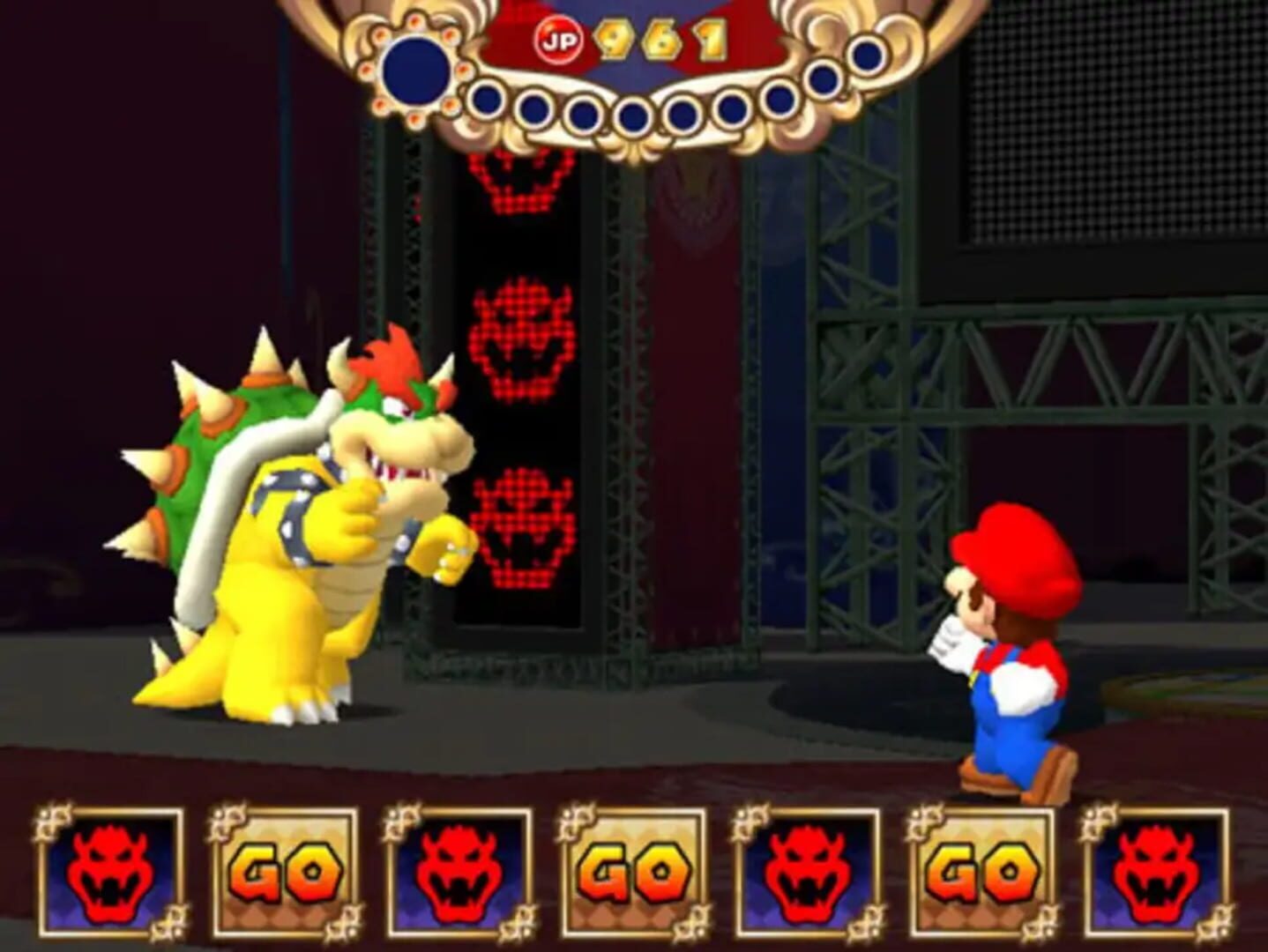
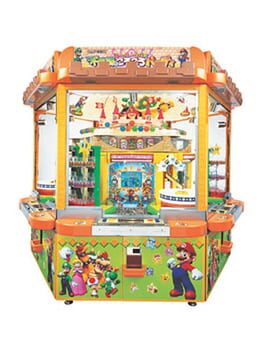
Super Mario: Fushigi no Koro-koro Party is an arcade remake of Mario Party 5 that was released exclusively in Japan. It is the first Mario Party arcade game to be developed by Capcom. The difference between this game and the console-based Mario Party game is that the game supports up to six players, instead of only four.

Card & Board Game / Comedy / Party
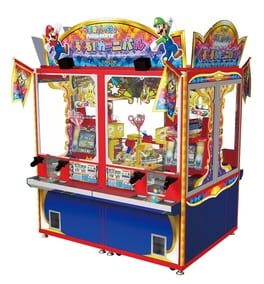
Mario Party Kuru-kuru! Carnival, is an arcade game based on Mario Party 8 that was developed by Capcom. The game was released exclusively in Japan in 2012, and supports up to four players. It is the fourth Mario Party arcade game developed by Capcom and the seventeenth installment overall.

Card & Board Game / Comedy / Party
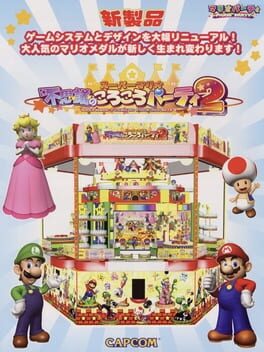
Super Mario: Fushigi no Koro-koro Party 2 is the sequel to Super Mario: Fushigi no Korokoro Party developed by Capcom. This arcade game is a Mario Party game released only in Japan and has all the usual characters playable. Eight to sixteen people could play the game. It is the eleventh installment in the series overall.

Strategy / Card & Board Game / Comedy / Party
Obocchamakun is a Miscellaneous game, published by Tecmo, which was released in Japan in 1991. This board game is played by up to four players, and the victory condition is to receive a kiss from the heroine. The map, which resembles a world map, is divided into Europe, Asia, the Soviet Union, Africa, North America, South America, the North Pole, the South Pole, and Tamba World (the underworld), and players must find the treasure demanded by the heroine among them. Treasures obtained by other players can be taken away by physical assault or by using items. Players can earn the necessary liking points to receive a kiss when they deliver the treasure they have found to a randomly selected city where the heroine is staying. When the player reaches the number of points set before the game begins, the player wins a kiss from the heroine.
Platform / Strategy / Card & Board Game / Comedy / Party
The Croods: Prehistoric Party! features the lovable Croods family: Grug, Ugga, Eep, Thunk, Sandy, Gran and Guy, on a hilarious adventure through 30 unique and addictive party-style mini-games. Explore spectacular landscapes in an incredible new world filled with never-before-seen creatures as you battle your friends and family in this awesome adventure with up to four friends in multiplayer gameplay.

Arcade / Card & Board Game / Comedy / Party
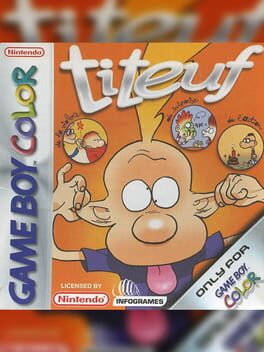
Titeuf is a party game for Gameboy. Nadia's picture was torn to thousand pieces. So you go on a treasure hunt with your friends. For each successful challenge, you win a piece of the picture. Playable alone or in multiplayer, 21 minigames are waiting for you.

Puzzle / Strategy / Card & Board Game / Comedy / Kids
"GORYUZIN ELECTRO" is a board game acknowledged for its quality by the Good Toy Committee in Japan in 1997. Based on the legend of the dragon, you have to compete connecting special frames and see to what extend can you proceed into your opponent's territory. No matter how many times you play, it is a fun game for everyone. The gameplay is difficult to explain, the goal of the game is to use all of the player pieces or use the ones that the player needs to reach to other part of the board, (for example the player starts in the bottom of the screen and have to reach the top) the harder part is to that before the opponent do it, both players compete to use their pieces to create obstacles that avoid the opponent to reach the other side, using the opening (that is too the closing piece) to close the line and get a point (or more depending of the pieces used). The game got a challenging gameplay but the difficulty level is really hard.

Strategy / Card & Board Game / Comedy / Party
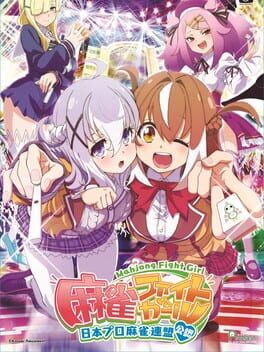
Mahjong Fight Girl is a mahjong video game developed and published by Konami and released for arcades on March 22, 2023 in Japan. It is the eighteenth game and a spin-off of the Mahjong Fight Club series.

Quiz/Trivia / Card & Board Game / Action / Party
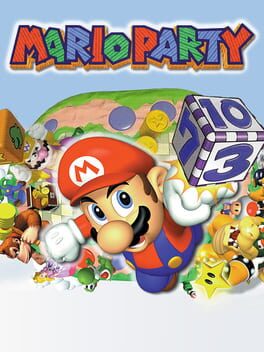
Every game in the main series has a standard Party Mode in which up to four players play through a board, trying to collect as many stars as possible. In every turn, each player rolls a die and progresses on the board, which usually has branching paths. Coins are primarily earned by performing well in a minigame played at the end of each turn. On most boards, players earn stars by reaching a star space and purchasing a star for a certain amount of coins. The star space appears randomly on one of several pre-determined locations and moves every time a star is purchased, usually occupying a blue space. Every Mario Party contains at least 50 to almost 110 minigames with a few different types. Four-player games are a free-for-all in which players compete individually. In 2-on-2 and 1-on-3 minigames, players compete as two groups, cooperating to win, even though they are still competing individually in the main game. Some minigames in Mario Party are 4-player co-op, even though it doesn't say it. In most situations, winners earn ten coins each.