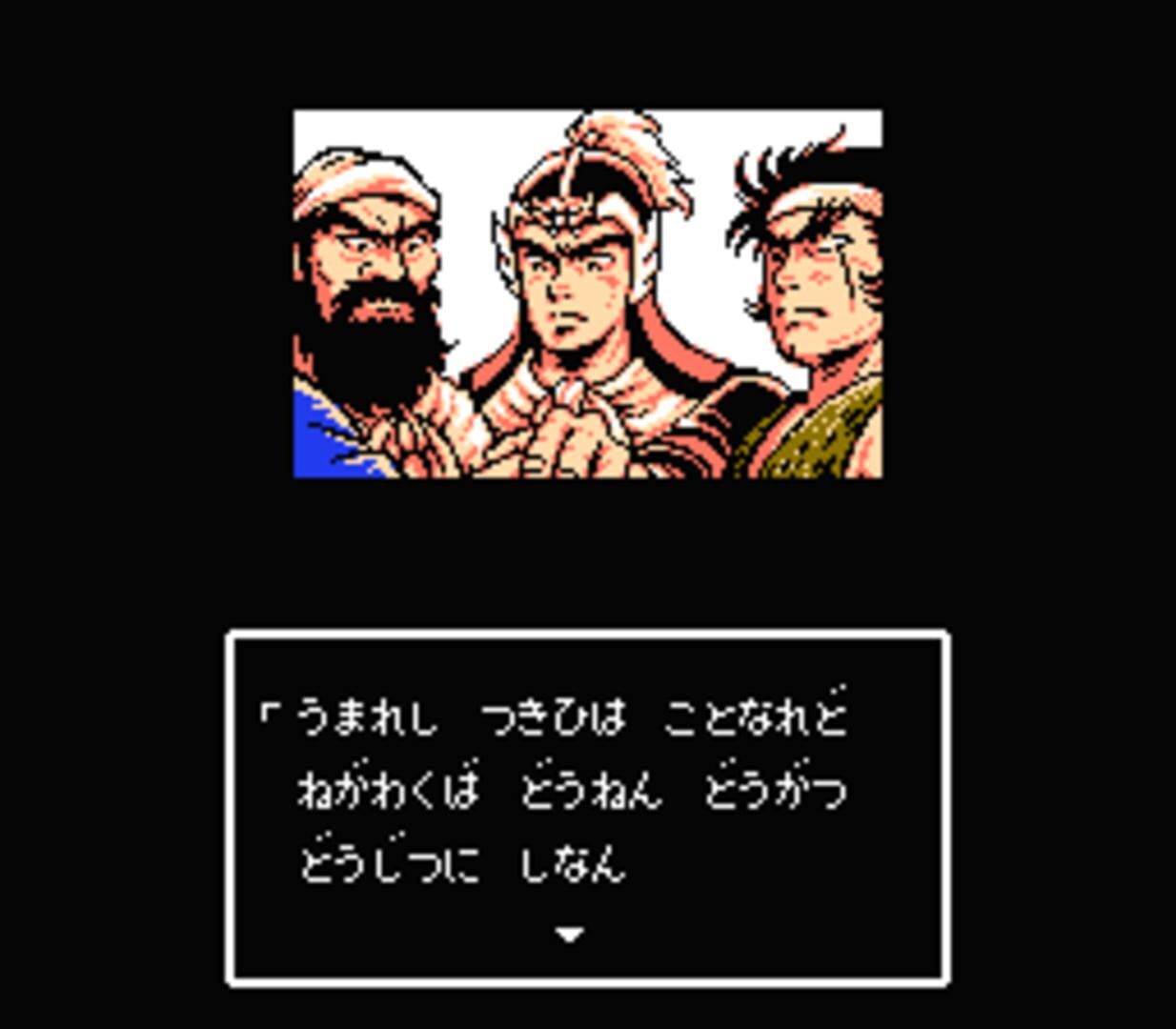
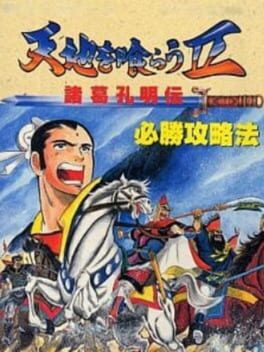
A Japanese roleplaying game published for the NES in 1991. Based on the manga Tenchi wo Kurau. Tenchi o Kurau II: Shokatsu Koumei-den ("The Devouring of Heaven and Earth II: The Story of King Ming") is a turn based roleplaying and strategy game developed and published for the Nintendo Entertainment System by Capcom on April 5th, 1991 in Japan. It is the second NES RPG produced by Capcom based upon the Tenchi wo Kurau manga series, the first being Destiny of an Emperor released in 1989. Gameplay: A traditional Japanese roleplaying game at its core, Tenchi o Kurai II puts the player in control of a party of warriors and mages as they try to take down a great foe that threatens the peace of their land. Throughout there are random encounters, boss battles, an experience system and valuable and/or useful loot. The player's party can hold up to seven members at a time, with one members acting as a "tactician". The tactician determines the list of tactics available for use by the player during battle.

Role-playing (RPG) / Strategy / Turn-based strategy (TBS) / Fantasy / Historical
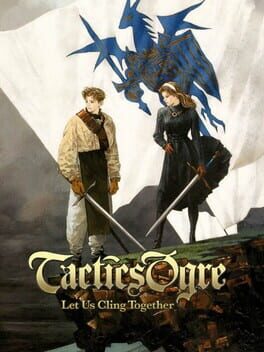
Tactics Ogre is a 3D isometric tactical role-playing game. The player starts out with a band of troops, builds a small army and fights many battles with choices to make in between, that will determine which one of the eight possible endings will be reached in a non-linear storyline. The player has the option to recruit characters, control individual equipment of each character, with over six male character classes, six female character classes, three demi-human classes, and more. It is also possible to train at safe locations to prepare the army before the next battle or storyline advancement.

Role-playing (RPG) / Strategy / Fantasy / Historical
Dark Law is a Role-Playing game, developed by SAS Sakata and published by ASCII Entertainment, which was released in Japan in 1997.

Role-playing (RPG) / Strategy / Turn-based strategy (TBS) / Fantasy / Historical
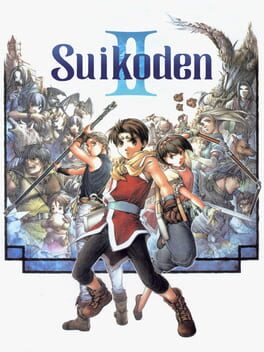
Suikoden II is a role-playing game developed and published by Konami for the PlayStation. Set in a world of warring nations, the game follows a silent protagonist caught between the Kingdom of Highland and the City-States of Jowston. Gameplay combines turn-based party combat, one-on-one duels, and grid-based strategic army battles. Players can recruit over 100 characters, many of whom join the party or contribute to a home base that expands throughout the game. Save data from the original Suikoden can be imported to carry over certain characters and story details.

Role-playing (RPG) / Strategy / Adventure / Action / Fantasy
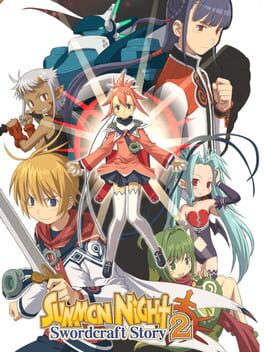
In Summon Night: Swordcraft 2, the player is an orphan from the Colthearts clan raised by a Craftknight (a smith/warrior). The character aspires to be a Craftknight as well. The player character, either Edgar Colthearts or Aera Colthearts, who are Edge Fencers, find themselves at the site of an abandoned ruin where a violent Summon Beast named Goura is awakened. In order to protect their new family, Edgar/Aera is bound to a wild Summon Beast (stray summon) and embarks on a journey to reseal the ruins.

Role-playing (RPG) / Strategy / Turn-based strategy (TBS) / Action / Fantasy
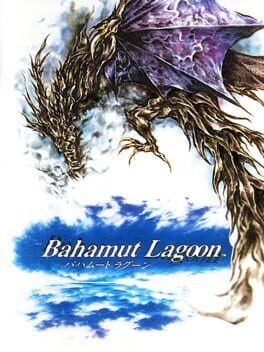
Bahamut Lagoon combines RPG mechanics with squad-based combat. Characters have HP, MP (SP for fighter characters), EXP, equipment, stats and class-specific, SP-draining special elemental abilities very much like traditional console RPGs. The player can explore his surroundings, talk to people and visit shops when not in battle, though to a limited degree as there is no world map and no way to leave the current area. The game's core is its turn-based battles fought on a 2d grid. Characters are assembled into parties of four and the player allowed a maximum of six parties, which are usually well outnumbered. The two opposing sides act in alternating turns so that each party can move once and/or attack once a turn. Attacks are divided into distant and close-up combat. In the former, a party uses a special ability (e.g. casting fireballs, throwing lightning, healing allies) of one of its members at a distance. The range and possible area of effect damage vary per ability. If the attacking party has two or more characters with the same ability, they join in the action to multiply its effectiveness. Distant combat results in less money and generally less damage, but the target cannot retaliate. Distant attacks can also affect the field; fire and ice ignite or extinguish forests and melt or freeze ice, etc. Close-up, each unit in two adjacent opposing parties can act once. Very much like Final Fantasy SNES combat, they can attack an enemy, use an item or a special ability (though these can't be combined and most only affect one target instead of all) or defend. Dragons are the player's ace in the hole. They have their own stats and gain experience like normal characters do. In battle, each party has a dragon attached to it and draws a large portion of its strength from that of its dragon: if a party's dragon is slain, the party will lose the ability to use special attacks and class-specific abilities for the remainder of the map. The beast acts as a very powerful autonomous unit that moves after its party does and it cannot be controlled beyond very simple commands, e.g. "Come!" Out of battle, dragons will eat anything and raising them by feeding them items is an important part of the game. Feeding can improve their stats as well as affect their behavior on the field, and the dragons develop into new forms as they grow. The player can change the characters in each of the parties, their formation as well as what dragon represents them at will.
Role-playing (RPG) / Strategy / Turn-based strategy (TBS) / Fantasy / Historical
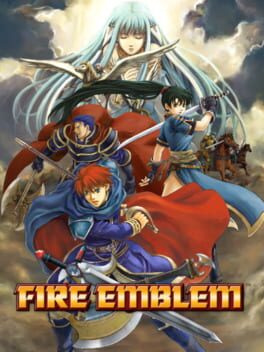
It is the seventh game of the Fire Emblem series, the second game in the series to be released for the Game Boy Advance, and the first to be released in both North America and Europe. It features a prologue storyline designed to introduce newcomers to Fire Emblem gameplay and tactical basics. The overall narrative is a prequel to the events of the previous game, Fire Emblem: The Binding Blade, which is set twenty years later. The game was first released under the localized title "Fire Emblem" in the West, but it was later rebranded as "Fire Emblem: The Blazing Blade" when Fire Emblem Heroes was released.

Role-playing (RPG) / Strategy / Action / Fantasy
Diablo is an isometric strategy RPG and one of the most well-known examples of the action-RPG subgenre. Although some of the game mechanics resemble a typical RPG, all actions are done in real-time just like in an action game. The player have to kill hordes of monsters through randomized dungeon levels in order to gain experience points, gold and a variety of equipment to bolster the hero's monster-killing potency.

Role-playing (RPG) / Strategy / Turn-based strategy (TBS) / Fantasy
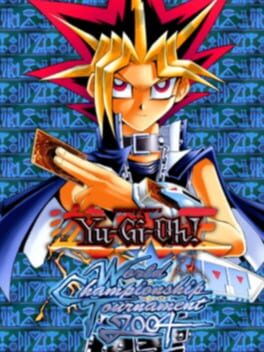
Find out who's the best card-battle player in Yu-Gi-Oh! World Championship Tournament 2004. Construct your monster cards, spell cards, trap cards, and special summon cards into three separate decks for different dueling strategies. You can conquer the tournament solo or link up with a friend in a multiplayer battle. With over 1000 game cards and dozens of popular characters from the Yu-Gi-Oh! TV series, the excitement and exhilaration of the Yu-Gi-Oh trading card game is captured in full force.