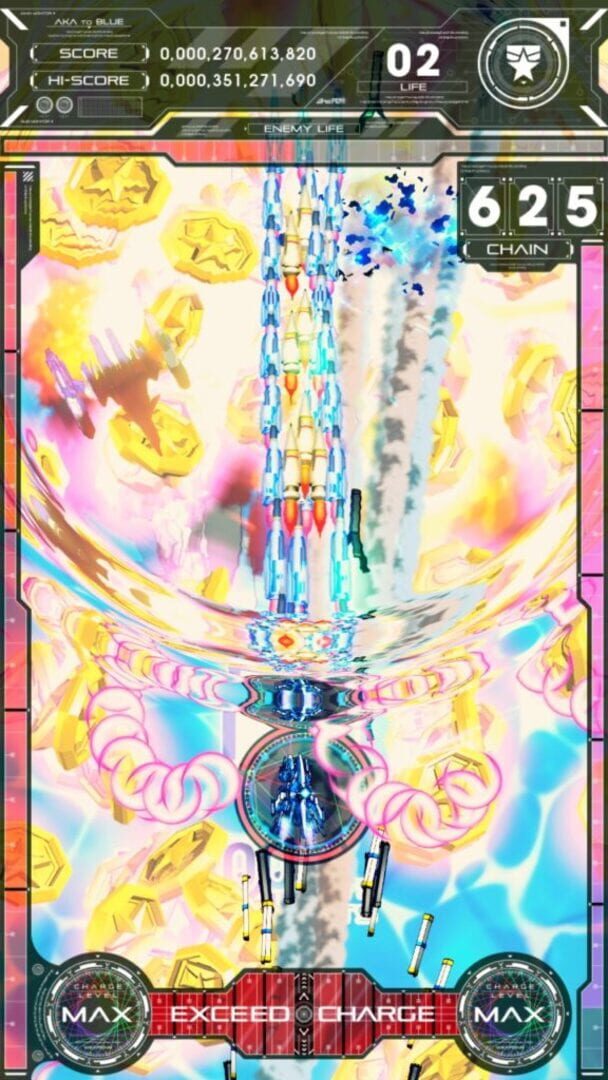
Screenshots
Featured in

Shooter / Puzzle / Indie / Action / Science fiction
In this vertical scrolling spaceship shooter, you control a ship that can change its polarity at will. As blue/white, the ship can easily destroy red/black enemies, and vice versa. Bullets of your polarity can be collected to fuel your energy gauge, but those opposite will kill you. Destroying an enemy ship causes them to fire revenge bullets which can be absorbed and fired back by the player. Different difficulties exist to change exactly how you interact with polarized points, or how they appear. It is the spiritual successor to Radiant Silvergun, featuring similar level and boss design, as well as it's buddhism inspired themes and aesthetics. Both are directed by Hiroshi Iuchi, who also composed Ikaruga's soundtrack.
Shooter / Arcade / Action / Science fiction
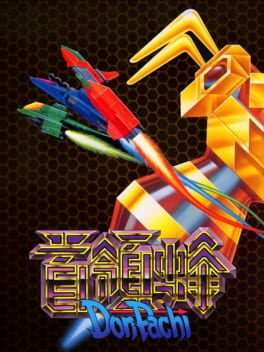
DonPachi is a 1995 vertical manic shoot-'em-up originally in arcades and was the first game from the developer Cave. Settings are mainly woodland and enemies are military vehicles and robots, culminating in the final boss, a huge robotic bee. One of three weapon configurations is chosen at start and then leveled up through dropped power-ups. DonPachi was ported to the Sega Saturn and Sony Playstation in 1996.
Shooter / Arcade / Science fiction
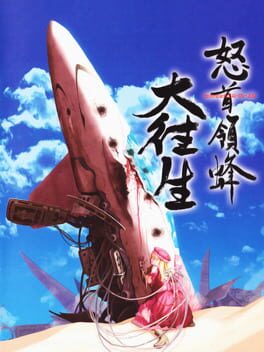
The fourth game in the Donpachi series.
Shooter / Arcade / Science fiction
Unlike in most other shoot 'em ups, there are no power-ups. All weapons are available from the start. Weapons can 'level up', however, becoming more powerful as the player uses them to score points. There are a selection of 7 weapons that can be used at any given time: The game is designed so that there is almost always a 'right' weapon for any situation. The bosses in the game are designed so that they have multiple 'sections' which, if all destroyed before the 'core' of the boss, will award the players with point bonuses. Being able to apply the right weapons on any different boss is key to obtaining these bonuses. For example, a boss may have two sections located on either side of the screen. You could immediately go up to one and begin shooting it with a vulcan, or you could hover in the centre and hit both at the same time with the side bombs. This would increase your chance of obtaining the bonus before the time limit runs out and the boss self-destructs. The game rewards players for "chaining" enemies of just one of three colors, red, blue, or yellow. Whenever the player kills three enemies that are of the same color, who can obtain a points bonus. This also facilitates faster upgrading of weapons.
Shooter / Arcade / Science fiction
Compared to DonPachi, DoDonPachi is generally known for introducing new gameplay elements while improving or changing existing ones. The overall background of the game, unlike following sequels, remains more or less centered around a supposed invasion by a mysterious race of mechanized aliens, which the player is called to face throughout its run. However, more sinister and shocking secrets lie beneath the surface, accessible only to those brave and skilled enough to clear the entire game.

Shooter / Arcade / Action / Science fiction
DoDonPachi SaiDaiOuJou is a vertical scrolling shoot 'em up arcade game released by Cave in 2012. It's the sixth chapter in CAVE's DonPachi series. A Japanese region-free release was released on May 30, 2013.

Shooter / Arcade / Science fiction
Prepare yourself for one of the most intense shoot ‘em ups to hit Nintendo DSiWare. Your mission is simple: get the highest score possible, across eight phases of fierce vertical-scrolling action.
Shooter / Arcade / Action / Fantasy
Batsugun is a vertically scrolling shoot 'em up video game created by the now-defunct Japanese game developer Toaplan. The title translates to "exceptional" or "extraordinary". It was the final game created before Toaplan's dissolution, and has been regarded as a key title in the development of the modern manic shooter, with elements of the game such as the size of the player's hitbox, the scale of their firepower, and the complexity of enemy bullet patterns all having an influence on future titles in the sub-genre. Members of the development team also went on to work on other successful manic shooters, most notably lead artist Junya Inoue.