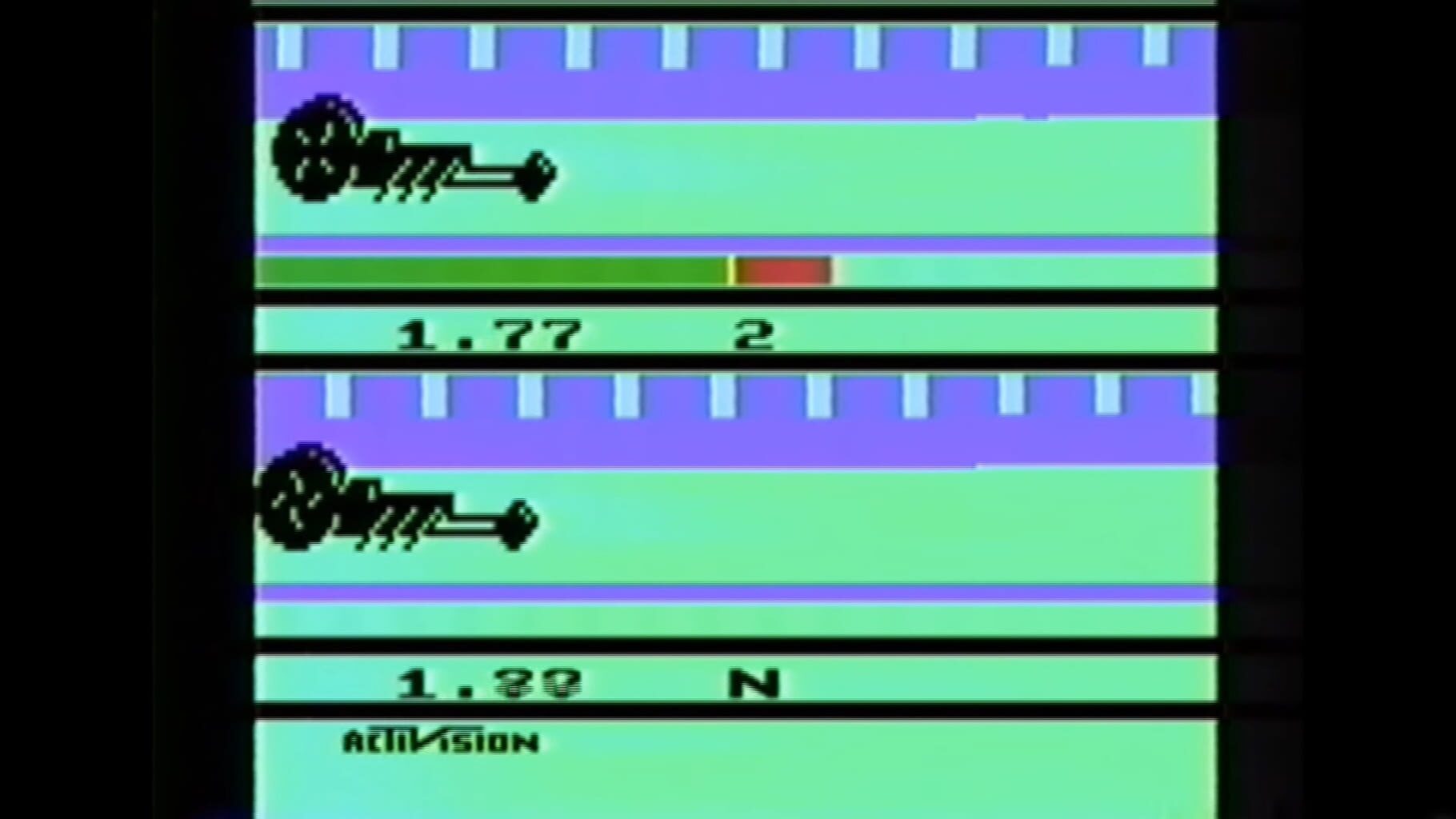

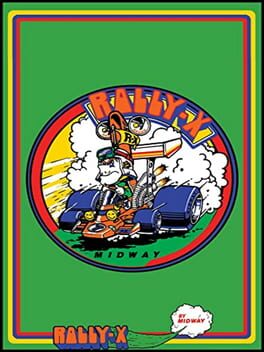
You have in your hand one of the most exciting video games ever designed. One word of caution: this game takes a little time to learn because it's so challenging. It's very tricky. So, please read these directions and give yourself some practice time. Then you can aim for the World Record. Game 1: Straight-ahead Dragster, one or two players. Game 2: Steerable Dragster, one or two players. Your Joystick Controller is both the clutch and gear shift for your Dragster; the red button is your gas pedal. Use left Joystick for the top car; right one for bottom car. Hold Joystick with button at the upper left. To shift gears, clutch by pushing Joystick to the left and shift by letting the Joystick spring back to the center. Your car starts each race in neutral (N). There are four gear positions--1, 2, 3, 4--and you must clutch and shift between each gear. You cannot downshift. When the countdown reaches 0, you can start. If you drop into gear too soon, before the end of the countdown, EARLY will appear on the screen and you have to wait for the next race. You can clutch during the countdown, but you cannot drop into 1st until the countdown reaches 0. The object of Dragster is to beat your opponent across the screen, or to race against the clock for best time.
Racing / Sport / Arcade / Action
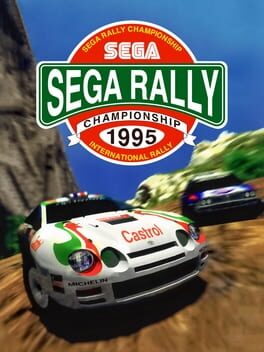
Sega Rally Championship is a 1994 arcade racing game developed by AM5 on the Sega Model 2 board. The unique selling point of Sega Rally was the ability to drive on different surfaces (including asphalt, gravel and mud), with different friction properties, with the car's handling changing accordingly. As the first racing game to incorporate this feature, Sega Rally is considered to be one of the milestones in the evolution of the racing game genre. The music for the arcade game was composed by Takenobu Mitsuyoshi, while the Sega Saturn port's soundtrack was done by Naofumi Hataya and the Guitar were played by Joe Satriani.

Racing / Action / Non-fiction
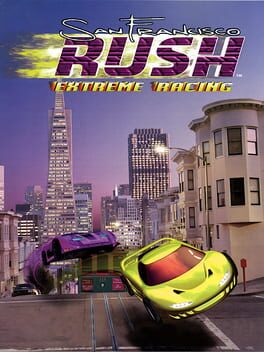
San Francisco Rush: Extreme Racing is the first game in the Rush series. Tne N64 version contains six regular tracks and two hidden tracks. The regular tracks can be run in either reverse or mirrored modes and feature added collectible hidden keys throughout the track that can be used to unlock hidden vehicles. It also contains a Practice Mode and a Death Race mode where the game ends if the player crashes. The N64 port of Rush also includes a Circuit Mode and a save system for Fast Times, circuit progress, and hidden keys that the player can find on secret spots to unlock new cars.

Racing / Arcade / Action / Non-fiction
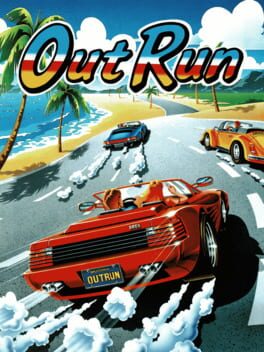
OutRun is a racing game originating in the arcades. The player can race across varied terrain in a readily available Ferrari, complete with a female passenger, over a series of short tracks. Gameplay is viewed form just above and behind the car. The roads are full of sharp bends and hazards, contact with which can cause the car to roll and lose the player's time. On each section of track there is a fork in the road, allowing the player to choose which direction he or she wishes to go in. The player has to to complete five track sections in total, out of the fifteen in the game.

Racing / Sport / Action / Non-fiction
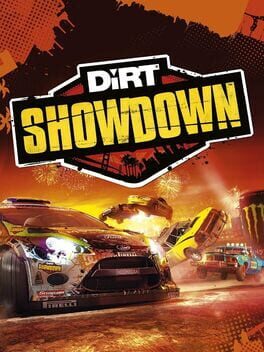
Race, crash and hoon your way through a world tour of motorised mayhem in DiRT Showdown! Crowd atmosphere, social gameplay and accessibility are all ramped up in this turbo- injected shot of driving delirium. Smash down the accelerator and earn the adulation of frenzied crowds at hyper-energised events at iconic locations. Trick, speed and smash your way to victory, then do it again.

Shooter / Racing / Action / Thriller
Twisted Metal: Head-On is a vehicular combat video game developed by Incognito Entertainment and released by Sony on March 24, 2005 for the PlayStation Portable and February 5, 2008 for the PlayStation 2. Head-On shares not only the distinction of being the seventh game released in the Twisted Metal series, but also is the first game in the series to ship fully online-enabled.

This game was the first game released for the Sega Model 1 arcade platform, and also the first to use the name "Virtua" in its title (something which would be followed by numerous Sega arcade games, including Virtua Fighter, Virtua Cop and Virtua Tennis. It is considered a milestone in 3D graphics and the racing genre, and acts as a foundation for most modern racing games.