
Shooter / Strategy / Arcade / Action / Science fiction
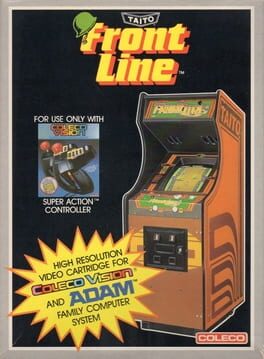
Front Line is a vertically scrolling action game. Your mission is to infiltrate enemy territory and destroy their fortress. To reach the fortress, you will have to make your way through varied and dangerous terrain. Jungles, deserts, brush, and rocks all slow your progress, plus each area has numerous enemy fighters and tanks trying to stop you. To help get past these obstacles, you are armed with a machine gun and grenades; at some points in the game you may even come across an abandoned tank which you can control to increase your odds of survival. When you reach the end of the level and successfully destroy the fortress, the game will repeat at a higher level of difficulty. Gameplay is for one or two players, and four different skill levels are available.
Shooter / Arcade / Action / Science fiction
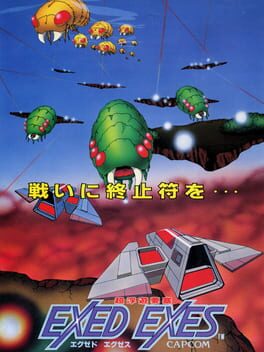
On a planet 6000 light-years from earth, there were creatures called Exes, which resemble large insects, that were used for industrial purposes. However, these creatures one day took to revolting against their creators. Two battle machines have been sent to fight against the Exes, known as Colonel and Sargent. The Exes are nearing completion of their secret weapon, Exed Exes, and they must be defeated before this is allowed to happen! Exed Exes is a basic vertical scrolling shooter; the game scrolls forward, and the player can maneuver their ship around the screen to shoot enemies and avoid attack. POW icons sometimes appear that can power up the ship or turn enemies into fruit that are worth extra points. The game can be played either solo or two-player cooperatively.
Shooter / Arcade / Action / Science fiction
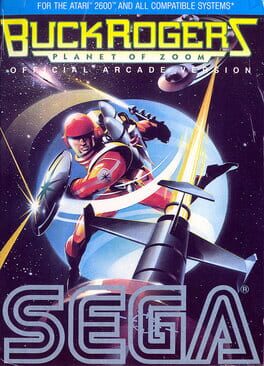
Sega released the arcade video game Buck Rogers: Planet of Zoom in 1982. It was a forward-scrolling rail shooter where the user controls a spaceship in a behind-the-back third-person perspective that must destroy enemy ships and avoid obstacles; the game was notable for its fast pseudo-3D scaling and detailed sprites. The game would later go on to influence the 1985 Sega hit Space Harrier, which in turn influenced the 1993 Nintendo hit Star Fox. Buck is never seen in the game, except assumedly in the illustration on the side of the arcade cabinet, and its only real connections to Buck Rogers are the use of the name and the outer space setting. Home versions were released for the Atari 2600, Atari 5200, Atari XE, ColecoVision, Coleco Adam, Intellivision, MSX and Sega SG-1000 video game systems, and the Commodore VIC-20, Commodore 64, Texas Instruments TI-99/4A, Apple II and ZX Spectrum computers. A version for IBM PC using CGA graphics was also available.
Shooter / Arcade / Action / Science fiction
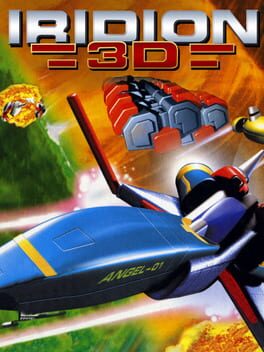
In the distant regions of our galaxy, far beyond the darkest limits of the Orion Nebula, a deadly force has bee unleashed upon the universe and is heading straight for Earth. Get ready to travel forward to a time, when the fate of the universe rests in the palm of your hands! - See more at:
Shooter / Arcade / Action / Science fiction
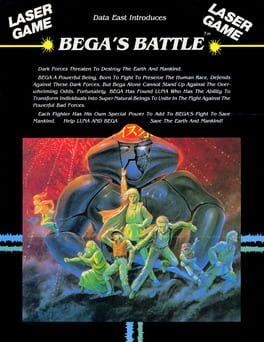
Data East used footage from the film Harmagedon to create a laserdisc video game titled Bega's Battle. It was released in June 1983. In the game, the player to take on the role of the robot Bega (Vega) whose goal was to stop the invasion forces of the alien Varga (Genma), while also rescuing his three friends who had been kidnapped by them. Even among laserdisc games Bega's Battle has become somewhat rare because many of the machines were converted into Cobra Command machines as part of a discount deal offered by Data East in exchange for the internals of the Bega's Battle arcade cabinet. Similar to Astron Belt, the game used the footage mainly for backgrounds, while the actual gameplay was a shooting game with sprites laid over the video. Bega's Battle also used brief full-motion video cut scenes to develop a story between the game's shooting stages. Years later, this would become the standard approach to video game storytelling. Bega's Battle also featured a branching storyline. The Twin Galaxies world record for Bega's Battle was set by Steve Harris (later the founder of Electronic Gaming Monthly) on July 18, 1983.
Shooter / Arcade / Action / Science fiction
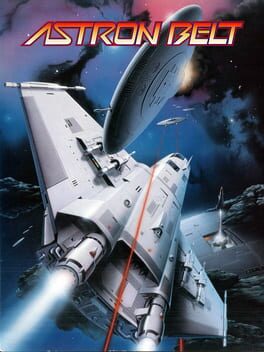
The player controls a lone spacecraft on a mission to singlehandedly take down the entire enemy armada. Enemy fighters and ships shoot at the player, and there are mines and other objects that must be shot or avoided. The game is divided into waves. At the end of each wave is a command ship that must be destroyed. In later waves the enemy fighters move and shoot more aggressively, and their shots are more accurate. Some waves take place in open space, while others require the player to battle enemies while flying through narrow trenches and tunnels. The player is on a timer at the beginning of the game, with an unlimited number of lives available. The length of the timer can be adjusted by the machine operator, but is normally 60 seconds. After the timer expires, the player is given a limited number of additional lives. When all of those lives are lost, the game ends.

Shooter / Puzzle / Indie / Action / Science fiction
In this vertical scrolling spaceship shooter, you control a ship that can change its polarity at will. As blue/white, the ship can easily destroy red/black enemies, and vice versa. Bullets of your polarity can be collected to fuel your energy gauge, but those opposite will kill you. Destroying an enemy ship causes them to fire revenge bullets which can be absorbed and fired back by the player. Different difficulties exist to change exactly how you interact with polarized points, or how they appear. It is the spiritual successor to Radiant Silvergun, featuring similar level and boss design, as well as it's buddhism inspired themes and aesthetics. Both are directed by Hiroshi Iuchi, who also composed Ikaruga's soundtrack.