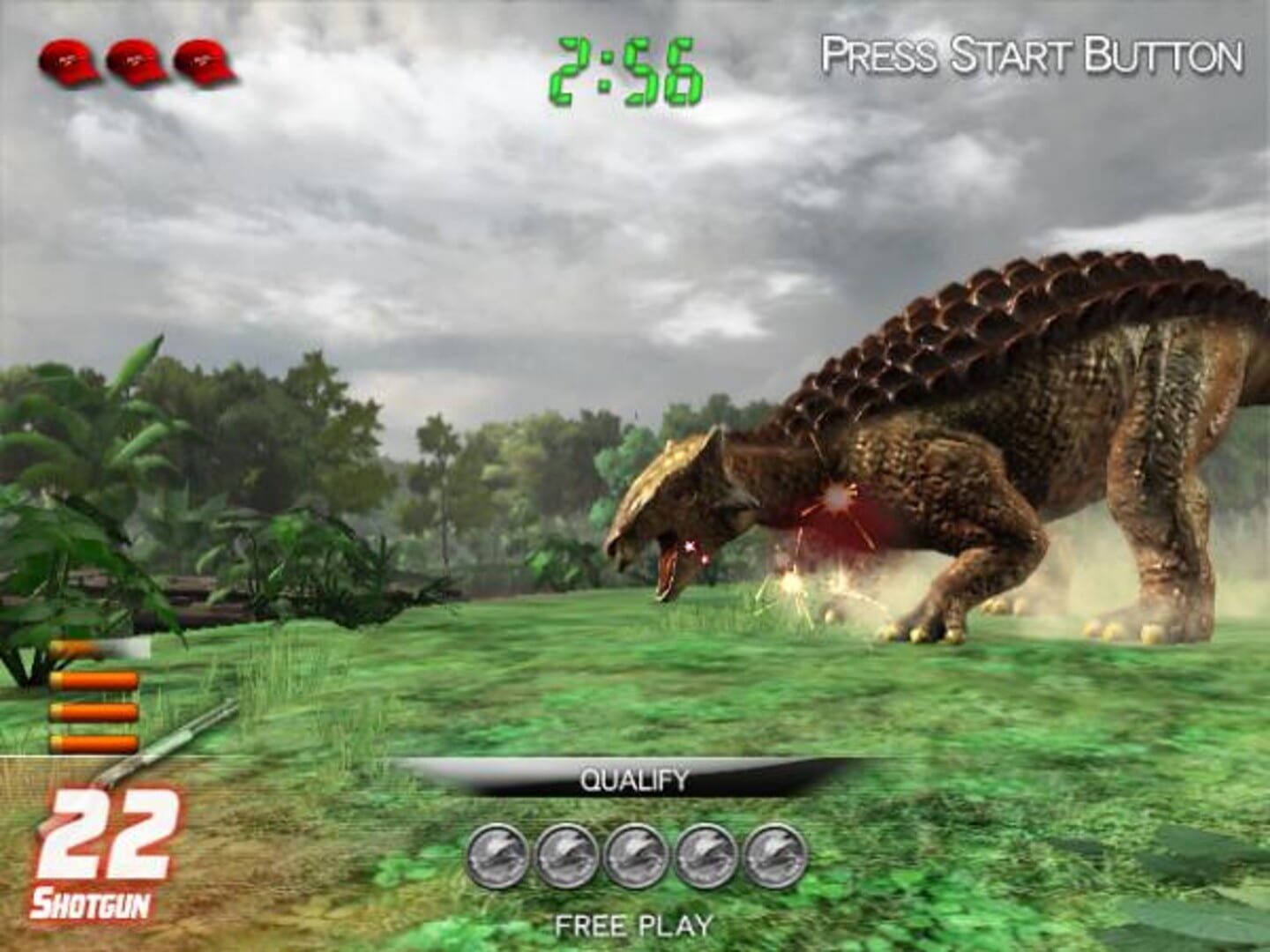
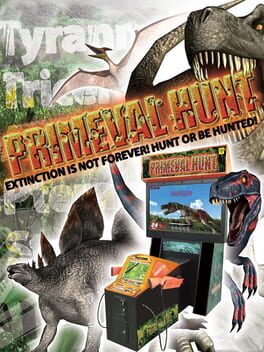
Primeval Hunt is a shooting arcade game which is developed and published by Sega and runs on their Sega Lindbergh hardware. It comes in both standard and deluxe models, with the deluxe version featuring a 62" HD Screen. Released for arcades in early 2008, players in the game must hunt 10 species of dinosaur over 12 levels and 3 Bonus stages using light guns styled after pump action shotguns with speakers mounted for the first time in the 'butt' of each gun. The game also utilizes a unique touch screen interface to give a free-roaming element to the gameplay. It is similar to the Big Buck Hunter arcade games.

Shooter / Arcade / Action / Science fiction
A shmup where you kill dinosaurs.

Shooter / Arcade / Action / Science fiction
Moving from one room to the next within the studio/arena, players have to shoot down hordes of enemies as they advance from all sides, while at the same time collecting weapons, power-up items, and assorted bonus prizes until a final show down with the show's host where you are finally granted your prizes, your life and freedom. One of the enemies is fat and is named Mr. Shrapnel who roams aside of the walls of some rooms and after a short period of time he explodes.

Time Crisis is a light gun shooter arcade game released by Namco in December 1995. It was later ported for the PlayStation in 1997, bundled with the Guncon light gun controller. Time Crisis is a three-dimensional first-person rail shooter similar to Virtua Cop and The House of the Dead installments, in which the player uses a light gun to fire at on-screen enemies. Time Crisis is best known for its cover system, in which players can duck behind cover to avoid enemy fire and reload their weapons. There are three stages, each consisting of three areas and a boss battle. The unique features are described below. A foot pedal that performs multiple functions: when the pedal is released, the player takes cover to conserve hit points while reloading the gun. While the pedal is released, the player cannot attack. In console conversions, a button command replicates the foot pedal's functions. The player loses a life if he/she is hit by a direct bullet or obstacle whilst not taking cover, with the game ending if he/she loses all lives. A light gun (introduced in Point Blank), which utilized a special memory chip to synchronize areas of the screen's image as the player rotated the gun around. The light gun also features a blowback function, which simulates real-life gun recoil. A countdown timer, recharged by clearing an area of enemies. As running down the clock causes an instant game over, the player must take risks, shooting enemies rapidly and hiding only when necessary. A time extension is rewarded when an area is passed, and there are also time bonuses awarded for shooting certain enemies quickly. The PlayStation port features an exclusive side-story mode, in which the player's performance, such as how quickly he can clear an area, affects the path he takes through the game, resulting in multiple possibilities.
Shooter / Arcade / Action / Science fiction
Time Crisis II is a light gun arcade game and the second installment in the Time Crisis series. It introduces co-operative multiplayer to the franchise. The game was first released in arcades in April 1998, with an enhanced port released on the PlayStation 2 in October 2001, bundled with the GunCon 2 controller.

Shooter / Indie / Arcade / Action / Science fiction
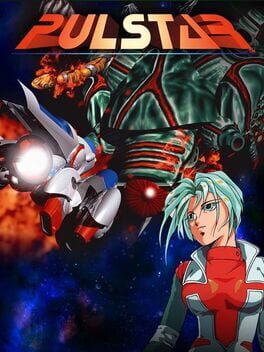
The basic gameplay is simple: progress through the levels in the spacecraft, collecting powerups and protecting the spacecraft from destruction. The game has very obvious similarities in design and gameplay to R-Type. It is actually believed that some ex-Irem employees left the company to join Aicom, which used to be a subcontractor for various coin-op manufacturers like Jaleco or SNK. Despite the familiarities, Pulstar is not without innovations. There is the option of using the weapon power bar, which consists of two halves. The right-hand side of the bar turns blue when the fire button is depressed. When fully charged the ship delivers a devastating emission of energy. The left-hand side turns red when it is continually pressed, shooting out a barrage of smaller, rapid blasts. The in-game visuals are mostly pre-rendered 3D graphics, which gives the interactive elements a far more realistic appearance. Great care was taken to really place the player into the world of the game, with cinematic style cut scenes and pre-rendered movies. There is a hefty reliance on strategy and not just blasting everything in sight. Using the charged weapon is key, and requires careful precision. Also, once a power up is obtained, a small orb appears at the posterior end of the ship. This can be used as an advantage by deflecting/absorbing oncoming enemy fire and taking out small enemies that run into it.

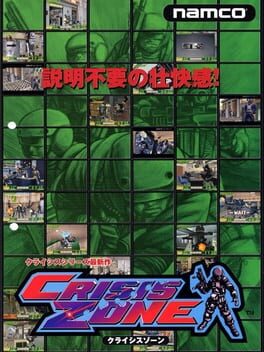
Crisis Zone is a light gun arcade game released by Namco in 1999, a spin-off of the Time Crisis series. As a feature, it handles a large machine gun type controller instead of a handgun like the conventional work. In 2004, the Playstation2 version was released with Guncon2 support.