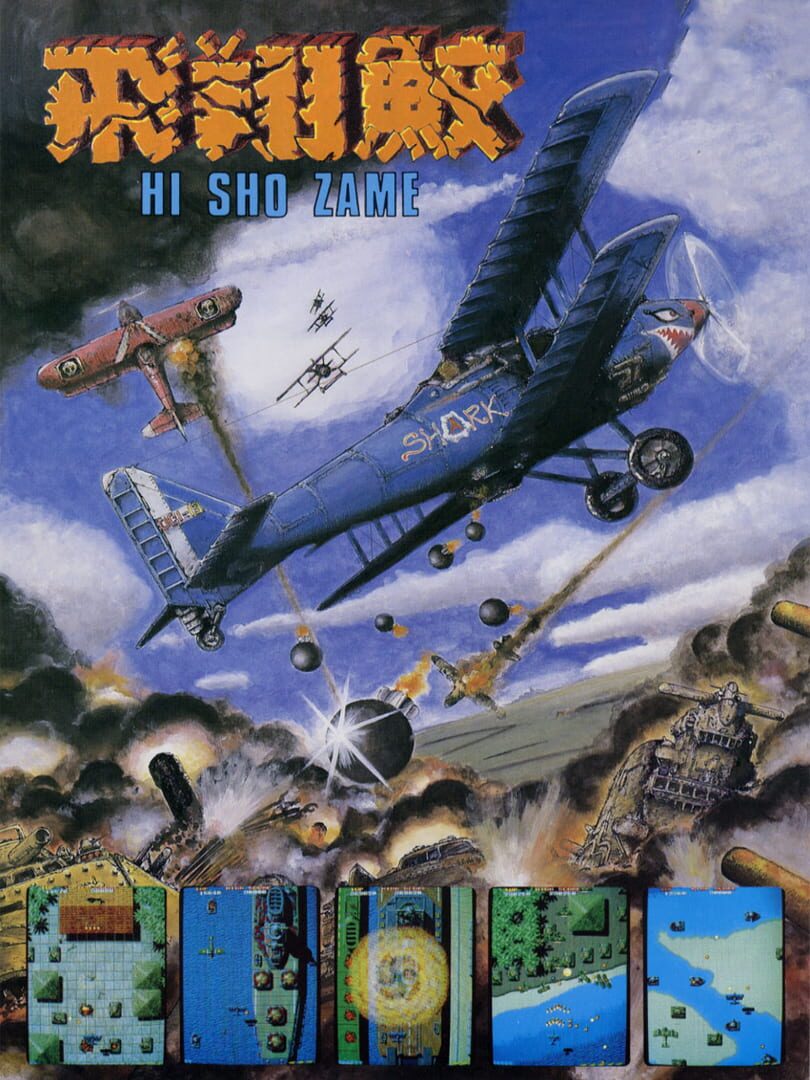
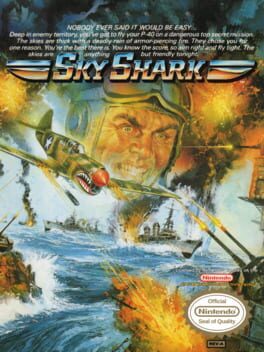

Sky Shark (released in Japan as "Hi Sho Zame", and in Europe as "Flying Shark")is a military-themed vertically scrolling shoot 'em up game in which players take control of the titular biplane through five increasingly difficult levels in order to defeat an assortment of military enemy forces like tanks, battleships, airplanes and artillery as the main objective. The title initially appears to be very standard, as players control their plane over a constantly scrolling background and the scenery never stops moving until a runway is reached. Players have only two weapons at their disposal: the standard shot that travels a max distance of the screen's height and three bombs. The bombs are powerful weapons capable of obliterating any enemy caught within its blast radius. Various items are scattered through every stage that appear by destroying certain enemies: Shooting down colored waves of enemy planes spawn items like "S" power-up icons, point bonuses and extra lives. Certain enemies on the ground spawn "B" icons that increases the player's bomb stock when destroyed. Every time the player lands at a runway beyond the first takeoff, the amount of bombs multiply 3000 points to the player's total score. Players are given three lives initially and bonus lives are awarded at 50000 points and thereafter. The game employs a checkpoint system in which a downed single player will start off at the beginning of the checkpoint they managed to reach before dying. Getting hit by enemy fire will result in losing a live, as well as a penalty of decreasing the plane's firepower to his original state and once all lives are lost, the game is over unless players insert more credits into the arcade machine to continue playing. Completing the last stage restarts the game with the second loop increasing in difficulty.
Shooter / Arcade / Action / Historical
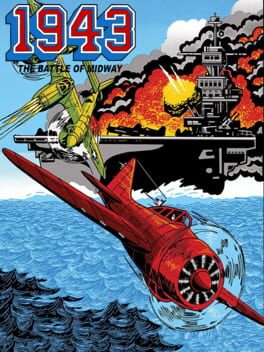
The game is set in the Pacific theater of World War II, off the coast of the Midway Atoll. The goal is to attack the Japanese Air Fleet that bombed the players' American Aircraft Carrier, pursue all Japanese Air and Sea forces, fly through the 16 levels of play, make their way to the Japanese battleship Yamato and destroy her. 11 Levels consist of an Air-to-Sea battle (with a huge battleship or an aircraft carrier as an End-Level Boss), while 5 levels consist of an all-aerial battle against a squadron of Japanese Bombers and a Mother Bomber that needs to be destroyed. As in 1942, players pilot a P-38. Two buttons are used: one for regular attacks (with several weapons) and one for special actions that executes either a loop like in 1942 or one of three special attacks that damage the plane. Unlike 1942, the player only has one life, with one refillable energy meter. Destroying a complete formation of red enemy planes will result in a power-up, such as a health boost or a temporary special weapons which replaces the default twin gun.

Shooter / Arcade / Action / Fantasy
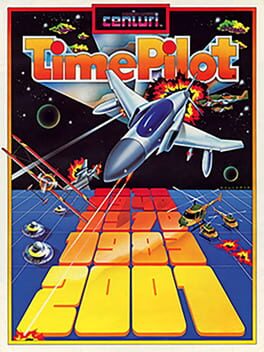
Time Pilot is a multi-directional scrolling shooter and free-roaming aerial combat arcade game designed by Yoshiki Okamoto, released by Konami in 1982, and distributed in the United States by Centuri. Debuting in the golden age of video arcade games, it is a time travel themed game that allowed the player's plane to freely move across open air space that can scroll indefinitely in all directions. The Killer List of Videogames included Time Pilot in its list of top 100 arcade games of all time. The player assumes the role of a pilot of a futuristic fighter jet, trying to rescue fellow pilots trapped in different time eras. The player must fight off hordes of enemy craft and defeat the mother ship (or "boss") present in every level. The background moves in the opposite direction to the player's plane, rather than the other way around; the player's plane always remains in the center.

Shooter / Arcade / Action / Warfare
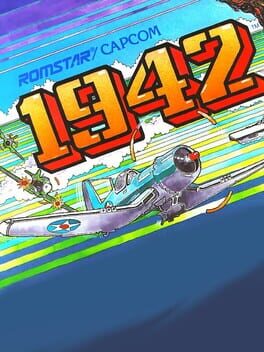
1942 is a vertically scrolling shoot 'em up made by Capcom that was released for the arcade in 1984. The goal is to reach Tokyo and destroy the entire Japanese air fleet. The player pilots a plane dubbed the "Super Ace" . The player has to shoot down enemy planes; to avoid enemy fire, the player can perform a roll or "loop-the-loop". During the game the player may collect a series of power-ups, one of them allowing the plane to be escorted by two other smaller fighters in a Tip Tow formation.

Shooter / Arcade / Action / Fantasy
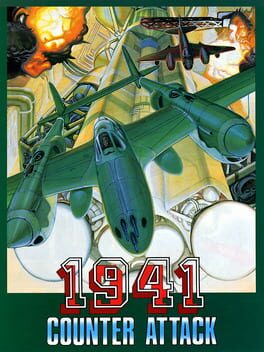
The year: 1941. The place: 20,000 feet in the air over the North Atlantic. Lightning flashes across the skies of war-torn Europe. Your mission: beat back the imperial forces before they can use their new weapon! In 1941: Counter Attack, the goal is to shoot down enemy airplanes and collect weapon power-ups. It is the prequel to 1942, and the third game in the 19XX series.

Shooter / Adventure / Arcade / Action / Science fiction
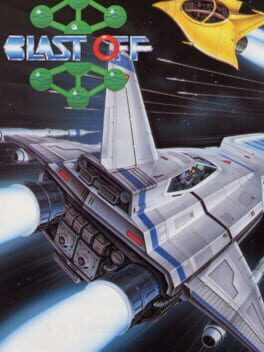
As in many other vertical scrolling shooters (including Namco's own Xevious), the player controls a ship, facing the top of the screen, that can move freely while the background scrolls down, bringing enemies in to view; the player may destroy enemies for points. The game uses two buttons - one is used to make the ship fire circular lasers, while the other is used to cycle through its four firing patterns. The red pattern is two lasers in a spiral pattern, while the blue one is one laser straight ahead and one behind, the yellow one is one laser straight ahead, one left, and one right and the green one is two lasers diagonally forward (one to the left and one to the right), and one straight behind; by holding down the button, the ship fires more powerful, spherical lasers. Even though the game is the sequel to Bosconian (which used a synthesized, DAC-generated voice saying "Blast off!" at the beginning of every round), Blast Off had more in common gameplay-wise with Namco's own Dragon Spirit than with Bosconian; this is especially noticeable in the third area of every world, where the player's ship undergoes an increase in size, and must destroy a boss. Despite several gameplay differences, the connection with Bosconian was emphasized in the marketing of the game, with the hexagonal space stations from Bosconian appearing in Namco's press literature, and on the game's title screen, and also making appearances in the game itself - and the game is also worth noting for its usages of various Engrish phrases, such as "To push start only 1 player button" (on title screen), "Go next" (at end of world), "Congraturations" (at end of game) and "Entry your name" (on high score table). There are a total of six worlds in this game, and each one has three areas (so there are a total of eighteen "stages" to play through).

Shooter / Arcade / Action / Warfare
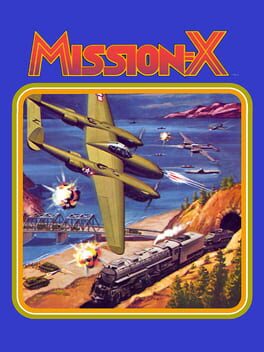
Mission X is a vertically scrolling shooter played from a top down point of view.You are pilot of a World War II plane on a mission to destroy as many enemy targets as possible. Your missions will be flown over land and sea, and can take place during the day or at night. Try to earn as many points as you can by dropping bombs on the land targets which include bridges, tanks, trains, boats, and more. The enemy will be trying their best to stop you, and will send out large numbers of tanks, anti-aircraft missiles, and planes to try to destroy you!

Shooter / Arcade / Action / Fantasy
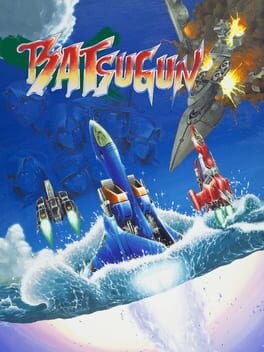
Batsugun is a vertically scrolling shoot 'em up video game created by the now-defunct Japanese game developer Toaplan. The title translates to "exceptional" or "extraordinary". It was the final game created before Toaplan's dissolution, and has been regarded as a key title in the development of the modern manic shooter, with elements of the game such as the size of the player's hitbox, the scale of their firepower, and the complexity of enemy bullet patterns all having an influence on future titles in the sub-genre. Members of the development team also went on to work on other successful manic shooters, most notably lead artist Junya Inoue.