
Arcade / Super Famicom / Super Nintendo Entertainment System
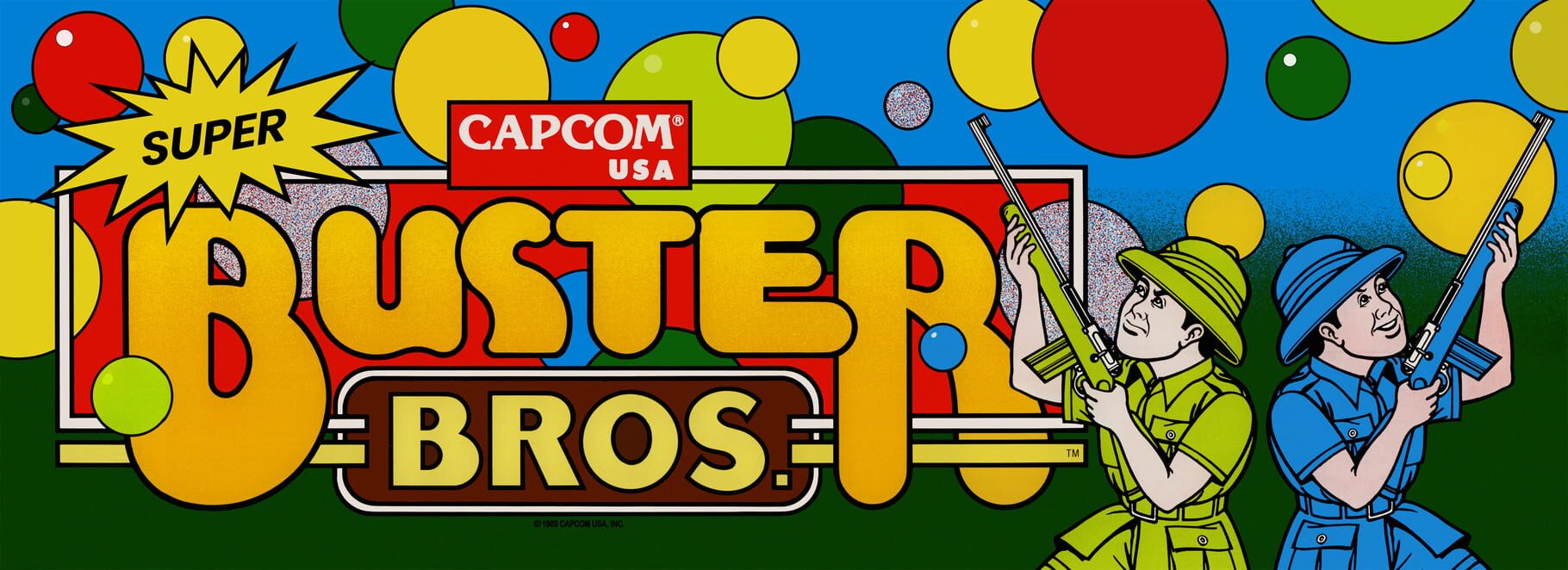
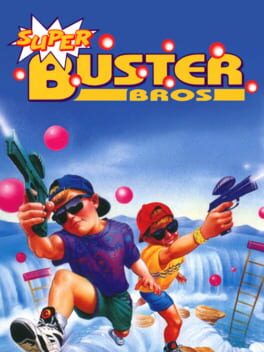
Super Pang is an adventure for one or two players that takes the player around the world, aiming to rid the planet of a terrible foe: seemingly innocuous-looking bubbles. The main portion of the game is Tour mode, where the player visits a series of different levels representing different countries of the world. Each player's character is armed with a gun, which shoots a vertical cable. If this hits a bubble, it will cause it to split in two. Upgrades allow two cables to be shot at once, or the ability to stick a cable to the ceiling where it will cling for a few seconds, bursting any bubble that hits it. Players must clear each screen of bubbles before progressing to the next one. The largest bubbles will have 4 degrees of splitting before clearing. Many level layouts have ladders, barriers and breakable bricks in part of the screen, affecting movement of both the player and the bubbles. Faster bubbles in the shape of diamonds also bounce around the screen going any which way rather than bouncing in predictable arcs like the other bubbles. Several power-up tokens are also available, offering features such as splitting all bubbles down to their minimal size, freezing the bubbles for a few seconds, and various different weapons. Monsters also enter the screen periodically, which hit the bubbles and take them down a size, and can often be directed by the cable weapon. In addition to the main Tour mode, the game also features Panic mode, in which a succession of bubbles are thrown at at the players. As the player progresses, the amount of bubbles required to reach the next level also increases, similar to scoring on Tetris.
Platform / Puzzle / Arcade / Action / Fantasy
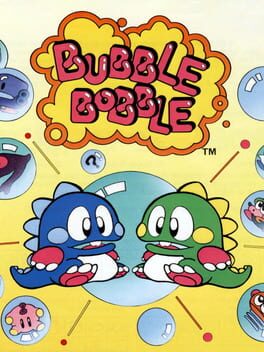
In the game, each player controls one of the two Bubble Dragons, Bub and Bob. The player can move along platforms, as well as jump to those above and to the side, similar to most platform games. The player can also blow bubbles. These can trap enemies, who are defeated if the bubble is then burst by the player's spiny back. Bubbles that contain enemies can be popped at the same time resulting in different foods being projected around the level. Each enemy trapped in a bubble equates to a different food. Food is consumed and transferred to points (an increasing scale of 1000 points is awarded for each enemy burst in tandem with another meaning: one enemy burst equals one food item worth 1000 points, two enemies burst equals two food items worth 1000 and 2000 points, three enemies burst equals three food items worth 1000, 2000 and 4000 points, and so on), which results in earning lives. These same bubbles also float for a time before bursting, and can be jumped on, allowing access to otherwise inaccessible areas. Players progress to the next level once all enemies on the current level are defeated. Enemies turn "angry" — becoming pink-colored and moving faster — if they are the last enemy remaining, escape from a bubble after being left too long or a certain amount of time has been spent on the current level. A monster will also become angry if either player collects a skull (the only negative item in the game), and the monster is hit by the resulting comet crossing the screen (however, this is a rare occurrence). After a further time limit expires, an additional invincible enemy appears for each player, actively chasing them using only vertical and horizontal movements. These do not need to be defeated to complete the level, and disappear once a player's life is lost. Contact with enemies and their projectiles (rocks, lasers, fireballs, etc.) results in death.

Shooter / Puzzle / Indie / Action / Science fiction
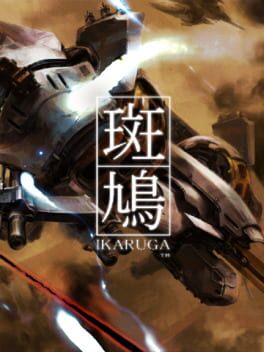
In this vertical scrolling spaceship shooter, you control a ship that can change its polarity at will. As blue/white, the ship can easily destroy red/black enemies, and vice versa. Bullets of your polarity can be collected to fuel your energy gauge, but those opposite will kill you. Destroying an enemy ship causes them to fire revenge bullets which can be absorbed and fired back by the player. Different difficulties exist to change exactly how you interact with polarized points, or how they appear. It is the spiritual successor to Radiant Silvergun, featuring similar level and boss design, as well as it's buddhism inspired themes and aesthetics. Both are directed by Hiroshi Iuchi, who also composed Ikaruga's soundtrack.


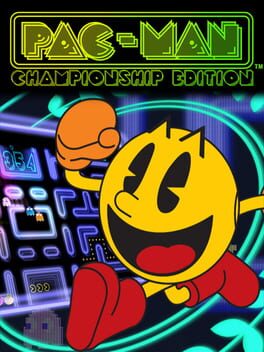
Pac-Man Championship Edition is similar in basic gameplay to the original 1980 Pac-Man: players have to eat dots, while avoiding the four ghosts that roam around the maze. Championship Edition, however, also brings many gameplay differences. The game was designed by Tōru Iwatani, the creator of the classic original 1980 arcade game Pac-Man, and it was Iwatani's final game before his retirement.

Puzzle / Strategy / Arcade / Action
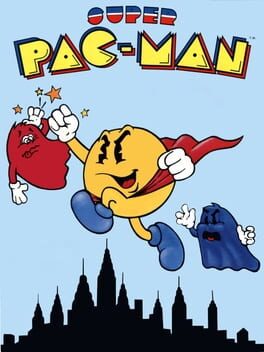
Super Pac-Man is a game in Namco's Pac-Man family, but instead of gobbling up dots, Pac is required to eat fruit and prizes, such as apples, bunches of bananas, doughnuts, hamburgers, fried eggs, ears of corn, sneakers, pieces of cakes, raspberries, limes, cups of coffee, mushrooms, Galaxians, bells, and shamrocks. Most of these items are hidden in passages that have locked doors at either entrance, and in order to unlock the doors, Pac needs to eat the key that is closest to the passage that he wishes to unlock. As usual, ghosts will keep chasing Pac around the maze until he has lost all his lives. However, Pac can enter the warp tunnels at either side of the maze to lose the ghosts quickly. There are two types of power pellets in the maze: green and yellow. Yellow power pellets cause ghosts to turn blue, allowing Pac to eat them for points, whereas green ones cause Pac to enlarge and will also cause the ghosts to become much thinner and wider, allowing him to fly over them. He can also break open the doors without the need of keys. The effects of the pellets, unfortunately, only last for a number of seconds. During the time that he is enlarged, a flashing star will appear besides two boxes that are located in the middle of the maze. The first box will display the current fruit or prize, and the other will display a rotating selection of them. If Pac manages to eat the star when they match there will be a large bonus score. Occasionally, after three or more stages, there will be a bonus stage where Pac automatically gets enlarged. The object of these stages is to eat everything in the maze before the time runs out and, during these stages, there will be no ghosts to pursue him.

Puzzle / Arcade / Action / Educational
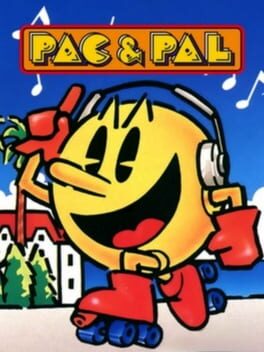
Pac & Pal is an arcade game that was released by Namco on July 30, 1983 exclusively in Japan. It runs on Namco Super Pac-Man hardware, and the object of the game is for Pac-Man to eat all the items before he is caught by the ghosts. Most of the items are fruits from the original Pac-Man game, with a few new additions. Their value varies, starting with cherries at 50 points, and ending with keys from 700 to 5000 points. The items had to first be unlocked by turning over cards distributed around the maze (instead of eating keys like in Super Pac-Man). Very few cabinets still exist today, and this is possibly one of the rarest Pac-Man titles to find in playable format outside Japan.

Shooter / Puzzle / Arcade / Action / Science fiction
High-speed action-packed game play returns with the addition of exciting head-to-head battle modes, a challenging new time attack mode, and expanded game play progression that goes beyond Fever Time to SUPER FEVER TIME! Space Invaders Extreme 2 - faster and more exhilarating than ever before!