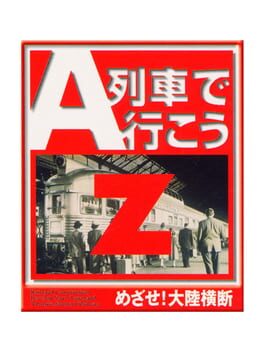
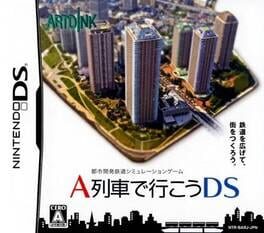
A-Ressha de Ikou DS is a railway management simulation game for Nintendo DS, developed and published by Artdink. It is part of the A-Train series and focuses on building rail networks, developing surrounding areas, and managing transport services to support urban growth. Players lay tracks, create train routes, adjust timetables, manage finances, and develop land around stations. The game uses the Nintendo DS touch screen for map control and construction.

Released in May 1999 in Japan for the PS1, this was a re-imagining of the first game's setting and objectives, using the 3D engine of A5.

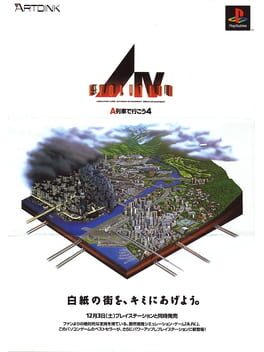
A.IV. Evolution is an updated console-only port of Take the A-Train IV, the fourth main entry in Artdink's long-running railroad management simulation series. It is largely a straight port of the original PC title, but the interface and graphics have been redesigned for the console format. The most significant new feature of this version is the ability to ride the trains and view the player's city in a full 3D polygon view, which would become a staple of later entries. The game was later released internationally with several additions as A.IV Evolution Global.

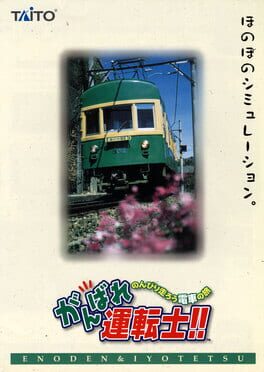
Ganbare Untenshi!! (loosely translated to "Good Luck, Driver!!") is an electric train driving simulation game developed and released by Taito for arcades in Japan on October 2000. A spin-off of the Densha de Go! series (and using the same engine as Densha de Go! 3 Tsuukin-hen), Ganbare Unten-shi!! focuses on light rail transit with two routes: the Enoshima Electric Railway and the Iyo Railway. While much of the game is the same as the main series, it modifies the braking and throttling controls for added precision and adds controls for operating the vehicle's doors. Due to street traffic, maintaining a timetable is not as strict as previous entries and the time-based penalty system is replaced with a "lives"-based one.

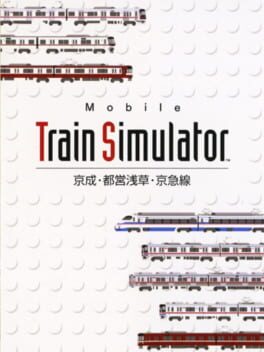
Mobile Train Simulator: Keisei, Toei Asakusa, Keikyu Lines is a PlayStation Portable port of the 2005 PlayStation 2 game Train Simulator: Keisei, Toei Asakusa, Keikyu Lines. Like the original game, it features the connected networks of the Keikyu, Toei, and Keisei railways from Haneda Airport to Narita Airport.

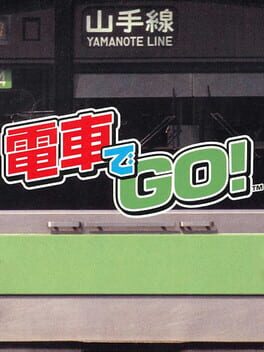
Densha de GO! is a 1997 train simulator arcade game developed and published by Taito in Japan. Players are tasked with driving a train, adhering to the schedule and obeying signals and speed restrictions. It features real-world train lines from Japan, including the Yamanote Line and Keihin-Tohoku Line. The game was ported to the PC, Sega Saturn, and PlayStation. The concept for Densha de Go! was inspired by designer Akira Saito's personal fascination with Japanese train lines and railroads. He wanted to create a game that allowed players to familiarize themselves with driving a train. The controls were his primary focus as he wanted them to be accurate and responsive, and to mimic the controls of a real train—his father worked for the Kyoto City Transportation Bureau Facilities Division, which made this easier to accomplish. Saito included real-world railroads and trains to appeal towards other railroad enthusiasts, thinking that it could also attract more "ordinary" players for its realistic, familiar theme. As arcades at the time were dominated primarily by racing and fighting games, he believed its unique concept could make it stand out. Densha de Go! is among Taito's most successful games, preceded only by Space Invaders. The PlayStation version sold over one million copies. The game was well-received by critics for its controls, attention to detail, and unique concept. Some felt that its home releases lacked enough content and had poor visuals. It was followed by a long series of sequels, spin-offs, and reimaginings, beginning with Densha de Go! 2 in 1999.

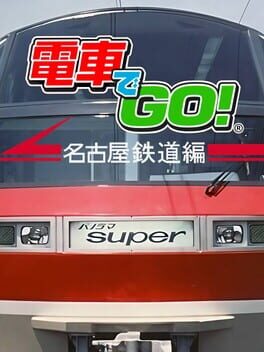
A release not seen in arcades, this Densha de Go! entry focuses on Meitetsu's railroad lines in Nagoya, including the series' only monorail. You play as a train engineer which serve the Meitetsu Nagoya line in Japan. There are many kinds of trains that you can drive, from express trains to monorails. Some trains are locked until you finish a mission, for example you can only drive monorails until you've finished the commuter and express train missions. All of the game parts, except the menu and station names, are in Japanese. In addition or the Meitetsu Nagoya Line, coverage includes Meitetsu Inuyama Line, Meitetsu Minomachi Line and Meitetsu Monkey Park Monorail Line. This was the first version to feature a monorail, and also featured a Meitetsu hybrid light rail route which ran both on regular train lines and as a sort of urban tram on special lanes in city streets. Part of the gameplay of this required the user to stop for regular traffic signals and avoid car traffic. This was the Densha de Go player's first opportunity to drive a vehicle much lighter (and thus shorter stopping distance) than standard trains. In this version, the driver must sound the horn before beginning to accelerate out of a station. This is unique to this title. The gameplay, physics, and strictness of this version were all somewhat relaxed compared to previous versions. The game was published by Taito for the Sony PlayStation in Japan on January 27, 2000. It was later ported to the PC by Unbalance on December 1, 2000. The PS1 version later received a re-release as part of D3Publisher's Simple 1500 series of budget games, as Simple 1500 Series Vol. 102: The Densha Untenshi - Densha de Go! Nagoya Tetsudou-hen, on August 29, 2002.
Simulator / Arcade / Non-fiction / Kids
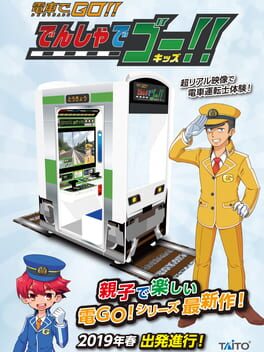
Densha de Go!! Kids (loosely translated to "Go by Train!! Kids") is an electric train simulation game developed by Taito and released by Square Enix for arcades (using PC-based Taito Type X4 hardware) in Japan on March 1, 2019. A spin-off of the 2017 game Densha de Go!!, Kids featured a simplistic single-screen arcade cabinet with a more child-friendly user interface and unique game rules (such as cleaning cartoon-ish obstacles from the window).