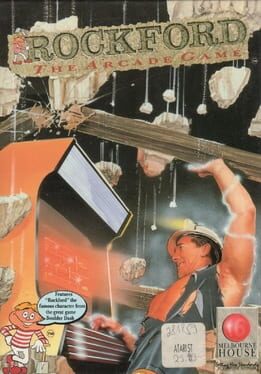
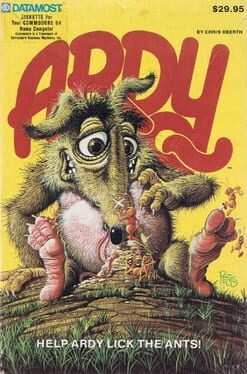
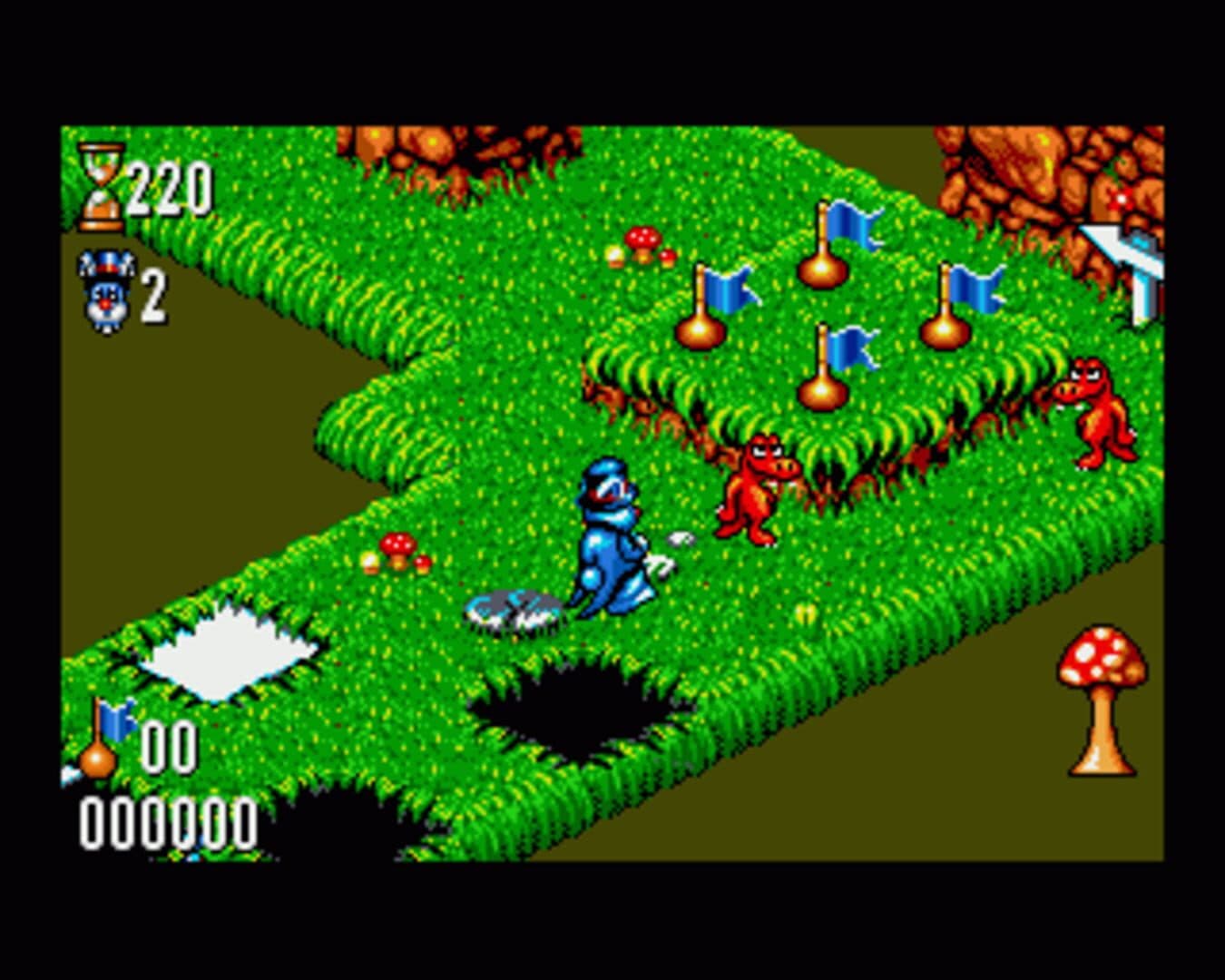
Whizz is one of the few 3D platformers to use an isometric viewpoint. The controls reflect this, with moving the controller to the right actually moving the character down and right, moving it down and right moving the character down directly, and so on. Each level is played out against a time limit, and the paths through the level aren't always clear-cut. You can avoid the baddies, which may be the best option, as killing them costs you some energy - this reduces the significance of the points system.

Platform / Puzzle / Strategy / Action / Science fiction
Released in 1987 on DOS, by Arcadia Systems.

Platform / Puzzle / Arcade / Action / Fantasy
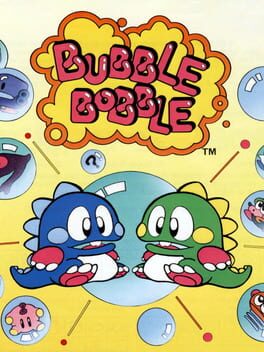
In the game, each player controls one of the two Bubble Dragons, Bub and Bob. The player can move along platforms, as well as jump to those above and to the side, similar to most platform games. The player can also blow bubbles. These can trap enemies, who are defeated if the bubble is then burst by the player's spiny back. Bubbles that contain enemies can be popped at the same time resulting in different foods being projected around the level. Each enemy trapped in a bubble equates to a different food. Food is consumed and transferred to points (an increasing scale of 1000 points is awarded for each enemy burst in tandem with another meaning: one enemy burst equals one food item worth 1000 points, two enemies burst equals two food items worth 1000 and 2000 points, three enemies burst equals three food items worth 1000, 2000 and 4000 points, and so on), which results in earning lives. These same bubbles also float for a time before bursting, and can be jumped on, allowing access to otherwise inaccessible areas. Players progress to the next level once all enemies on the current level are defeated. Enemies turn "angry" — becoming pink-colored and moving faster — if they are the last enemy remaining, escape from a bubble after being left too long or a certain amount of time has been spent on the current level. A monster will also become angry if either player collects a skull (the only negative item in the game), and the monster is hit by the resulting comet crossing the screen (however, this is a rare occurrence). After a further time limit expires, an additional invincible enemy appears for each player, actively chasing them using only vertical and horizontal movements. These do not need to be defeated to complete the level, and disappear once a player's life is lost. Contact with enemies and their projectiles (rocks, lasers, fireballs, etc.) results in death.
Platform / Puzzle / Arcade / Action / Comedy
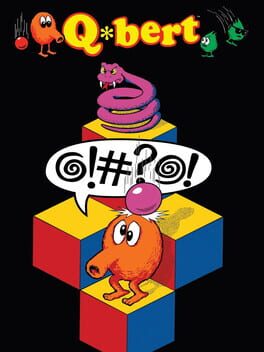
Q*bert was a popular arcade game that was released on a large number of consoles in the early 1980s. It was developed and published by Gottlieb, and became their most successful game. The concept serves as a precursor to the isometric platformer genre, where the title character must work to turn all cubes to a certain colour in a psuedo-3D world, made 3D through isometric graphics in the same way that the Penrose Stairs was made. The game was widely successful and has become a highly recognizable brand of the 1980s gaming era.

Platform / Puzzle / Adventure / Action
In the earliest licensed entertainment videogame of Jim Davis' lazy cat cartoon character, you play Garfield in his attempt to rescue Arlene from the cat pound. The primary gameplay involves object manipulation, gaining objects either by picking up or receiving them from other characters (usually in exchange for other objects). Most characters from the cartoons play a part in the game. Odie the dog follows you around - swipe him for points. Garfield's cousin Nermal can help you out. They can also carry objects for Garfield's use. Garfield needs regular food and rest - without one of these he falls asleep and it is Game Over. Contact with many foes is draining. A butcher's is one major food source.


Platform / Puzzle / Arcade / Action / Science fiction
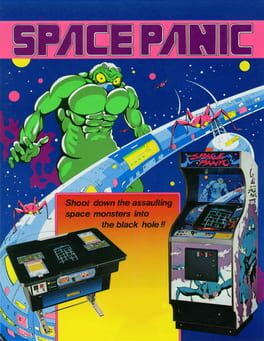
A game remarkably similar to Lode Runner, you play an astronaut with limited oxygen (time) chased around by various space aliens. Your only method of dealing with these multicolored threats from space is to dig a hole, lure it into a hole and then manually fill up the hole with the alien in it. Dropping aliens on top of other aliens earns you extra points and eliminates both. Levels get progressively harder and enemies grow faster.

Platform / Puzzle / Arcade / Action
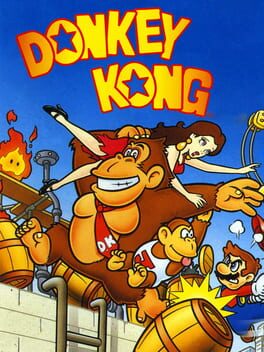
Donkey Kong is a Game Boy game which starts out with the premise of being a straight remake of the original Donkey Kong arcade game. Although at first it appears to be just a port, the familiar levels from the arcade game are just a prelude to the real platform jumping adventure. There are 97 levels spread out over 9 worlds. These levels are much more complex than the originals, featuring scrolling backgrounds, numerous objects to collect, and enemies to avoid. Along the way, you will encounter several boss style battles with Donkey Kong, as well. When played on a Super Game Boy, the game is colorized, digitized speech is added and the ending music takes advantage of the SNES sound chip.