Mystery box
?
Sealed
Mystery Box
Every game in your current results, in one box. Add it to a quest and each run draws a fresh game from it, revealed on release day.
Odyssey 2
1981
This side out
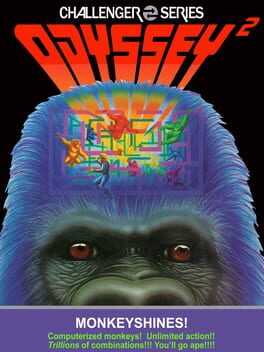
MONKEY TAG! (1 or 2 players) Press 0 on the numeric section of the Odyssey2 keyboard. The screen will display four computer-controlled monkeys in a matrix of monkey bars. Two men appear at the lower right and left of the screen. They are activated by the hand controls. The object of the game is to tag as many monkeys as you can with your man - without getting tagged back. The left hand control maneuvers the man at the lower left of the screen. The right hand control activates the man at the lower right of the screen. Push the joystick to the right to make your man go to the right. Push the joystick to the left to make your man go to the left. Push the joystick forward and press the action button to make your man jump up to the next highest level of monkey bars. Push the joystick forward at an angle and press the action button to make your man jump on a diagonal. The men can only jump up one level of monkey bars at a time. One man can give the other a boost. If one jumps on the head of the other, he can reach the next highest level of monkey bars on his next jump. A man tags a monkey by catching it and pressing the action button. The tagged monkey will jump away in the direction the joystick is held at the instant the action button is pressed. If you catch a monkey and delay pressing the action button, the monkey will jump away without a tag being scored. Players score one point for every monkey tagged. The game score appears at the lower left of the screen. The highest score in a series of games appears just above the game score. If both hand controls are being used, the men play as a team and the score displays their total points. You are not competing with another player - you are competing with the computer. When a monkey is tagged, it will turn red and try to tag one of the men. If a man is tagged by a red monkey, he will freeze in position and is out of the game. The higher the game score, the longer the monkeys will stay red and the harder it will be for the men to avoid getting caught. A new game will start automatically when both men have been tagged by red monkeys. The monkey bars will be displayed in a completely different arrangement at the beginning of each new game. Every game automatically starts at the first skill level. When ten points have been scored, the computer will automatically change to the next highest skill level to provide greater challenge. The third skill level will be presented when 30 points have been scored. The monkeys stay red longer and are more difficult to evade with every increase in skill level. If you wish to play at the second skill level before scoring ten points, press the + key once. To play at the third skill level, press the + key twice. TAILSPIN! (1 or 2 players) Press RESET. Press 0 on the numeric section of the keyboard. Press R (for ROTATION) on the alphabet section of the keyboard. The monkey bars will rotate upwards to a new position every few seconds. This calls for a completely different playing strategy. You will have to anticipate the next position of the monkey bars and adjust your movement and timing accordingly. Press S (for STOP) on the alphabet section of the keyboard to stop the rotation of the monkey bars. You can start or stop the rotation of the monkey bars at any time during the game. SHUTEYE! (1 or 2 players) Press RESET. Press 0 on the numeric section of the keyboard. Press I (for INVISIBLE) on the alphabet section of the keyboard. The monkey bars will disappear. You are now playing blindfolded - but the monkeys are not. The monkey bars will reappear momentarily any time one of the men is falling. They will also reappear if one of the men stands on the head of the other. Press V (for VISIBLE) to make the monkey bars reappear. MONKEY CHESS! (3 players) Press RESET. Press 0 on the numeric section of the keyboard. You are now playing a new kind of chess against a grand master, the Great Monkey himself. He has twice as many pieces - but you have complete control of the board. It is the classic game turned inside out. Two of the players operate the hand controls. The third player tries to outwit the Great Monkey by changing the pattern of the chess board of monkey bars throughout the game! To remove a vertical monkey bar: Locate the bar by its letter and number coordinates. Press the number on the numeric section of the keyboard. Press the letter on the alphabet section of the keyboard. Press CLEAR. The vertical bar will disappear. To add a vertical monkey bar: Locate the coordinates for the position in which you wish to insert the monkey bar. Press the number. Press the letter. Press ENTER. To delete a horizontal monkey bar: Locate the bar by its letter and number coordinates. Press the letter. Press the number. Press CLEAR. To add a horizontal monkey bar: Locate the coordinates of the position in which you wish to place the horizontal monkey bar. Press the letter. Press the number. Press ENTER. In summary, pressing the letter first will affect horizontal bars. Pressing the number first will affect the vertical bars. The player controlling the keyboard masterminds the strategy it takes to beat the Great Monkey at his own game. "Ladders" can be built to help the men get quickly to any part of the screen. Ladders can also be "unbuilt" to prevent the monkeys from using them. "Cages" can be built to temporarily delay tagged monkeys from tagging the men. Hint: Pretend that the cage has a door and memorize its coordinates. One of the men tags a monkey and uses the joystick to release him into the cage. The player using the keyboard has already preset the "door" coordinates and is ready to press ENTER. The completely closed cage will delay a tagged red monkey from tagging one of the men. The player controlling the keyboard can also insert obstacle bars in the path of pursuing red monkeys. BANANAS! (For professionals only. 3 players.) Press RESET. Press 0 on the numeric section of the keyboard. Insert the keyboard entries for Tailspin, Shuteye and Monkey Chess is various combinations. You will be using all your firepower to confuse the monkeys and achieve high scores under very exotic conditions. The challenge range will escalate from utter confusion to total chaos! RECAP OF KEYBOARD ENTRY CODES: TAILSPIN! R (Rotate) S (Stop) SHUTEYE! I (Invisible) V (Visible) MONKEY CHESS! LETTER/NUMBER (Affects horizontal bar) NUMBER/LETTER (Affects vertical bar) ENTER (Adds bar) CLEAR (Deletes bar)
Odyssey 2
1983

This side out
Trans American Rally is a racing game released in 1983. It is avaliable only for the Odyssey Videopac +.
Odyssey 2
2000
This side out
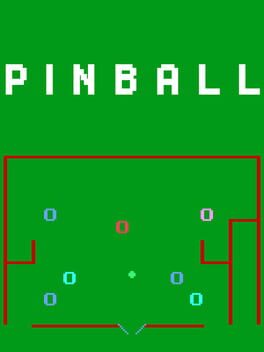
This cancelled pinball game was originally developed in 1978 by Ralph Baer for the Odyssey 2. It allowed players to build their own tables by positioning O-shaped bumpers onscreen. Ralph Baer never completed it, but in 2000 he authorized the creation of 30 cartridges of the prototype, which were sold at Classic Gaming Expo 2000.
Odyssey 2
1980
This side out
Shooter / Action / Science fiction
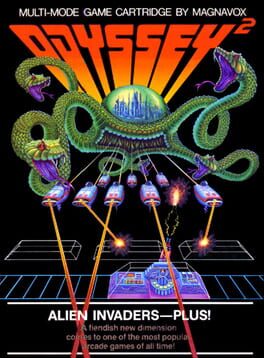
It's you versus the robotic armada of the Merciless Monstroth, a one-eyed tentacled entity bent on conquest. Use your laser base to take out the enemy cannons and the robots, being careful that you shoot them when their barriers don't block you and when they're not shooting at you! Get shot and you lose your laser base, but as long as you have barriers, you can run under one of them and convert it into another laser base to continue the fight. Run out of them and it's only a matter of time before you become a victim of the Merciless Monstroth. The unusual part of this game is its scoring: if you destroy the robotic armada plus Merciless Monstroth, you earn a point; but if the armada destroys you and all your bases, Merciless wins a point. The game ends when either you or Merciless wins ten points.
Odyssey 2
2000
This side out
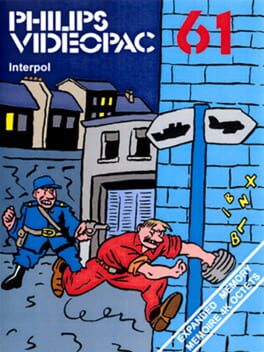
Interpol is a game for two players, one controls two spies (red characters) and the other controls two police officers (blue characters). The spies are in possession of secret information and must try to leave the country with them, by air or by sea. The police officers have to stop their plan. The airport and the port are blocked by the police, and individuals interested in traveling must present a code which only the police knows.
Odyssey 2
2023
This side out
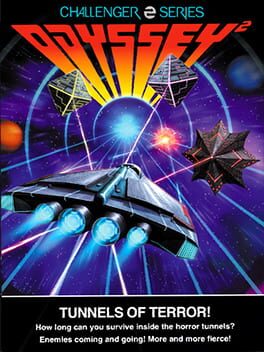
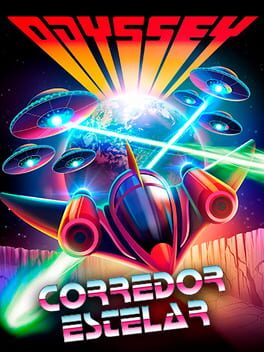
Something different is happening in the Galaxy: a mysterious cataclysmic event has caused several interdimensional tunnels to open in space, and you are the patrolman Jonas aboard the Twister of Central Command. Without connection and with intense lights invading your cabin, your only alternative is to destroy the ships that cross the tunnels of terror. Several levels and five different enemies alternate phases in a game with a breakneck pace in which you won’t have a minute of peace or it will be the end of you. Embark on this odyssey…
Odyssey 2
1982
This side out
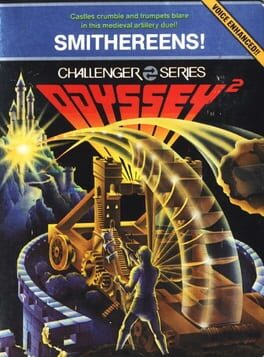
Stone Sling is the 20th official game released by Philips for the Videopac console. In the United States, it was sold under the title Smithereens! for the Magnavox Odyssey² console. The game allows for two player simultaneous gameplay where both players have a fortress as well as a catapult used to fire each other. With each hit the fortress' size decreases by a bit. However, sometimes if your aim is off, the catapult will miss the fortress and instead hit one of the opposing soldiers. Like other Videopac games, Stone Sling could not compete against Atari games, though the game did do well in Europe and Brazil.
Odyssey 2
2014
This side out
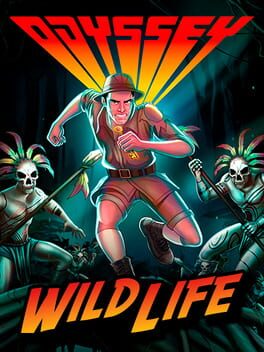
You are Josué Jorge and about to embark on an amazing Odyssey in search of the Chalice of Immortality. The place is the legendary island of Ginnugahar, which is a living territory, hungry for the life energy of anyone who dares set foot there and search for the relic. Watch your time over there, because the minute you enter the forest, its chronometer will start and until it stops, your life force will be sucked as it counts down. Finish the quest before time runs out or forever be part of that dreaded piece of land!
Odyssey 2
1983
This side out
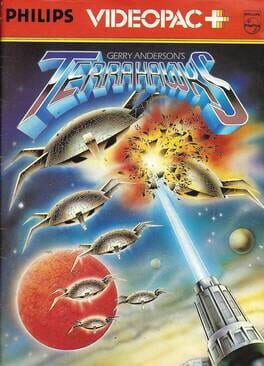
51 Terrahawks is shoot em up game for Philips Videopac G7000
Arcade
1982
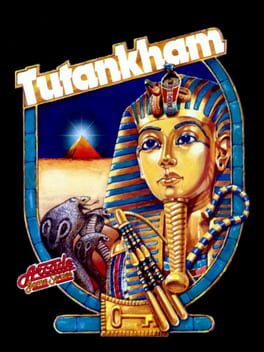
This side out
Shooter / Platform / Puzzle / Action
Tutankham is a combination of the maze, action and shoot 'em up genres. Taking on the role of an explorer grave robbing Tutankhamun's tomb, the player is chased by creatures such as asps, vultures, parrots, bats, dragons, and even curses, all that kill the player on contact. The explorer can fight back by firing lasers at the creatures, but he can only cover the left and right directions. The player is also endowed with a single screen-clearing "flash bomb" per level or life. Finally, each level has warp zones that teleport the player around the level, which enemies cannot use. To progress, the player collects keys open locked doors throughout the levels, searching for the large exit door. Optional treasures can be picked-up for bonus points. Each level has a timer; when it reaches zero the explorer can no longer fire lasers, and once a level is cleared the remaining time is converted to bonus points.
Odyssey 2
1982
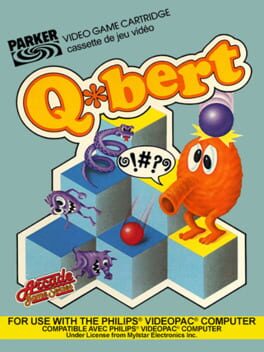
This side out
Q*bert is an isometric platform game with puzzle elements where the player controls the titular protagonist from a third-person perspective. Q*bert starts each game at the top of a pyramid of cubes, and moves by jumping diagonally from cube to cube. Landing on a cube causes it to change color, and changing every cube to the target color allows the player to progress to the next stage.
Odyssey 2
1979
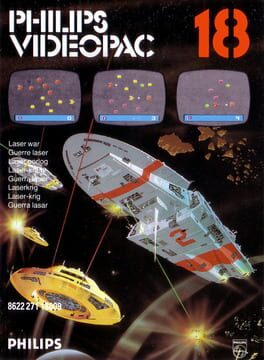
This side out
The players are in the Battle Control Central at the heart of the United Planets Interstellar Galactic Empire. From there, they monitor the activity of the twin solar systems of Terien and Lorien, forty-three billion light years away. Their mission is to control to protect the planets of those solar systems from the invasion fleet with the remote controlled battle cruisers. They'll control their ships with the joystick and fire lasers with the action button. The invasion fleet will shoot the players and the planets as well. Shot planets will have their colors changed and will be conquered when their colors match the invaders ship's colors. If the players' ship is destroyed, a new one will be launched from one of the planets with their color. If there's no planet with their color, they'll have to wait until a planet's color change to theirs. If the players crash into planets with a color different than theirs, both the ship and the planet will be destroyed. Destroyed planets won't come back, but the central planet at each orbit is indestructible. Players can also hide their ships in their own planets, by landing on them. Planets with ships landed will blink. The winner is the player who first destroys ten enemy ships.
Odyssey 2
1980
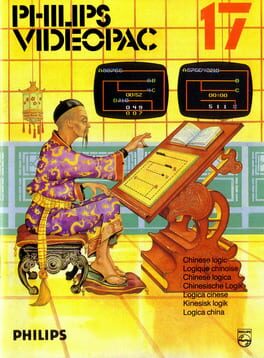
This side out
The player has to move a sequence of numbers (9 to 0) from the point A of a pattern of lines to point D (or B in the variations). The numbers must be placed in point D in the same descending order. There are two other points to which the numbers can be moved, B and C. If one or more numbers are parked in one of the points, the player can only additionally move to that point numbers which are lower than the last one already parked. The numbers can be moved one by one only and to do so the player has to type the letter of origin and then type the destiny letter. Moves can be undone by pressing the "clear" key. The computer keeps track of the time elapsed and the number of moves made by the player, also showing the minimum amount of moves to solve the puzzle. There are 9 other possible variations, with the difference of having the way to point D blocked and different amounts of numbers to move. Those variations can be selected by pressing "reset" and the desired number, as follows: one figure - minimum number of moves: 1 two figures - minimum number of moves: 3 three figures - minimum number of moves: 7 four figures - minimum number of moves: 15 five figures - minimum number of moves: 31 six figures - minimum number of moves: 63 seven figures - minimum number of moves: 127 eight figures - minimum number of moves: 255 nine figures - minimum number of moves: 511
Odyssey 2
2022
This side out
Trunkal has the three most coveted moons in the galaxy, natural sources of unique energy power, they generate all the energy for the planet, and there is also all the military defense that has always prevented any attempt at alien invasion, in all there are 72 stations scattered across the moons, but the unlikely happened, the Kirgons, an alien race that consumed all the resources of their planet discovered that Trunkul can become the perfect environment for a new home. Then, one day, 72 machines known as sentinels, invaded Trunkul's defense system and took over the lunar facilities ending all defense of the planet, If that wasn't enough, they also drained the moon's energy to charge a ray that would be fired and annihilate all life on the planet. But the resistance has figured out how to disable the sentinels, and only the best pilot in the galaxy, Michael Gabes aboard the X-1 can accomplish the mission before the beam charges and fires....
Odyssey 2
1981
This side out
Released in 1981 on Odyssey 2 / Videopac G7000.
Odyssey 2
1998
This side out
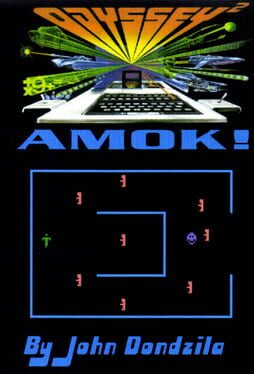
Amok! was the first Odyssey² new release about 15 years after the console was discontinued. It is inspired by Berzerk. The player is trapped in a spaceship and is armed with a laser pistol, which can fire in all 8 directions. Each stage is a maze with one or more exits, and the player has to try to exit them while avoiding to touch its walls and get killed. Besides the danger of the walls, the player will face the berzerk robot sentinels, which can move about and shoot, but that can also be killed if they touch the walls. After a while, the Smileybot will appear and try to kill the player. The Smileybot can pass through walls and cannot be killed by the player. The game features 12 stages of increasing difficulty. The player has 3 lives; dying will make the player restart the current level, with all berzerk robot sentinels being replaced.
Odyssey 2
1979
This side out
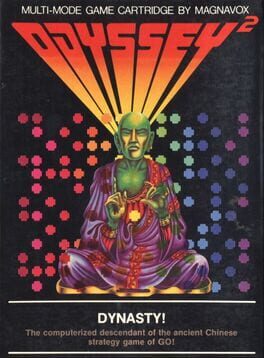
Press 0 on the alpha-numeric keyboard if you are playing on color TV. Press 2 if you are playing on Black and White TV. The game is played on an 8 x 8 matrix. Four "armies" in two different colors are at the center. A flashing question mark at the right hand side of the screen is asking if the "armies" of that color are to be played by a person or the computer. Press "yes" on the alpha-numeric keyboard for person. Press "no" for computer. If you have entered "yes," a second symbol will appear followed by a flashing question mark. If you wish that color played by a person, press "yes." If you want to play against the computer, press "no." If you have elected to play against the computer, the symbol for microprocessor will appear on the screen. If you are playing against another person, individual timers will appear separately at the top of the screen. Player one's timer will appear first. You can enter up to 99 minutes of time for each player in the game. Different times may be entered for each player to give a novice more of a chance against an experienced player. If you want to play with no time limit, enter 00 on the numeric section of the keyboard. If you are playing against the computer, the microprocessor will make its move instantly. It can make more than 100,000 electronic decisions per second. The object of the game is to occupy as much of the matrix as possible. The game begins with two "armies" of each color at the center of the matrix. The game ends when the board is filled or when neither player can enter a move and capture and opposing "army." The player with the most "armies" on the matrix is the winner. A running score appears at the top of the screen throughout the game. Every entry must satisfy two conditions: - An "army" must always be placed next to an opponents "army." - One or more of the opposing "armies" must be trapped by the newly entered "army" and another "army" of the same color. The trapped "armies" will automatically change to the conqueror's color. If these condition cannot be met, there will be an audio signal and the player loses a turn. Use the joy stick of the hand control to position the box on the screen where you want to locate an "army." Press the action button to enter the "army" onto the screen. Player one uses the left hand control. Player two uses the right hand control. Players may capture more than one army in different directions on the same move. The directions may be in any horizontal, vertical or diagonal straight line. Secret strategy hints. - The corners are the most important strategic positions. Once an "army" occupies a corner, it controls three directions. An "army" commanding a corner position cannot be captured because it cannot be surrounded on two sides in a straight line. - The outside positions of the matrix are very important because they effect five directions but are only vulnerable from two sides. - Caution! Be careful before occupying the first rows inside the perimeter of the matrix. They are jumping off points to the outside and corner positions. VERSION II: DIRECTIONAL DYNASTY Press 1 on the alpha-numeric keyboard if you are playing on color TV. Press 3 on the alpha-numeric keyboard if you are playing on Black and White TV. Enter player information and timer settings as per Dynasty rules 4 through 9. Directional Dynasty differs from Dynasty in only one way, but it changes the game completely. Players cannot capture "armies" in more than one direction on the same move. You must make a choice. When you enter an "army" into a position offering an option to capture "armies" in more than one direction, the surrounded "armies" will not change color automatically. Push the joy stick on the hand control towards the "army" or "armies" you wish to capture. A second positioning box will appear in that row. Press the action button and the surrounded "armies" in that row will change color automatically. It is very important to consider strategic position as well as the number of "armies" open to capture when exercising a directional option.
Odyssey 2
1980
This side out
Puzzle / Strategy / Action / Science fiction
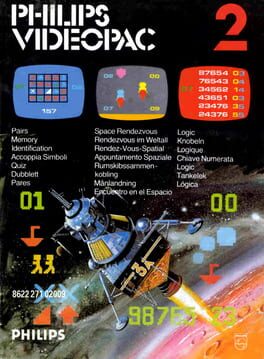
Three games are available in this compilation: Pairs (selected by pressing "1") is the same game as Matchmaker!, a regular Memory game. A matrix with 20 letters appears on the screen and the player has to find pairs of symbols hidden by the letters. Two counters will be displayed: time and number of matches. In two players mode (selected by pressing "2"), the players share the matrix and the one who makes more matches win. Space Rendezvous (selected by pressing "3") is somewhat similar to Lunar Lander. Two players have to try to link up their spaceships to the orbiting mother ship, while avoiding hitting the ground. Each ship has 50 megajoules of power and will be refueled when a perfect link-up is performed. A counter will be displayed for each player, and wins the player who first performs 10 perfect link-ups. If one player goes out of fuel, he's out of game. Logic (selected by pressing "4") is the same game as Logix!. The player has to guess a sequence of five different digits. The player types in the first try and the computer will display a two digit number with the number of correct digits to the right and the number of correctly placed digits on the left. The player has then to continue guessing the sequence based on the clues given. The object is to solve the problem in the least number of tries, counted on the left on the screen.
Still plenty of games...