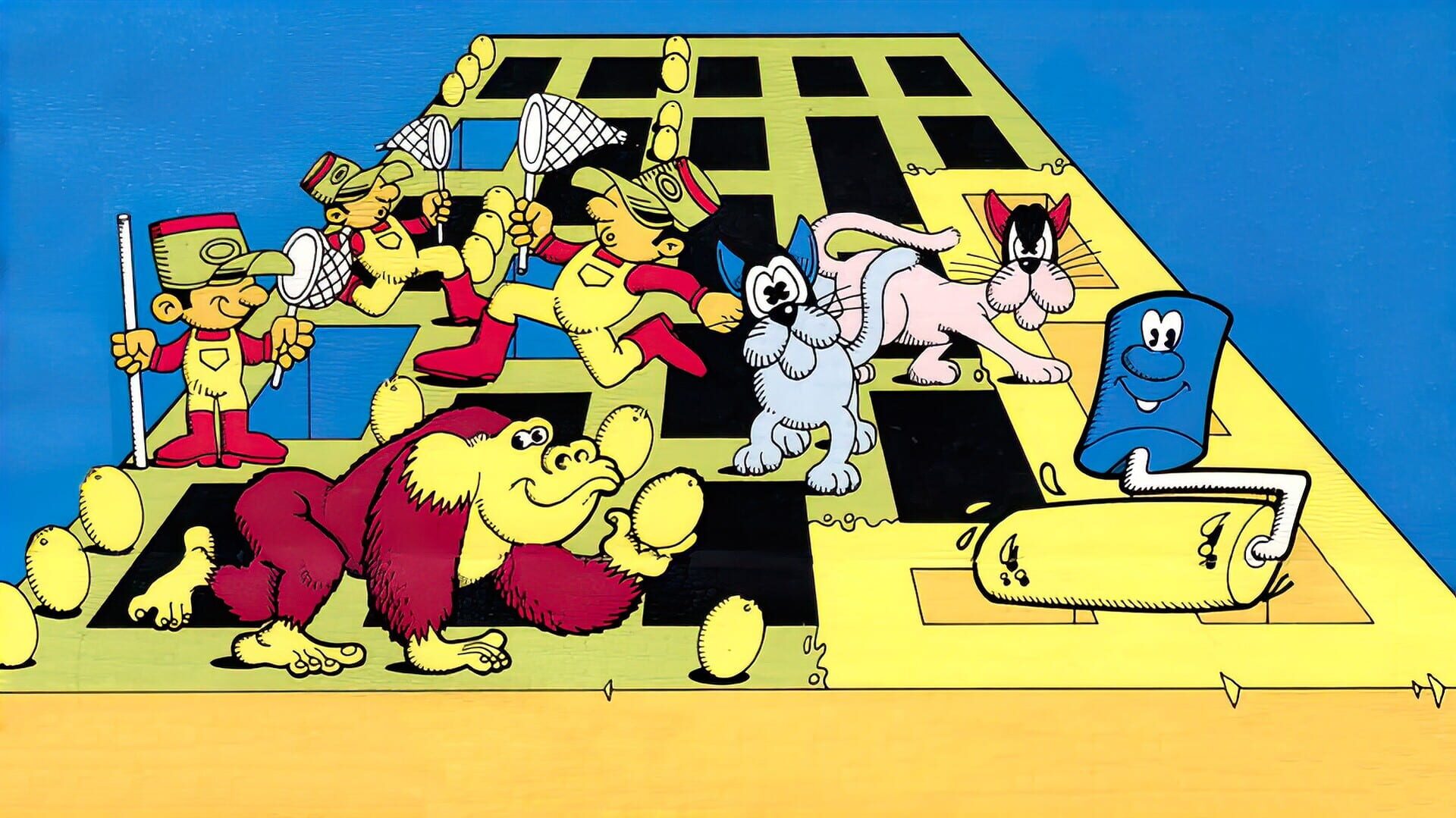
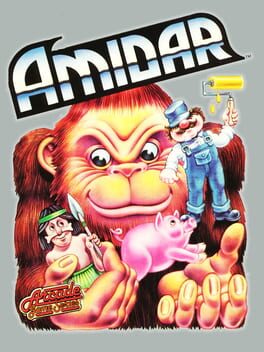
Amidar is an arcade game programmed by Konami and published in 1981 by Stern. Its basic format is similar to that of Pac-Man: the player moves around a fixed rectilinear lattice, attempting to visit each location on the board while avoiding the enemies. When each spot has been visited, the player moves to the next level. The game and its name have their roots in the Japanese lot drawing game Amidakuji. The bonus level in Amidar is a nearly exact replication of an Amidakuji game and the way the enemies move conform to the Amidakuji rules - this is referred to in the attract sequence as 'Amidar movement'. A version for the BBC Micro was created but never released.

Puzzle / Strategy / Arcade / Action
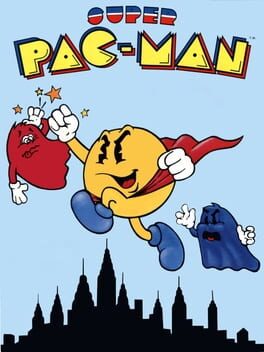
Super Pac-Man is a game in Namco's Pac-Man family, but instead of gobbling up dots, Pac is required to eat fruit and prizes, such as apples, bunches of bananas, doughnuts, hamburgers, fried eggs, ears of corn, sneakers, pieces of cakes, raspberries, limes, cups of coffee, mushrooms, Galaxians, bells, and shamrocks. Most of these items are hidden in passages that have locked doors at either entrance, and in order to unlock the doors, Pac needs to eat the key that is closest to the passage that he wishes to unlock. As usual, ghosts will keep chasing Pac around the maze until he has lost all his lives. However, Pac can enter the warp tunnels at either side of the maze to lose the ghosts quickly. There are two types of power pellets in the maze: green and yellow. Yellow power pellets cause ghosts to turn blue, allowing Pac to eat them for points, whereas green ones cause Pac to enlarge and will also cause the ghosts to become much thinner and wider, allowing him to fly over them. He can also break open the doors without the need of keys. The effects of the pellets, unfortunately, only last for a number of seconds. During the time that he is enlarged, a flashing star will appear besides two boxes that are located in the middle of the maze. The first box will display the current fruit or prize, and the other will display a rotating selection of them. If Pac manages to eat the star when they match there will be a large bonus score. Occasionally, after three or more stages, there will be a bonus stage where Pac automatically gets enlarged. The object of these stages is to eat everything in the maze before the time runs out and, during these stages, there will be no ghosts to pursue him.
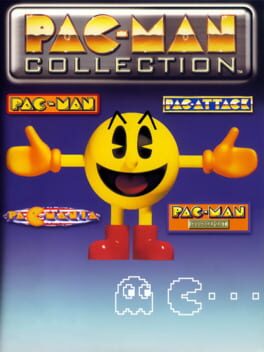
One of the first video games ever created, PAC-MAN still happens to be one of the best, as well. This comprehensive collection includes three unique Pac-Man titles in one complete package. Inside you'll find the original Pac-Man which has you traversing mazes, avoiding deadly ghosts, and chomping down nutritious dots; Pac-Mania is a 3D take on the first version, in which you can actually jump over the ghosts; and Pac-Attack is a Tetris-like experience that'll have you lining up blocks in a fast-paced environment.

Puzzle / Strategy / Arcade / Action
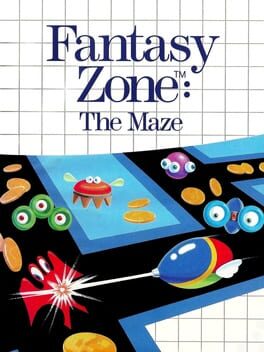
The evil Menons have returned... in multi-level bases which are hidden in seven different planets! The brave Opa-Opa has been called to battle their evil threat. And joining him in the fight is his younger brother, Upa-Upa. Your Mission: Guide this brave team of brothers through level after level of treacherous mazes. Get the golden coins stolen by the Menon hoard and use them to purchase powerful weapons. The Fantasy Zone is counting on you! Don't let them down.


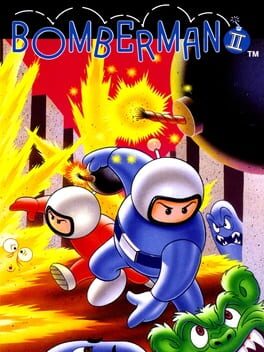
Bomberman II follows the popular Famicom/NES game Bomberman, incorporating a number of new features to the series. The game maintained the classic Bomberman game-type, requiring the player to navigate a maze of blocks using bombs to make a path. It added a two-player and three-player mode, and had a more developed storyline. The game was developed by Hudson Soft and released on the Family Computer and the NES. It was marketed as Dynablaster in Europe.

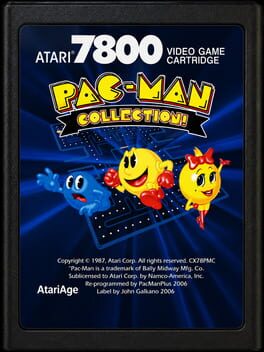
Pac-Man Collection (Atari 7800) is a 2006 homebrew compilation by Bob “PacManPlus” DeCrescenzo, published through AtariAge. It includes multiple Pac-Man and Ms. Pac-Man arcade variants—such as Puck Man, Hangly Man, Ultra Pac-Man, and Random Mazes—each can also be played in Plus mode, with selectable Fast, Slow, or Button-activated speed settings. It includes these games: Pac-Man Puck Man Hangly Man Ultra Pac-Man Random Mazes (Pac-Man style) Ms. Pac-Man Ms. Pac-Attack Ms. Random Mazes

In Every Extend, players control a ship with the only ability to detonate itself. Stages begin with a set time limit and enemies appearing on screen in randomized patterns. When the player detonates their ship and an enemy is caught in its blast radius, the enemy will explode and have its own blast radius that other enemies can get caught in, causing a chain reaction. Every Extend Extra is a redevelopment of the popular freeware game Every Extend, which was a personal project by Kanta Matsuhisa under her "Omega" pseudonym.