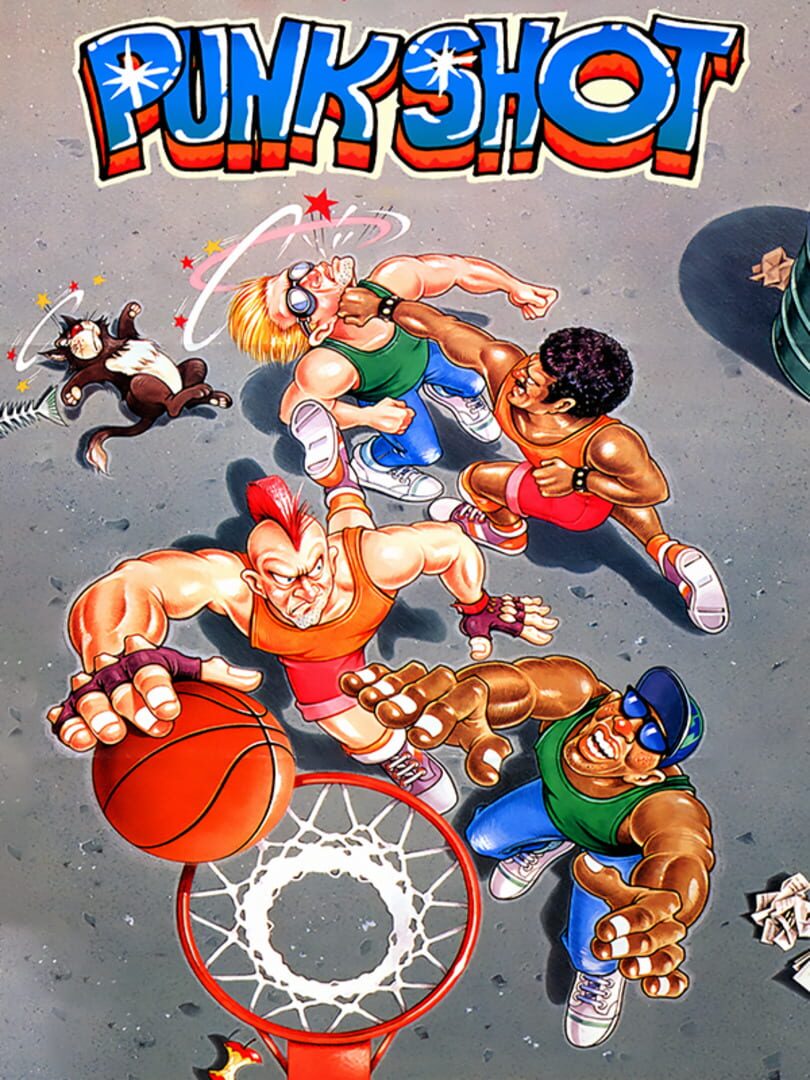
Punk Shot takes up to four players to downtown NYC for some two-on-two street basketball, no referee, no rules. The opposing two-man teams face off for a match played in four quarters (2 to 5 minutes each), on improvised courts in 3 different locations: the alley, the park, and the harbor. Naturally, it ain't just about being cool and shooting some b-ball outside of the school: on each side you have a couple of guys who are up to no good, with a constant enthusiasm for making trouble in the neighborhood. As such, Punk Shot joyfully turns basketball into a full-contact sport - heads will be bashed, noses punched, and private parts kicked. To top it off, each court features an assortment of environmental hazards, from slippery banana peels and having your butt set on fire, to the park dogs and their special taste for pants.

Fighting / Sport / Arcade / Action / Horror
Darkstalkers 3 is the second sequel in the Darkstalkers series of fighting games by Capcom, originally released for the arcades in 1997. The game was originally planned to be released as Darkstalkers: Jedah's Damnation in the United States, but this title was only used in the arcade version. New characters added in this version are Donovan, Huitzil (Phobos in Japan), and Pyron, with hidden characters of Dark Talbain and Oboro Bishamon .

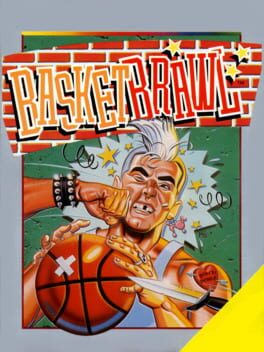
Basketbrawl is a sports video game released for the Atari 7800 in 1990, then for the Atari Lynx in 1992. It is a basketball simulation which allows hitting and fighting with other players. The name is a portmanteau of basketball and brawl. It is similar to the 1989 Midway arcade game Arch Rivals which had the tagline "A basket brawl!" Atari released another sports/fighting combo for the Atari 7800 in 1990 as Ninja Golf. Both were in the final 11 games published by Atari for that system in 1990-91 before dropping support.

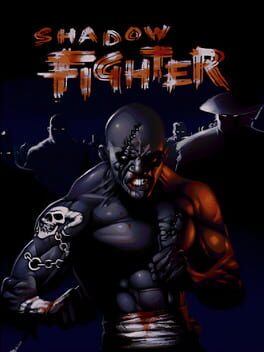
Shadow Fighter is a computer game for the Commodore Amiga, and Amiga CD32 developed by NA.P.S. team and published by Gremlin Interactive in 1994, and became one of the Amiga's best fighting game offerings during its final years, competing at the time with the likes of Acclaim's impressive home console ports of Midway's Mortal Kombat franchise, and Team 17's Body Blows.

Fighting / Sport / Action / Comedy
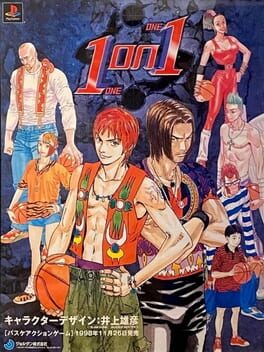
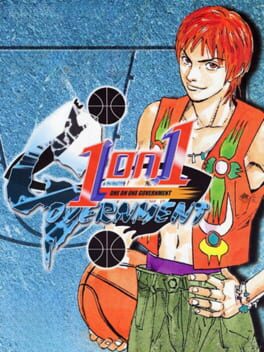
1 on 1 Government is a 3D street basketball game developed and released by Jorudan (in conjunction with Tecmo) for arcades exclusively in Japan. The sequel to the original PS1 game 1 on 1, Government adds a new two-on-two game mode (known as "2 on 2") and two additional playable characters (with all characters unlocked from the start).

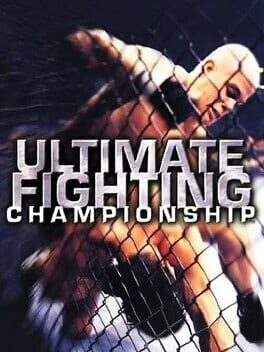
The Ultimate Fighting Championship tournaments started in the 1990s, giving martial artists of the world a chance to distinguish themselves in a fighting environment with very few rules. Fighters could be matched up against fighters of any style, and the match ended only when one fighter submitted. The popularity of the sport resulted in the creation of other mixed martial arts tournaments and the evolution and merging of fighting styles for greater effectiveness. Ultimate Fighting Championship is a 3D fighting game that tries to simulate the experience of a real mixed martial arts fight. Players can choose from a selection of established UFC fighters, or create their own fighter through the Career Mode. While in Career Mode, players start the character creation process by selecting from several style templates, then using points earned through fighting and beating a series of progressively more difficult fighters to buy attribute upgrades in stamina, endurance, punching ability, kicking ability, or to learn certain techniques.

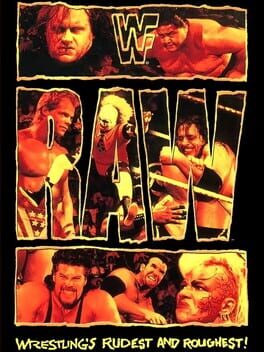
Raw slams your senses with 24 megs of the most ruthless mat mayhem ever! The hottest superstars, all new superhumans megamoves and more in-and-out-of-the-ring action stand between you and the championship belt. This Raw...and RAW IS WAR!

Fighting / Sport / Action / Comedy
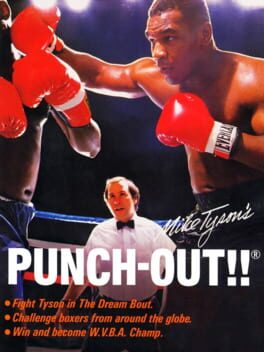
Punch-Out!!, originally released in North America as Mike Tyson's Punch-Out!!, is a boxing sports fighting video game for the Nintendo Entertainment System (NES) developed and published by Nintendo in 1987. Part of the Punch-Out!! series, it is a port of both the Punch-Out!! and Super Punch-Out!! arcade games (particularly the latter) with some variations. Punch-Out!! features a boxer known as Little Mac working his way up the professional boxing circuits, facing a series of colorful, fictional boxers, leading to a final fight with real-life boxer, the then-World Heavyweight Champion, which is Mike Tyson in the original version and Mr. Dream in the later version. Little Mac has a limited repertoire compared to most of his opponents. His punches are limited to left and right jabs, left and right body blows, and a powerful uppercut. The uppercut can only be used once the player earns a star, which is typically accomplished by counter-punching the opponent directly before or after certain attacks are launched. The player can acquire up to three stars. To perform the uppercut, the player needs to press the start button once a star is earned. To defend, Mac can dodge left or right, duck, and block punches by putting up his guard. Little Mac also has a heart meter, which decreases by three upon being struck by an opponent and one upon blocking an attack or an opponent blocking/dodging the player's attack. When the heart meter decreases to zero, Little Mac temporarily turns pink and appears exhausted, leaving the player unable to attack but still able to dodge or block. At this point, Mac can regain some hearts (and his normal color palette) only by avoiding the opponent's punches. He immediately loses all of his hearts upon being knocked down, but can regain some by getting up. A bout can end by knockout (KO), if a fighter is unable to get up within ten seconds after being knocked down; by technical knockout (TKO), if a fighter is knocked down three times in one round; or by decision, if the bout lasts three full rounds without a clear winner. In order to win by decision, the player must accumulate higher than a certain point total by punching the opponent and/or knocking him down (different boxers require different point totals to win by decision). However, some bouts cannot be won in this manner and will automatically result in a loss for the player if the opponent is not knocked out. Mac can only get up three times during any one bout; if he is knocked down a fourth time, he will be unable to rise and thus lose by knockout. When Mac loses his first bout to a ranked opponent, he will have a chance to fight a rematch. However, if he loses a Title Bout, he will fall in the rankings - one place for the Minor or Major Circuits, two places for the World Circuit. Losing a rematch causes him to fall one place (unless he is already at the bottom of his circuit), forcing him to fight his way back up. A third loss (not necessarily a consecutive one) ends the game. The exception is the final fight against Mike Tyson/Mr. Dream; a loss to them automatically results in a game over.