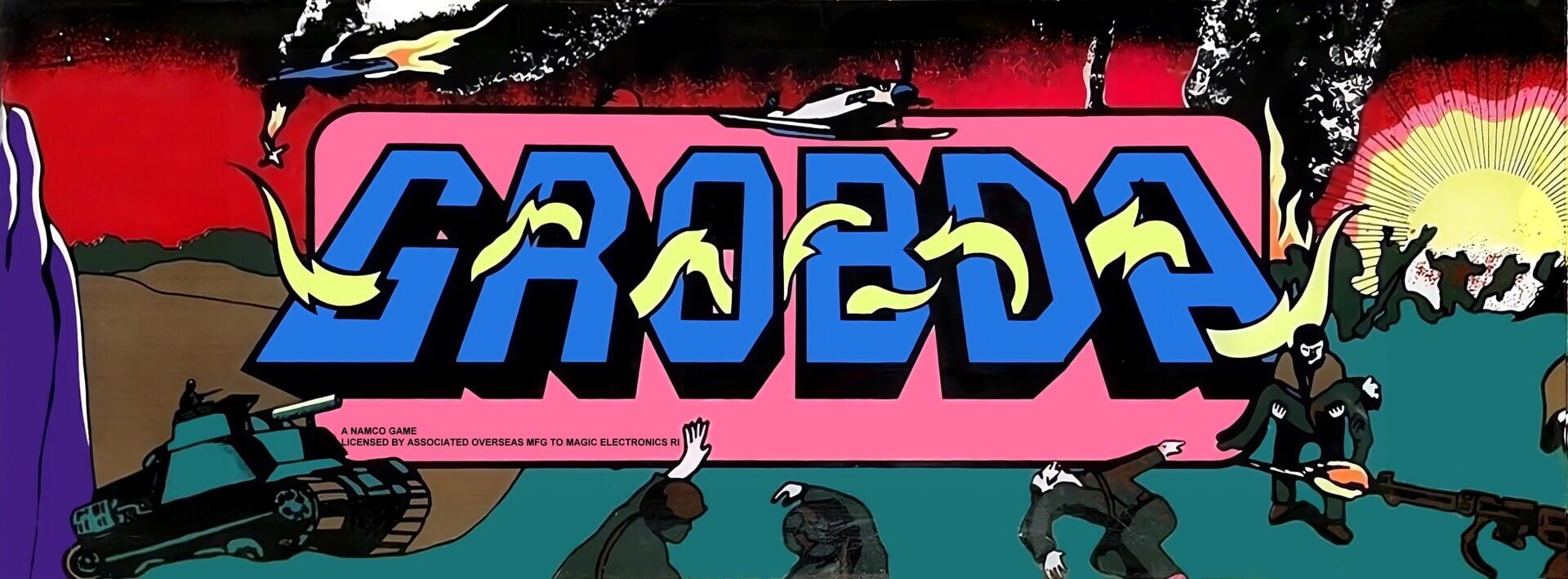
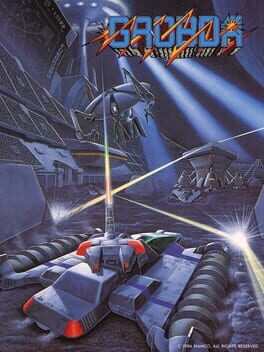
The player must take control of Grobda, a tank trapped in an arena filled with numerous indestructible obstacles and several enemy tanks. When an enemy tank is killed, it will cause an explosion, and any other enemies that happen to be in the blast radius at the time will also suffer the same fate. But if Grobda is too close to the explosion, it will also be killed. Grobda has a shield that offers very temporary protection from enemy fire, but this will soon disappear if it is constantly under attack or shot. Each round is called a "battling", and there are a total of ninety-nine in the game.

Shooter / Arcade / Science fiction
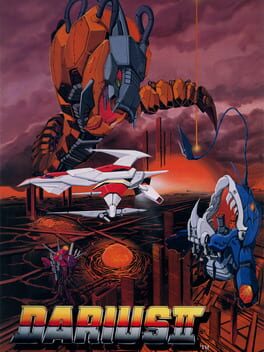
Darius II is a 1989 arcade video game developed by Taito. It is the direct sequel to the 1987 Darius. It was later released as Sagaia in Japan in 1991 for the Game Boy as well as non-Japanese ports. A remake was released for the PC Engine Super CD-ROM as Super Darius II in 1993. A Mega Drive conversion was released in Japan in 1990; it was later released for the Genesis in the United States and Brazil in 1991, where it was renamed Sagaia. Changes include a boss rush mode (via a code) and various modifications to levels and mechanics, such as the boss Steel Spine being moved to another level and the boss Killer Higia being replaced with a similar creation called Nehonojia. This conversion does not support two players, so the ability to choose between Proco Jr. and Tiat Young was added; Proco plays like normal, while Tiat starts every life off with one power level to every weapon. A Master System conversion, developed by Natsume, was released in Europe and Brazil in 1992, also titled Sagaia. It is somewhat based on the Mega Drive port, and while Tiat Young and her abilities are still present (though even more limited), many zones (and thus bosses) have been completely removed. The Super CD-ROM version features an entirely new set of bosses, major changes to levels, and a fully arranged soundtrack including new songs.

Shooter / Arcade / Action / Science fiction
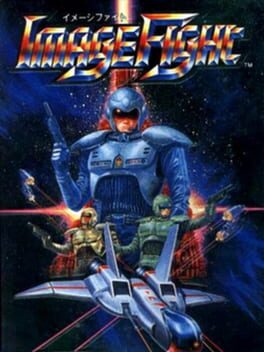
On a fateful day in 20XX, the Earth's moon exploded into four large fragments and a multitude of meteors. Aliens from afar had succeeded in destroying the West's moon base. One after another, mankind's other military industrial space complexes were being lost. What mankind dreaded had come to pass. Scores of unidentified fighters were in the area. In addition, the moon's main computer, still intact after the explosion, had a strange vegetation coiled around it. Their trademark evil exploits being a dead giveaway, invaders from the Boondoggle Galaxy had arrived to take over the Earth. To counter these evil forces, leading scientists from all over the globe created the "OF-1" Fightership. Combat pilots depart the Earth to fend off the invaders and earn everlasting glory.

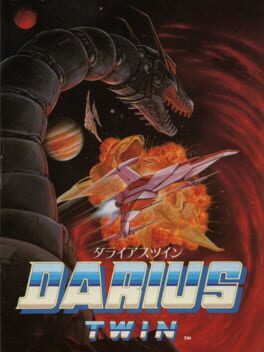
Darius Twin is a shoot 'em up video game released for the Super NES in 1991. It was the first new installment in the Darius series to not be originally designed for the arcades, and also the first to have a normal 4:3 screen-ratio. Interestingly, while it's a unique game in the Darius series, it appears to reuse sprites and background designs from Darius and Darius II. Also, while the names of the bosses are new, they really are reworkings of previous bosses for the most part.

Shooter / Arcade / Action / Science fiction
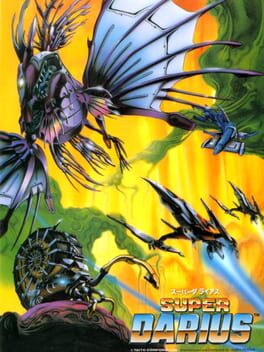
Super Darius is a 1990 port of Darius for the PC Engine CD-ROM, and the only attempt at an accurate port of the game for many years; it even uses recordings of music and sound effects straight from the PCB! Its other claim to fame is the introduction of all 26 bosses from the original draft for Darius, some of which were earlier seen on promotional material and some of which were used in Darius II instead. A "light" version for normal PC Engines, Darius Plus, was released later in the year. At the time that was released, owning both versions allowed you to get Darius Alpha. Super Darius was also included in the list of games available for the PC Engine CoreGrafx Mini in March 19, 2020, available in all the regions.

Shooter / Arcade / Science fiction
Aries was a peaceful and calm planet for millennia; however, it is now faced with its worst crisis. The deadly army of Obellon fighters led by General Don Jingi, the evil merchant known to do anything for personal gain, is out to steal the “Starlight,” a powerful source of energy that could destroy the universe if misused. You must properly guide the “Hunting Dog” fighter-plane along with Hawk and Esty (special undercover agents protecting the Galaxy) to destroy Obellon before they destroy the world. You are the last resort of our planet.

Shooter / Arcade / Action / Science fiction
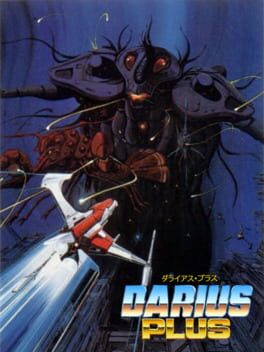
NOTE: "Darius Plus" is the TurboGrafx-16 PC-Engine port of the original Darius produced by Bits Laboratory and NEC Avenue. This is a different port than the title "Darius+", which was published by The Edge and developed by Softek for the Amiga, Atart ST, and ZX Spectrum. Amidst the clutter of arcade shooters in the late 1980s, companies needed to make their games stand out in some way. Simply flying a ship into outer space simply wasn't going to cut it anymore. Taito had an idea. Yes, there was still a spaceship. And yeah, that "outer space" part was still there too. But instead of the usual aliens, you fought fish. Yes, fish. Not even regular, aquatic fish, but robotic fish with lasers equipped to their fins, giant metal teeth and missiles firing from their gills. And not just fish either. There are squid, snails, and other undersea variations out for your blood as well. The requisite plot is about the people of the planet Darius, who are being terrorized by said intergalatic fish. Only the heroic pilots Proco Jr and Tiat Young can save the day. The constant star of the Darius series is the Silver Hawk. Much like Gradius, it has a primary, forward firing weapon, along with bombs that can be used to attack vertically, and the usual shield. The arcade game Darius games also used a unique system that attached three monitors together to create one massive horizontal playing field (also used in Taito's Ninja Warriors.) Naturally, this couldn't quite be replicated on the console system, so that nifty little gimmick is lost, but emulators can still replicate the dimensions of the screen, even if you end up looking at a tiny picture. Looking to further set itself apart from the crowd, every Darius game has multiple levels, with several branching paths throughout the game. It adds tremendously to the replay value, especially since there are usual multiple endings, depending on which final zone you end up at. Darius is a two-dimensional horizontally scrolling shoot 'em up set in a fictional future. Uniquely among shoot 'em ups, the game's screen was three times wider than conventional size, and the arcade cabinet used an arrangement of three screens to accommodate it. The player controls an ornate fighter spacecraft, named the Silver Hawk, and must navigate through scrolling terrain while battling a variety of fighter craft, ground vehicles, turrets, and other obstacles throughout the game's stages (referred to as zones in the game). The ship's arsenal consists of forward-firing missiles, aerial bombs and a protective force field, all of which can be upgraded by power-ups (in the form of large, colored orbs) that are dropped by specially-colored enemies throughout the game's zones. When the player reaches the end of a zone, a boss appears, which must be defeated to proceed. Once the boss of a zone is destroyed, the player is given a choice of which zone to play next via a branching path. While there are 28 zones in total, only seven can be played in a single run. When various ports of it were made for different consoles, Taito (and others) were forced to shrink the playfield to fit on one screen. The PC Engine saw three releases: - Darius Alpha (1990): A very rare beta release. This is one of the rarest Hu-Cards ever published. You could only get a copy of this hardcore shoot-em-up by buying Darius Plus and Super Darius and then mailing coupons to the publisher. 800 copies were made available, and names were drawn from those who mailed their info in. Some copies of the game were also given away as prizes by PC Engine Gekken and Marakatsu magazines. - Darius Plus (1990): The full game itself, again a PC Engine HuCard. The bosses that were removed in Alpha do not return here. Both Alpha and Plus were actually written for the PC Engine SuperGrafx and playing them on that console results in slightly improved graphics (less flicker and slowdown). - Super Darius (1990): A conversion of Darius for the PC Engine's Super CD-ROM, very close to the original arcade version other than being single-screen. Features new bosses, as well as a "boss rush" mode.
Released in 1990 on TurboGrafx-16/PC Engine, by Taito.