Mystery box
?
Sealed
Mystery Box
Every game in your current results, in one box. Add it to a quest and each run draws a fresh game from it, revealed on release day.
Arcade
1988
This side out
Shooter / Platform / Action / Fantasy
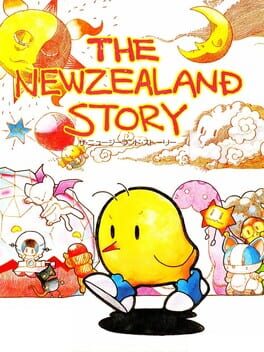
Tiki, a sneaker-wearing kiwi who must save his lover Phee Phee and several of his other kiwi chick friends who have been kiwi-napped by a large blue leopard seal. The player has to navigate a scrolling maze-like level, at the end of which they release one of Tiki's kiwi chick friends trapped in a cage.
Famicom
1984
This side out
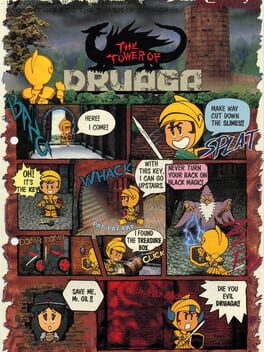
The story still's the same: Ishtar sends Gilgamesh up the 60 maze levels of the Druaga's tower to rescue Ki and retrieve the Blue Crystal Rod. He must find each level's key to proceed to the next one.
Arcade
1991
This side out
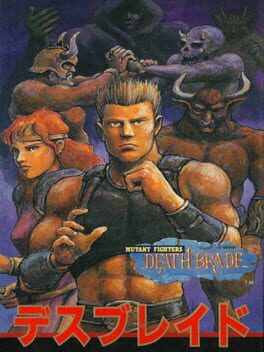
Warriors clash against each other in a series of "Death Matches" in a quest to claim the throne and become king or queen of all fighters.
MSX
1991
This side out
Role-playing (RPG) / Adventure / Science fiction
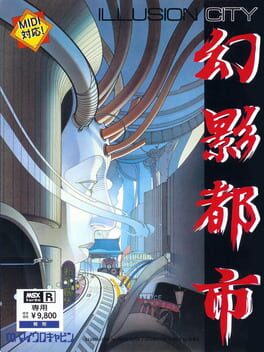
Illusion City is a Japanese-style role-playing game with several distinguishing characteristics. Unlike most games of the genre, it has no overworld, and takes place entirely in a vast city divided into several districts. The player advances the story by exploring the city, talking to non-playable characters, gathering information, receiving missions, and eventually heading into large, complex hostile areas. There are no random battles in the game; all enemies are visibly moving on the field, and many of them can be avoided. Combat is turn-based, utilizing an "over-the-shoulder" perspective similar to that of Phantasy Star II. Characters join the party as dictated by the plot; an active party includes three combatants. A wide variety of weapon and armor types can be purchased or found in dungeons. Each character has his or her own weapon proficiencies, which can be increased by repeatedly using the same weapon type. Firearms require specific ammunition (e.g. bullets, shotgun cartridges, etc.), which is expended in combat and must be re-stocked. In addition, certain characters can use offensive, supportive, and healing techniques. The game's visual style aims for realistic presentation of locations and characters, and shares more common traits with contemporary Western visual aesthetics than the traditional Japanese anime art.
Arcade
1989
This side out
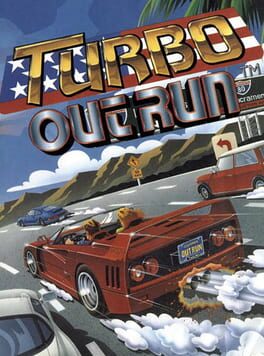
The sequel to OutRun features similar basic gameplay to the original, with the action viewed from behind the car, and the challenge being to complete each stage within the time limit. Contact can cause the car to spin, slow down or even flip; in each case you will lose time. There are 16 stages set across the US, gradually moving from east to west, all depicted differently visually. After every 4 levels, you go into a shop screen, with a choice of upgrades. As the title implies, you now have a turbo booster installed, which speeds up the car, although over-use can cause the engine to overheat, and it is not recharged until each shop section. You have 5 continues, and failure to complete the course within the time limit costs you one.
PC-9800 Series
1993
This side out
Role-playing (RPG) / Simulator / Strategy / Fantasy
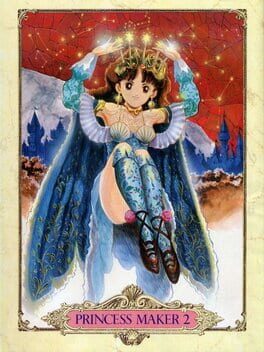
In this fantasy game, the player takes role of a war hero who raises a girl to the age of 18. At the end of the game, the daughter goes into a line of work; what this work is, how much talent she has for it, her marital life, and her overall happiness all depend on the player's actions.
Arcade
1984
This side out
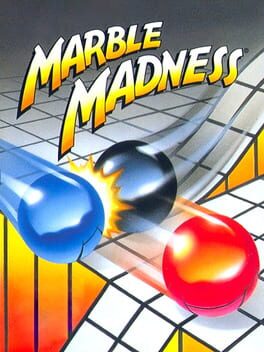
Marble Madness is an isometric platform game in which the player manipulates an onscreen marble from a third-person perspective. The player controls the marble's movements with a trackball, though most home versions use game controllers with directional pads. The aim of the game is for the player to complete six maze-like, isometric race courses before a set amount of time expires. When a player completes a race, the remaining time is added to the next race's allotted time. The game also allows two players to compete against each other. Courses are populated with various objects and enemies designed to obstruct the player. As the game progresses, the courses become increasingly difficult and introduce more enemies and obstacles. Each course has a distinct visual theme. For example, the first race, titled "Practice", is a simple course that is much shorter than the others, while the fifth race, named "Silly", features polka-dot patterns and is oriented in a direction opposite from the other courses
MSX
1992
This side out
Simulator / Strategy / Non-fiction
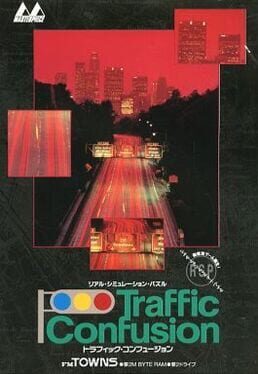
Traffic Confusion is a traffic congestion simulation game where the goal is to clear the the map of cars which each has their own destination while keeping accidents and potential deaths to a minimum. Stress among the drivers will build up while they're waiting stuck in traffic or congestion is too high etc. You lose the game if the stress level reaches its maximum point.
DOS
1993

This side out
Simulator / Strategy / Business / Sandbox
It has all the features, flexibility, art, animation, and power you need to create an environment of your dreams. Choose from a selection of bonus cities and scenarios to rule or ruin as you please. Build schools, libraries, hospitals, zoos, prisons, power plants, and much more... Lay down roads, railways, and highways. Explore the underground layer and build subways and utilities without compromising your aesthetics. Customize different buildings or design your own graphics sets from scratch. This is the ultimate classic Maxis city-building and management simulation. If this game were any more realistic, it'd be illegal to turn it off!
Arcade
1987
This side out
Shooter / Arcade / Action / Warfare
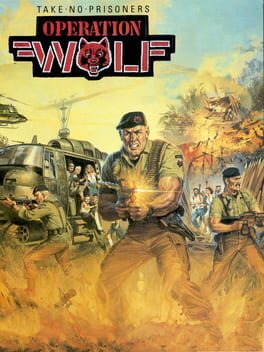
In the steamy jungles of South America, heavily armed extremists are holding innocent civilians prisoner. Little do these terrorists know that real terror is about to land on their front porch! The sound of rotor blades and staccato bursts of gunfire echo through the valleys. Terrorists be warned! Operation Wolf is going to teach you what terror is all about! Operation Wolf consists of six missions, which are displayed on the Operations Map Screen. A mission is completed when all enemy forces are reduced to zero. The current level is completed when you escape from the airport with the prisoners. Your injury level increases when the enemy hits you. The game automatically ends if the injury indicator on the right side of the screen becomes completely red. You can reduce your injury level by getting power drinks.
PC-88
1988
This side out
Simulator / Strategy / Turn-based strategy (TBS) / Fantasy / Historical
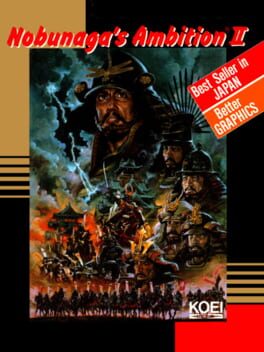
Nobunaga's Ambition II is the sequel to Nobunaga's Ambition. The setting is 16th century feudal Japan, a period when ruthless daimyo (feudal lords) contended with each other for dominance. Ultimately, the winner in this struggle will become Shogun and hold actual power over the islands, while being nominally subject to the Emperor. The game casts the player as one of the daimyo, allowing them freedom to decide the fate and future of feudal Japan, through diplomacy and ultimately war. The objective is to unify Japan under the player's rule. If the player fails through death on the battlefield, assassination at the hands of a ninja, or through natural causes, they can choose a successor and play on. Functionally, the first job is to let prosper the fief (province) under the player's control through agricultural development and town investment.
PC-9800 Series
1993
This side out
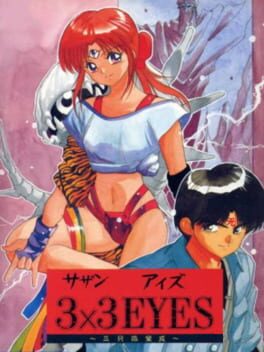
Sanjiyan Henjō is based on the manga and anime series 3x3 Eyes. Pai, a young girl from the immortal tribe of sanzhiyan, three-eyed demons of Chinese origin, wants to become a human again. She meets a Japanese teenager named Yakumo Fujii, whom she accidentally turns into a "wu", an immortal obedient servant of a three-eyed demon. Together, Pai and Yakumo try to regain their lost humanity.
PC-9800 Series
1992
This side out
Point-and-click / Visual Novel / Science fiction / Horror
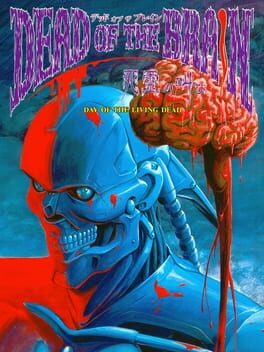
Dead of the brain is a horror-based Adventure Game created in 1992 that is played in a point-and-click format.
C64
1986
This side out
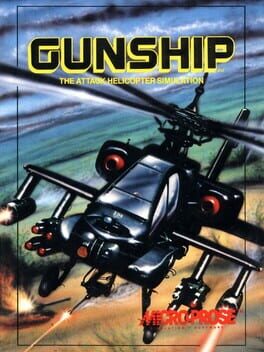
After selection of region, style, and enemies, the pilot is assigned a primary mission and a secondary mission. These could include such objectives as "Destroy enemy headquarters" or "Support friendly troops" (i.e. destroy targets near friendly forces). The latter would be an easier mission, because the battle would be fought closer to friendly lines.
Arcade
1988

This side out
At the start of each level the player is informed who they are pursuing, a great distance away: They must apprehend the criminal before their time limit expires. The criminal's car is constantly moving away, so if the player repeatedly crashes or drives too slowly, the criminal will escape. At some points during the game the road splits, and the correct turn must be taken, otherwise it will take longer to catch the criminal. When their vehicle is reached, the time limit is extended; the vehicle must be rammed a number of times until the criminal is forced to stop, then is arrested. The game includes five levels. As both the initial time limit to reach the criminal and the time extension to ram the criminal are just 60 seconds, the game is very short - a player who is able to finish the game on one credit will enjoy at most ten minutes of game-play. Interestingly enough when Nancy at Chase HQ (at the start of every level) calls on the radio the frequency is always 144.X (various)Mhz. This is actually the 2-meter band of amateur or ham radio frequencies. Although superficially similar in technology to Sega's Outrun, Chase HQ features significant technical advancements over that title in the presentation of perspective, hills and track splits.
Arcade
1983
This side out
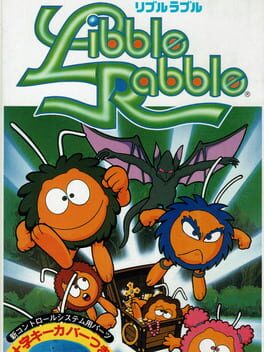
Libble Rabble is an arcade game that was released by Namco in October 1983. It was designed by Toru Iwatani, who had also designed the Gee Bee series, Pac-Man, and Pole Position. It is a curious but challenging game, where the player tries to harvest little mushrooms (Mushlins) while avoiding various enemies, and was the first game from Namco to use a Motorola 68000 processor (which ran at 6.144 MHz). At first glance, the gameplay resembles Taito's Qix. The player controls two "arrows", one red (Libble) and one blue (Rabble) with a line strung between them. The object is to wrap the line around poles and surround Mushlins and enemies with it. The player can either close the loops themselves (worth more points for the Mushlins) or move both arrows to the same edge of the screen. The player clears a "season" when he or she harvests all the Mushlins. Along the way, various enemies will appear and try to stop the player. The most common are four little hooded critters (Hobblins), which start each season in the corners. If the player catches them in a loop, they will be sent to the top of the screen for a short period of time. Other critters such as fireballs (Killers), sparks (Changers), and Demons will also appear. These can be killed by closing a loop around them. Sometimes, scissors-like enemies (Shears) appear, and if they cross the player's line, they cut it. If the player's line is ever cut by Shears or Demons, a new one is instantly made: directly between the two arrows. Every so often when the player closes a line, a detector goes off indicating that the area he or she has closed off has a treasure chest somewhere. To actually uncover the chest, the player must surround a small enough area which covers just the chest, and no other possible hiding places. The game guides the player along that step, first by challenging him or her to uncover a chest at the start of the game (and then by revealing the locations of the chests for the first two seasons). When the player actually uncovers a chest, six bonus creatures (Topcups) will pop out, then make for the edges. The player must corral them with his or her line and then close the loop to score the bonus for them: they mean bonus letters. If the player manages to complete a bonus word, the season is automatically cleared out and the player moves to a bonus stage where he or she must try to uncover and collect chests (to collect a chest, the player needs to close a loop around an opened chest) within a time limit. The player loses a life if any of the assorted critters touch one of the arrows or if he or she runs out of time (the border is the player's timer, and he or she can boost the time by looping Mushlins and plants), and the player gains an extra life at 40,000, 120,000, 200,000, 400,000, 600,000 and 1,000,000 points by default. After the 100th season, the season counter will stop at 99, similar to how Galaxian and King & Balloon's round indicators would stop after 48 rounds.
Still plenty of games...